A Nevada stair climb and the story of Rick Rescorla show what it means to carry forward the people, not merely the footage.
They Climbed for the 343 Who Never Came Down
More than 460 firefighters, police officers, paramedics, and military members climbed the Strat tower this week. They climbed 108 floors and 1,455 steps, some in full turnout gear and carrying hose packs weighing as much as 75 pounds.
They did it for the 343 New York City firefighters killed on September 11.
One of the climbers was Sawyer Epstein, a 26-year-old Las Vegas firefighter-paramedic who was still an infant when the towers fell. He has participated every year since joining the fire academy. Each time, he carries the name of FDNY firefighter Michael Montesi, who died at 39.
“It’s really important for us to honor those who lost their lives on 9/11 because they truly made the ultimate sacrifice,” Epstein said.
“That’s something we all sign up for when we become firefighters or first responders, but it’s something we hope we never have to do.”
I caught the 9/11 Memorial Stair Climb at The STRAT this morning, and this one hit me a little differently. 🇺🇸🚒
Firefighters were getting ready to climb 110 flights to the top of The STRAT in honor of the first responders who climbed into the World Trade Center on September 11,… pic.twitter.com/m0ArK7Sk1C
— Jedi Rich (@jedirich_) September 11, 2026
Epstein cannot remember September 11. Yet every year, he carries a dead man’s name up 108 floors.
That is how memory survives: Someone else agrees to carry it.
The Man Who Knew They Would Come Back
Rick Rescorla was not wearing a police officer’s or firefighter’s uniform when danger struck. He was wearing a suit and tie.
James B. Stewart wrote about Rescorla’s life and death for The New Yorker the following year.
Rescorla was Morgan Stanley’s security director at the World Trade Center. He was also a decorated Vietnam veteran who had survived the Battle of Ia Drang, prostate cancer, and nearly every other danger placed in front of him.
Long before September 11, he understood that the towers remained a target.
In 1990, Rescorla brought his friend and counterterrorism expert Dan Hill to the World Trade Center and asked him how he would attack it. They walked into the underground parking garage without being stopped. Hill immediately identified a load-bearing column and said a truck filled with explosives could be driven inside.
Rescorla warned the Port Authority. Less than three years later, terrorists detonated a truck bomb beneath the World Trade Center.
After the 1993 bombing, Rescorla did not reassure himself that the worst had already happened. He reached the opposite conclusion: They would come back.
He and Hill studied the threat. Rescorla warned that terrorists were becoming more tactically sophisticated. He understood that the towers were not merely office buildings. They were symbols of American financial power, which made them targets.
He even contemplated an attack from the air.
Rescorla urged Morgan Stanley to leave the World Trade Center entirely and relocate to a low-rise complex in New Jersey. The company’s lease ran until 2006, so he prepared for the danger he could not convince others to escape.
Twice a year, he ordered thousands of employees into the stairwells. They practiced descending two by two. Senior executives were not exempt. Employees complained about the interruption and mocked his military precision.
Rescorla continued anyway.
On the morning of September 11, the Port Authority told occupants of the South Tower that the building was secure and instructed them to remain where they were.
Rescorla ignored the order.
He grabbed his bullhorn and began evacuating Morgan Stanley’s employees before the second plane struck their tower. The drills people had resented became muscle memory. Thousands knew where to go because one man had spent years imagining the day everyone else considered too unlikely or too inconvenient to prepare for.
As smoke filled the building, Rescorla moved through the stairwells singing the same old Cornish battle songs he had once sung to frightened soldiers in Vietnam. He kept people moving. He kept them calm. At one point, overcome by the heat, he had to sit down. Then he got back up and continued.
“Today is a day to be proud to be an American,” he told them.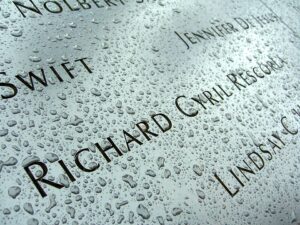
Nearly all of Morgan Stanley’s approximately 2,700 employees in the South Tower escaped.
Rescorla could have escaped with them.
Instead, he called his wife, Susan. They were supposed to leave for Italy the next day. He told her that she had made him happier than he had ever been, then returned to search for anyone still trapped inside.
Ten minutes before the South Tower collapsed, Rescorla was seen on the tenth floor, heading up.
A coworker told him to leave.
“I will as soon as I make sure everyone else is out,” he answered.
Then the tower came down.
Rescorla had spent years predicting the danger, preparing for it and forcing others to prepare with him. When the day finally arrived, he was exactly where he had trained himself to be. He got his people out. Then, knowing what was happening above him, he turned around and climbed back into it.
The Day Our Childhood Was Upended
I was 12 when the towers fell. I was home instead of at school; my New Yorker mother was beside me, and my grandmother was calling from New Jersey.
When the second plane hit, the meaning of the first became unmistakable.
“It’s on purpose,” I realized.
Then the buildings collapsed on live television.
“All those people just died,” I said out loud.
Millions of American children reached that same conclusion alongside the adults in the room. There was no explanation waiting for us because they were learning what was happening at the same moment we were.
It was basically a nationally live-streamed terrorist attack and mass casualty event at a time before we really understood that the internet could be used for much more than chat rooms, pirating music, and selling Beanie Babies.
That is the part of the millennial experience that is difficult to explain.
We began our childhood in an older, slower world and then watched thousands of people die in real time. We became pre-adults who understood new emerging security apparatuses before we understood the technology that would eventually dominate our lives.
We learned phrases such as “axis of evil,” “weapons of mass destruction,” and “terrorism” before we learned algebra.
We watched older siblings, cousins, and classmates leave for wars that lasted long enough for children born after September 11 to grow up and fight in them.
The world before that morning did not gradually fade away. It collapsed on television in front of us.
A basic faith in the order of things went with it: the childish assumption that adults knew what was happening, or that America was safely beyond the reach of such horror.
We were old enough to remember the world before September 11, young enough to be formed by everything that followed, powerless to do anything but watch and reach conclusions at the same pace as the adults around us.
“The Real Heroes Are Dead”
Years after Vietnam, Rescorla learned that We Were Soldiers Once … and Young would place a battlefield photograph of him on its cover. He put the book aside without reading it. When he heard it was being adapted into a film, he said he had no intention of watching that either.
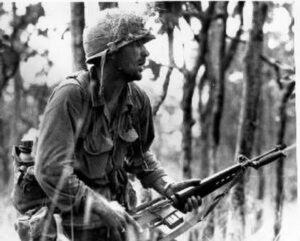
He was uncomfortable with survivors being turned into heroes.
“The real heroes are dead,” he would tell his wife, Susan.
He meant the men who never came home from Vietnam.
That sentence is why Rescorla’s story carries so much weight. He spent his life refusing the word “hero,” then died in a final act so heroic that it is almost impossible to describe without making it sound invented.
But heroism does not mean someone’s death hurts less. That is the cost hidden beneath every clean sentence about sacrifice.
Someone waits for a telephone call that never comes. Someone puts a dead husband’s suit on his side of the bed because it still smells like him. Someone spends the rest of her life understanding the decision that broke it.
Rescorla was right. The real heroes are dead.
The rest of us are left with the responsibility of remembering who they were, what they understood, and what they chose when their moment arrived.
Blurred Footage, Fading Memories
But that memory is not waiting for some distant generation to disappear. It is already being lost.
September 11 is already becoming blurred footage shown once a year.
Even The Falling Man, one of the most remarkable photographs ever taken, risks becoming merely an image people recognize without fully confronting what it contains: one human being, trapped above the fire, suspended for a fraction of a second between the building and the earth.
The human cost is captured in serene stillness amid a terrifying, imminent death.
The Falling Man, 2001.
The most widely seen images from 9/11 are of planes and towers, not people. This is why the Falling Man is different.
The photo, taken by Richard Drew in the moments after the attacks 25 years ago today, is one man’s distinct escape from the burning… pic.twitter.com/3ht74nTJxY
— Massimo (@Rainmaker1973) September 11, 2026
We are already explaining to younger people that the passengers of United Flight 93 did not make those final calls from smartphones. They used Airfones built into the backs of airplane seats, swiping credit cards to place calls from the sky.
Through those calls, they learned that other hijacked planes had been used as weapons. Then, understanding what awaited them, they chose to fight back.
Those details matter. Without them, history becomes a sequence of images detached from the human beings inside them.
That is how memory disappears. Not all at once, but piece by piece, until lived horror becomes grainy footage and sacrifice becomes a sentence in a textbook.
That is why Sawyer Epstein carries Michael Montesi’s name up 108 floors. It is why first responders climb in the Nevada heat for 343 firefighters they never met. It is why those who remember September 11 must keep describing not only what happened, but what it felt like to watch it happen.
We tell the next generation that those towers were filled with human beings.
We tell them that firefighters ran up while everyone else came down.
We tell them that the passengers of Flight 93 called the people they loved and then fought for the lives of strangers on the ground.
We tell them that Rick Rescorla saw the danger coming, spent years preparing thousands of people to survive it, led them out, and then turned around.
They carried one another when it mattered most. Now it is our turn to carry them.
Yesterday, Nevada showed that even as the footage blurs and the world of September 11 grows harder to explain, its names, choices, and courage will survive as long as the living choose to carry them forward.
As the years tick on, it becomes clearer to me that the generation that witnessed September 11 as children must now become its keepers.
Millennials are the youngest people who remember the world before the towers fell, and increasingly, we are the ones responsible for explaining the full weight of that day to those who know it only as history.
That is what remembrance means: not merely recalling the events, but honoring the humanity of those who lived and died through them.
The opinions expressed by contributors are their own and do not necessarily represent the views of Nevada News & Views. This article was written with the assistance of AI.