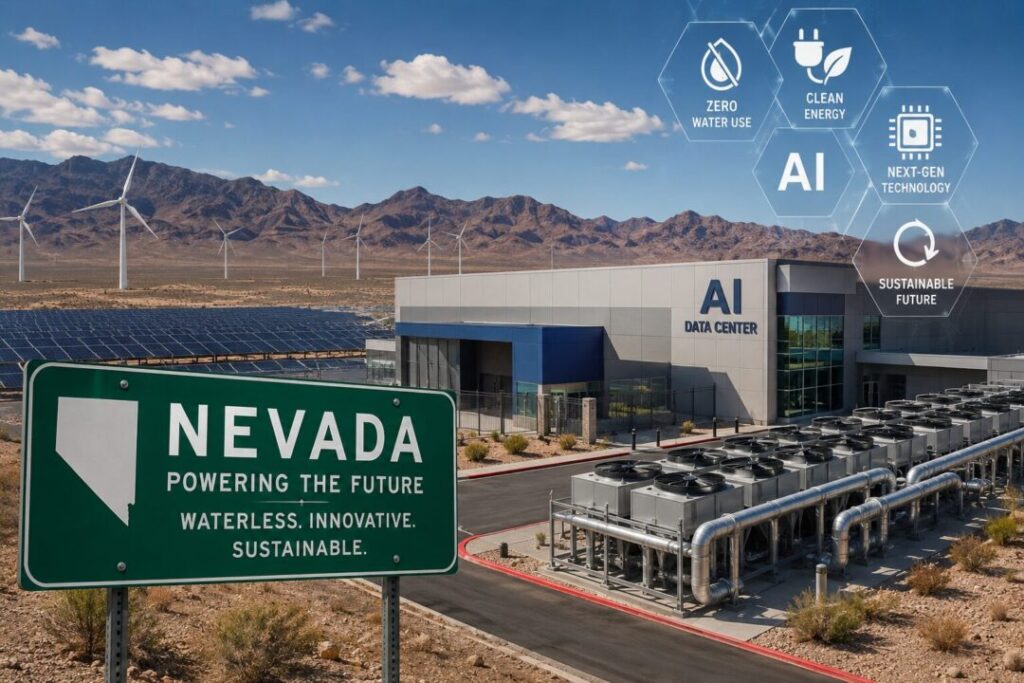
(Marc M. Friedland) – Every time a new technology hits the Silver State, the professional class of worrywarts and central planners comes crawling out of the woodwork. They’ve found their latest target: AI (Artificial Intelligence) Data Centers.
If you listen to the local naysayers, environmentalists, and hand-wringers in places like Henderson and Boulder City, you’d think these facilities are an “unsustainable bubble” destined to drain the Colorado River dry and crash our power grid. They scream that we already have enough data centers and that building new ones is completely unnecessary.
Well, I’d like to remind folks that feelings do not hold a candle to facts. And the facts show that the anti-growth crowd is Dead Wrong.
Let’s set the record straight with some cold, hard reality.
Fact #1: Yesterday’s Infrastructure Can’t Handle Today’s AI
The first myth the naysayers push is that we can just use existing facilities. “Why build more concrete warehouses when we already have data centers?” they ask.
Here’s why: the vast majority of older facilities were built for traditional cloud storage and website hosting. Running cutting-edge AI on that legacy infrastructure is a physical impossibility.
· The Power Gap: Traditional data centers are designed for “low-density” computing. They rely on standard air cooling that becomes completely useless once a server rack exceeds roughly 30 kilowatts of power.
· The Meltdown Risk: A single modern AI server rack packed with next-generation chips draws up to 1 megawatt (1,000 kilowatts) of power. Trying to run modern AI models in an old data center would literally melt the equipment.
AI requires facilities custom-built from the ground up to handle massive computational loads and highly specialized liquid cooling. Furthermore, AI chip technology upgrades every two to three years. New facilities are built with modularity in mind so millions of dollars in silicon can be swapped out seamlessly. Older data centers just can’t do it.
Fact #2: Next-Gen AI Data Centers Don't Drink Our Water
The loudest complaints in the nation’s driest state always center around water preservation. Critics love to paint a picture of giant tech corporations sucking Southern Nevada’s aquifers dry.
But technology has already outpaced their talking points. The shift toward zero-water cooling technologies has completely transformed the industry, effectively separating AI growth from local water consumption.
Modern tech companies are implementing architectures that achieve a Water Usage Effectiveness (WUE) of exactly zero at the facility level:
· Two-Phase Waterless Liquid Cooling: This removes water from the equation entirely. It uses a nonconductive dielectric fluid placed directly over the AI chips. As the chips heat up, the fluid vaporizes to pull the heat away and condenses back into liquid within a fully sealed system.
· True Closed-Loop Systems: Unlike old-school data centers that continuously evaporate water into the atmosphere using cooling towers, modern closed-loop systems are filled exactly once. The system repeatedly recycles the same fluid. Microsoft recently noted that its newest AI designs consume roughly the same amount of water annually as a single neighborhood restaurant.
· High-Density Air Chillers: For less dense configurations, massive industrial air-cooled heat exchangers dump heat straight into the atmosphere without evaporating a single drop of water.
When a developer builds a data center in the Las Vegas Valley using these technologies, they aren't draining Lake Mead. In fact, because the Southern Nevada Water Authority (SNWA) heavily restricts high-water evaporative systems, our region is the perfect proving ground for waterless infrastructure. Once set up, these facilities bypass municipal water infrastructure entirely.
Fact #3: Private Innovation is Already Solving the Energy Puzzle
Now, the critics will pivot. When you shut down their water argument, they’ll cry about the “upstream energy-water paradox.” They'll point out that waterless cooling takes more electricity to run compressors, and that traditional power plants use water to generate steam.
Nice try, folks. But the tech sector is already three steps ahead of you.
To solve this resource challenge, tech giants aren't relying on old ways of thinking. They are pairing waterless data centers directly with dry-cooled solar arrays, geothermal energy, and dedicated battery storage right here in Nevada. They are even striking deals to back clean, independent energy generation to ensure both the computing and the power are genuinely water-free.
The Bottom Line
Nevada has an unbelievable opportunity to lead the next American economic frontier. The demand for AI infrastructure is a non-negotiable reality for global competitiveness. We can either welcome the massive investment, high-tech jobs, and tax revenue that come with custom-built, waterless data centers, or we can let the naysayers scare away progress with outdated arguments.
Now you know the facts. If the anti-growth crowd wants to keep whining, they’re welcome to try—but they’ll need to bring some actual data next time, because their feelings just aren't cutting it anymore.
The opinions expressed by contributors are their own and do not necessarily represent the views of Nevada News & Views. Digital technology was used in the research, writing, and production of this article. Please verify information and consult additional sources as needed.