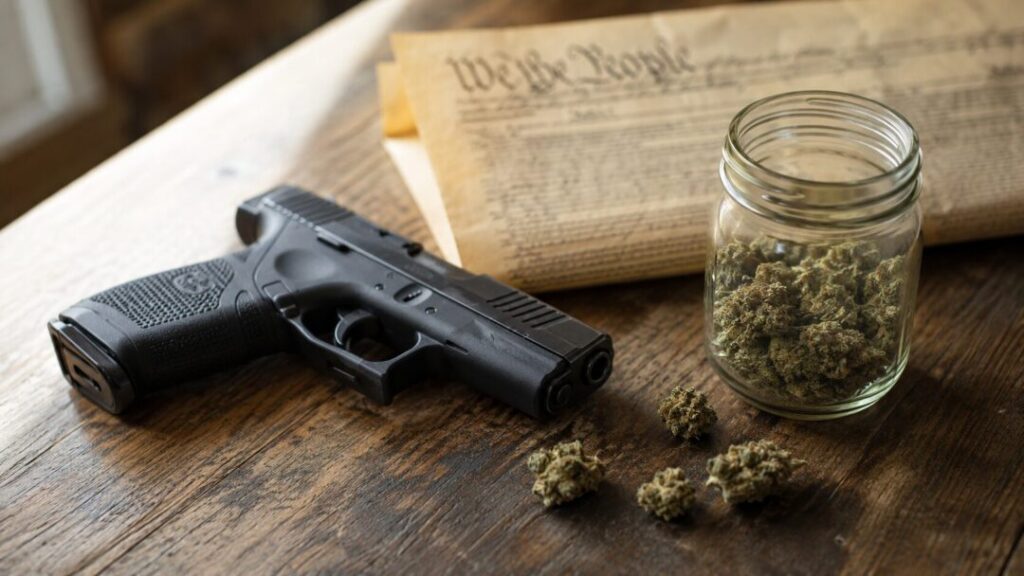
On June 18, 2026, the Supreme Court issued a unanimous (9-0) ruling in United States v. Hemani. Justice Neil Gorsuch wrote the opinion.
The case was about whether the federal government can take away someone's gun rights simply because they use drugs.
Who Is Hemani?
Ali Danial Hemani is a Texas man who admitted to regularly using marijuana. He also kept a firearm in his home for self-defense. He was not under the influence of drugs at the time he possessed the gun.
Despite that, the federal government charged him under a law called 18 U.S.C. § 922(g)(3), which makes it a felony for any “unlawful user” of drugs to possess a firearm. He faced up to 15 years in prison.
Where the Drug-User Gun Ban Came From
To understand this case, it helps to know where the law came from. The story involves two pieces of legislation.
In 1968, Congress passed the Gun Control Act (GCA). This law created the basic framework for prohibiting certain categories of people — such as felons and the mentally ill — from possessing firearms. It established the structure of § 922(g), which lists the groups of people who cannot legally own guns.
Then, in 1986, Congress passed the Firearm Owners' Protection Act (FOPA). This law was meant to ease burdens on lawful gun owners while strengthening tools against violent crime and drug trafficking.
As part of that law, Congress amended the 1968 Act to add a new category of prohibited persons: anyone who “is an unlawful user of or addicted to any controlled substance.” That new provision became § 922(g)(3), the exact law Hemani was charged under.
According to a Congressional Research Service report, there was little discussion in the 1986 legislative history about the difference between being an “unlawful user” and being “addicted” to drugs. That lack of clarity became important in Hemani's case.
What the Court Decided
All nine justices agreed that prosecuting Hemani under this law violated the Second Amendment.
The key points were:
- Drug users cannot be categorically stripped of gun rights.
The government cannot automatically take away someone's Second Amendment right just because they use drugs. Any restriction must be narrowly tailored, not a blanket ban. - The government's historical evidence wasn't strong enough.
Under the Court's Bruen test (from 2022), gun laws must be similar to laws that existed when the Constitution was written. The government pointed to old laws about “habitual drunkards.” But Gorsuch wrote that those laws “targeted different kinds of people, did so for different purposes, and operated in different ways.” A habitual drunkard at the time of the nation's founding meant someone rendered “practically incapacitated and incapable of managing their affairs” — not just someone who regularly used a substance. - The law lacked due process.
The Court noted that historical laws usually provided some form of process before a person lost their liberties. Section 922(g)(3), by contrast, “automatically divests an individual of his constitutional right to bear arms the moment he becomes an unlawful user and until he ends his drug use, all without any pre-deprivation process.” - The punishment was disproportionate.
Gorsuch emphasized that the government wanted to “automatically strip Mr. Hemani of his Second Amendment right” and “imprison him for up to 15 years” based only on the fact that he “regularly uses any amount of any controlled substance”, without proving he was a danger or was impaired while handling a gun. - The drug schedules didn't prove dangerousness.
The Court pointed out that the Controlled Substances Act classifies drugs based on health and welfare concerns, not on whether they cause violent behavior. So using those drug schedules to define who is too dangerous to own a gun was a mis-match.
What This Means Going Forward
The ruling does not mean drug users have an unlimited right to own guns. States and the federal government may still be able to pass narrower laws, for example, banning gun possession while actively under the influence of drugs.
But they can no longer use a broad, automatic ban that applies to all drug users at all times.
The decision also raises questions about how this interacts with state-level marijuana legalization. Many states have legalized marijuana, but it remains illegal under federal law.
This ruling means people in those states who use legal marijuana under state law can no longer be automatically denied their federal gun rights.
Why It Was Surprising
A unanimous ruling from this Court on gun rights was unexpected. The Court has typically split 6-3 along ideological lines on Second Amendment cases.
The fact that all three liberal justices joined the conservative majority suggests the federal law's broad sweep was seen as clearly going too far, even by justices who generally favor gun regulation.
The Bigger Picture
This ruling is part of a continuing trend since the Supreme Court's 2022 Bruen decision, which expanded gun rights and required modern gun laws to match the “history and tradition” of firearms regulation.
Hemani is one of the first major cases to apply that test to a federal gun law, and the result was that the ban failed.
Sources
- Supreme Court opinion No. 24-1234
- SCOTUSblog
- Texas Tribune
- CBS News
- ABC News
- NRA-ILA
- ACLU case page
- Cornell Law Institute
- Congressional Research Service report, Guns and Drugs: A Brief History of 18 U.S.C. § 922(g)(3) (March 2026, Congress.gov)
All sources accessed June 2026. The opinions expressed by contributors are their own and do not necessarily represent the views of Nevada News & Views. Digital technology was used in the research, writing, and production of this article. Please verify information and consult additional sources as needed.