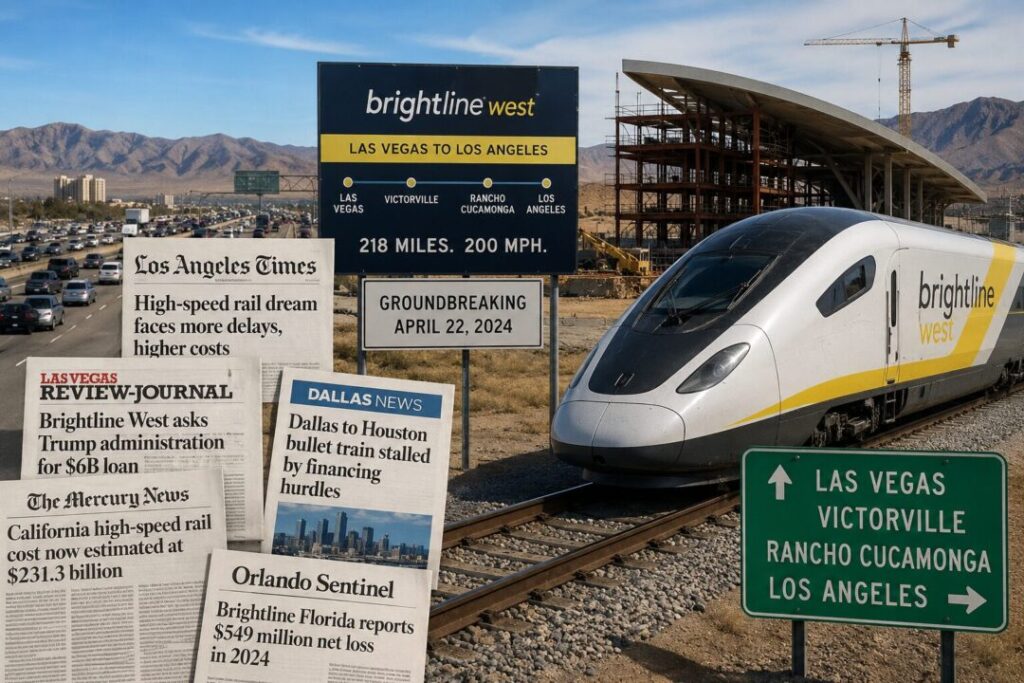
The dream of building a high-speed train line between Las Vegas and Los Angeles goes back more than 20 years.
The project started in 2005 as DesertXPress with support from Nevada leaders including Sen. Harry Reid. Its initial cost estimate was $5 billion.
After funding failures, a private company, Brightline, acquired the project in 2019 and created Brightline West, advertised as America’s “first true high-speed passenger rail system.”
In 2023, the Brightline West project seemed assured. The 218-mile-long project shuttling passengers between Las Vegas and Los Angeles, with stops in Victorville and Rancho Cucamonga, California, had just received a $3 billion loan from the Biden administration.
Trains would travel 200 miles per hour, reducing traffic and cutting travel time on congested Interstate 15. Prices would range between $119 to $133 one way.
A groundbreaking was held on April 22, 2024 with U.S. Transportation Secretary Pete Buttigieg, both Nevada Democratic Sens. Jacky Rosen and Catherine Cortez Masto, and Republican Gov. Joe Lombardo in attendance.
Construction began on a Las Vegas rail station. However, the project is now delayed, costs are rising and Brightline is veering into bankruptcy on their Florida train line.
It was first set to be operational in time for the 2028 Olympics in Los Angeles, but the timeline is now pushed to late 2029.
The project initially had a cost estimate of $12 billion, jumped to $16 billion and then to $21 billion in September, 2025. Brightline asked the Trump administration for a $6 billion loan in 2025.
The loan would bring the project’s funding to $11.5 billion, a little more than half the current projected cost. The remaining $9.5 billion would come from private investors.
That loan request is still pending. Completion of the project will require additional federal funding, with construction and cost of capital expenses increasing.
In 2008, California voters approved Prop. 1A “the Safe, Reliable High-Speed Passenger Train Act for the 21st Century”, a $9.95 billion bond issue.
The California high-speed rail system’s price tag continues to soar, even though there’s little hope that Californians will get anything close to what was promised.
The California High-Speed Rail Authority now re-estimates the full buildout at an astounding $231.3 billion.
The high-speed rail project does not resemble what voters approved. The complete Los Angeles-to-San Francisco system promised in 2008 was supposed to have costs of $33 billion, go over 200 miles per hour and take riders from SF to LA in 2.5 hours by 2020.
It’s 2026, and nothing is running. Costs have increased 600%. The system no longer promises a Japanese or European-style bullet train, but a blended system that would run at reduced speeds on freight rail tracks for long stretches. And the train will likely never reach LA or SF.
The rail authority says it’s still more than six years away from even having its dubious Merced-to-Bakersfield “train to nowhere” operational.
“It shouldn’t cost us more to get to Modesto than it costs us to get to the moon,” San Jose Mayor Matt Mahan said in a gubernatorial debate.
Additional spending on high-speed rail could better be allocated to California’s pothole-riddled roads and traffic congestion.
In Florida, Brightline took just four years to begin operations in 2018 between Miami and West Palm Beach. The train’s much-touted expansion to Orlando International Airport commenced in September 2023. Construction costs were significantly more than estimated.
Brightline Florida is currently $5.5 billion in debt. It had a net loss of $549 million in 2024 as ridership failed to meet expectations, with fares beyond the means of many Floridians.
Technically, Brightline is “higher-speed” rail given a maximum velocity of 125 m.p.h.
And, the estimated $30 billion 240 mile Dallas- to- Houston high-speed bullet train is now stalled by financing hurdles.
Currently, The only U.S. service in operation that qualifies as high-speed rail is Amtrak’s Acela.
The opinions expressed by contributors are their own and do not necessarily represent the views of Nevada News & Views.