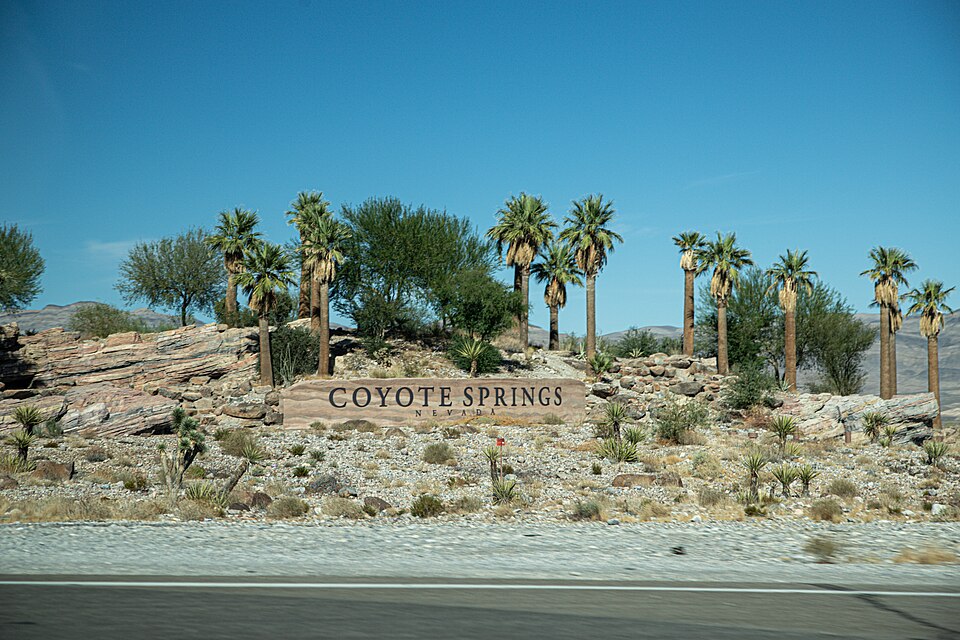
A jury will now decide how much taxpayers owe for Coyote Springs, a desert city that was never built.
Nevada taxpayers could be on the hook for hundreds of millions of dollars after a judge ruled the state unconstitutionally took water rights from the developers of Coyote Springs.
Clark County District Judge Mark Denton ruled Wednesday in favor of Coyote Springs Investment, the company behind the stalled master-planned community about an hour north of Las Vegas.
The case now moves to a second phase, where a jury will decide how much the state must pay. Estimates put it as high as $600 million.
How We Got Here
We covered this case in July when the trial started. Here is the short version.
Coyote Springs was supposed to be a brand-new city near the Clark-Lincoln county line, with well over 150,000 homes. The developers, now owned by the Seeno family, planned to pump about 30,000 acre-feet of groundwater a year to make it work.
Then the state engineer, Nevada’s top water regulator, decided several underground basins in the area were connected. Pumping for Coyote Springs could dry up water for senior rights holders downstream and threaten an endangered fish, the Moapa dace. The state cut the project’s water way back.
In 2024, the Nevada Supreme Court backed the state engineer’s authority. Today, Coyote Springs has a golf course and zero homes.
The developers sued in 2020, arguing the state took their property without paying for it. In legal terms, that is called an unconstitutional taking.
What the Judge Found
Denton agreed with the developers on the key point. According to reporting on the ruling, the state took away rights it had already awarded, while still making the developers keep paying to prove they were putting that water to good use.
Meanwhile, a 2018 state letter made clear the state would “not sign off on the subdivision maps.”
Denton wrote that “CSI had a reasonable investment-backed expectation” based on decades of conduct by the State Engineer’s office.
He did toss some of the developers’ claims, leaving four for the jury phase. That trimmed the price tag. Early estimates had the state’s exposure as high as $2 billion.
Mark Hutchison, the developers’ attorney, has made the case plainly.
“Those rights have been taken by the state, and the state needs to pay us hundreds of millions of dollars in just compensation,” he said, according to his law firm.
Why This Matters
On one hand, property rights matter. In Nevada, water rights are treated as real property.
If the government grants you a right, keeps taking your money to maintain it, and then makes it worthless, that should not be free. The Constitution says government must pay when it takes private property.
On the other hand, the bill goes to taxpayers. Every dollar the state pays comes from Nevada families who never had a stake in this desert city.
The bigger lesson is simple. Bad regulatory decisions have real costs. When agencies hand out permits and then change the rules years later, the public pays for it.
The Other Side
The state has argued the original permits always reserved the right to limit pumping once problems with the aquifer showed up. Environmental groups have long said there was never enough water for a city this size.
There are also worries about what this means going forward.
A Review-Journal water reporter told KNPR the case could have a chilling effect on how the state engineer regulates water. If every cut leads to a lawsuit, regulators may hesitate to act during a drought.
What Comes Next
No public date has been set for the jury phase. There is also a wrinkle. Denton is set to retire at the start of next year.
Judge-elect Adam Ganz will take over his department, but it is not yet clear which judge will see the case through. Both sides have signaled that appeals are likely.
The opinions expressed by contributors are their own and do not necessarily represent the views of Nevada News & Views. This article was written with the assistance of AI.