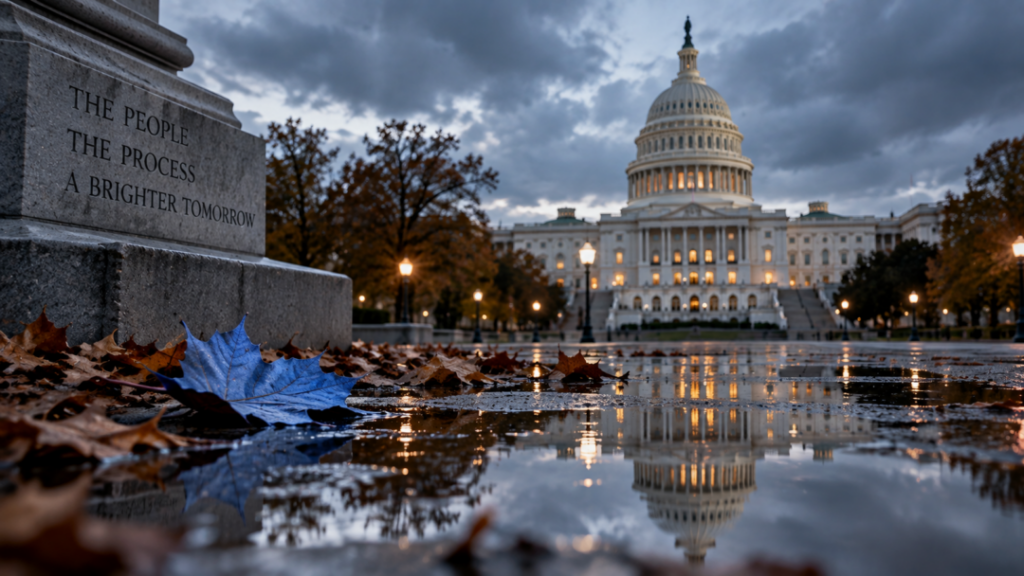
We’re in the midterms’ homestretch, less than seven weeks until Election Day.
Neither party has much of a plan for the future.
Democrats believe it’s sufficient to simply blame President Trump for the economy and cry “affordability.”
They offer vague promises to do something about housing, healthcare, grocery and gasoline prices.
With the success of some far-left candidates in primaries, Democrats hope to deflect criticism by claiming they are the “big tent” party. Republicans will press them on what wildly radical views of the Democratic Socialists of America their nominees share.
An all-time high 58% majority of voters believe the Democratic Party is “too liberal,” CNN polling shows.
After Biden’s failures on both the border and inflation, can Democrats now be entrusted with Congressional power?
Republican campaign strategy is worse.
Trump believes that making the election all about him is the GOP’s path to victory. Democrats are delighted to join in making the election a referendum on Trump rather than about a choice.
Trump is widely unpopular— 39.8% approval in the RealClearPolitics average, with 58.0% disapproval.
The Trump Team is giving Democrats what they want because of Trump’s narcissism.
He believes he won by a “massive” margin in 2024 even though his popular vote edge was the third smallest since 1964 —support that quickly eroded.
The GOP’s midterm strategy is to double down on the MAGA base. This stems from polls showing Republicans suffering from a big enthusiasm gap compared to Democrats. Republican strategists believe the problem is MAGA loyalists who tune out when Trump is not on the ballot.
At the GOP’s midterm convention in Dallas on September 8 and 9 Trump spoke for 2 ½ hours over two evenings to thousands of energized MAGA enthusiasts. Media fact-checkers highlighted multiple false and misleading statements.
But Trump may have been targeting the wrong Republicans.
Pollster Scott Rasmussen of RMG Research divides the electorate into four main groups: A) those who favor Trump-like policies, B) traditional Republican policies, C) traditional Democratic policies, or D) policies like those of Democratic Rep. Alexandra Ocasio-Cortez.
At the time of Trump’s inaugural, 38% of registered voters favored “Trump-like policies”—compared with 14% who preferred traditional GOP policies and about 20% for each Democratic category.
In the past 18 months, those choosing MAGA policies dropped 10 points to 28%, while the category preferring a more traditional Republican approach increased 7 points to 21%. The Democratic numbers barely changed.
August polling shows the MAGA base is already fired up. More than 50% of them are “very enthusiastic” about voting. They are just as excited as Democrats.
However, among the now increased category of traditional Republicans, only 25% are “very enthusiastic” about voting. That’s the GOP’s turnout problem, not MAGA loyalists.
At the convention, Trump promised a $5,000 “dividend” for every U.S. adult citizen if Republicans retain control of Congress in November.
With 260 million American adult citizens, $5,000 to each would cost $1.3 trillion. That amount is preposterous when the 2026 federal budget deficit is already $2 trillion and our national debt exceeds $40 trillion.
Vote buying has a long history, and Democrats are professionals at the game. Trump’s promise is highly inflationary, and the national debt would increase significantly.
Democrats need a net gain of just 3 seats to flip the House from the current 220-215 Republican majority.
Prediction models now forecast Democrats winning 226 House seats to 209 for Republicans.
The Senate has a 53 to 47 GOP majority. The Senate map looks increasingly fraught for Republicans.
GOP candidates trail in eight of the major battleground Senate races, the RealClearPolitics aggregate of polls shows. Republicans trail in five states they currently hold– Alaska, Maine, Ohio, North Carolina and Texas.
A five-seat Democrat pick-up would result in a 52 to 48 Senate Democratic majority—unless the polls are wrong or there’s a late GOP surge.
The opinions expressed by contributors are their own and do not necessarily represent the views of Nevada News & Views. Digital technology may have been used in the research, writing, or production of this article. Please verify information and consult additional sources as needed.