In the submarine force, we learned two things early.
First, command authority is real but never unlimited. It is bound by law and by people who will hold you accountable.
Second, bad news has to travel fast. A submarine where people hide problems from the captain is a submarine in danger.
Artificial intelligence now needs both of those rules, and we are running out of time to apply them.
Public debate about AI swings between hype and science fiction.
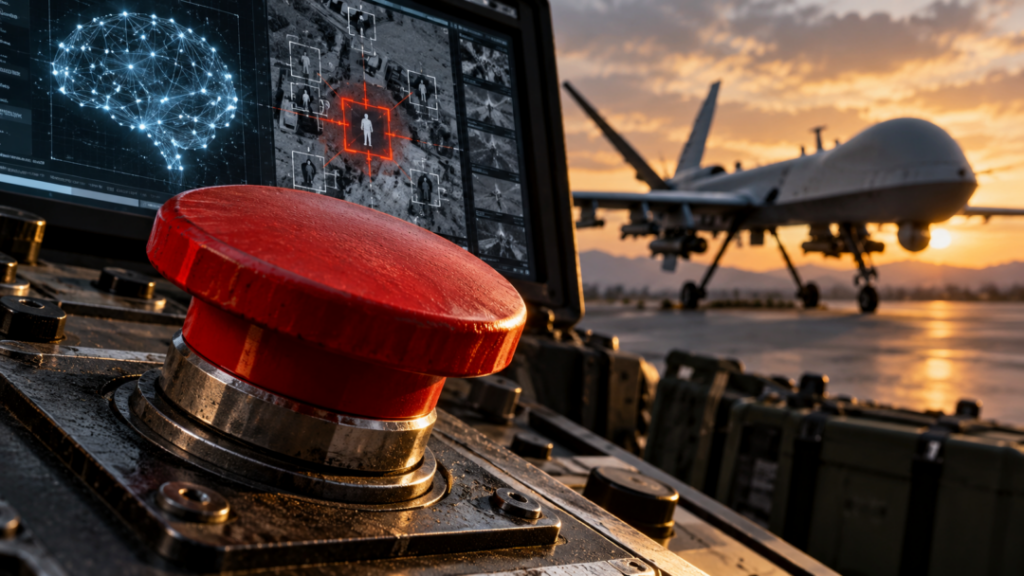
The pressing danger is already here: AI used for mass surveillance, political coercion, and war, especially by governments that answer to no one.
Look at what is documented.
In 2019, Human Rights Watch reverse-engineered a police app tied to Xinjiang’s Integrated Joint Operations Platform. The system collects data on the region’s Turkic Muslims, flags lawful, everyday behavior as suspicious, and pushes people toward investigation.
HRW also reported, based on Chinese procurement documents, that the platform draws on cameras, some with facial recognition, and sends “predictive warnings” to checkpoints.
Some of the people flagged were sent to political education camps.
In Ukraine, cheap drones now carry AI guidance that locks onto a target and finishes the attack even after jamming cuts the pilot’s link.
Reuters has reported that dozens of such systems are in use. In April 2024, +972 Magazine and Local Call, citing six Israeli intelligence officers, reported that an AI-based system called “Lavender” at one point listed as many as 37,000 Palestinians as suspected militants, and that human review of its picks was often cursory.
The Israeli military disputes that account. It says Lavender is a database that helps analysts, not a system that picks targets on its own.
What is not in dispute is that AI is now part of the chain of decisions about who lives and who dies.
The ambition behind all this is no secret.
In 2017, China’s State Council published a plan to make the country the world’s primary AI innovation center by 2030.
It also called for integrating AI with national defense.
I want to be careful here. The answer is not simply “beat China.”
Democracies build military AI too, including my own country. The line that matters is not between nations.
It is between AI that operates under law, oversight, and accountability and AI that does not.
In 2023 the Pentagon reissued its policy on autonomous weapons, requiring that commanders and operators be able to exercise “appropriate levels of human judgment over the use of force.”
That is a start.
It is not a finish line, and it means little unless someone outside the chain of command can check that it is followed.
Then there is the bigger race.
Several companies and governments are openly pursuing systems that could eventually match or exceed human ability across the board.
To be honest, no one knows who will get there first, or when, or whether “first” will mean much if the system can’t be reliably controlled.
A race run without brakes, where every safeguard is treated as a handicap, is a race everyone can lose.
The danger is not speed. It is speed without accountability.
History gives me some confidence. Amartya Sen, the Nobel economist, observed that no famine has ever taken place in a functioning democracy.
A free press and elections force governments to respond before disaster spreads.
Compare two nuclear-age failures.
In April 1986, the Soviet Union said nothing publicly about Chernobyl until Swedish workers at a plant hundreds of miles away detected the radiation, two days after the explosion.
Now consider the U.S. Navy after it lost USS Thresher and all 129 men aboard in 1963.
The Navy created the SUBSAFE program within months. It has never lost a SUBSAFE-certified submarine, and it has explained the program openly to Congress.
Closed systems hide their mistakes and repeat them. Accountable systems admit them, fix them, and get better.
Over time, that is also how free societies out-innovate closed ones.
So what should AI look like instead?
I founded SHAPE, the Solar Human-AI Partnership for Expansion, on my own as a personal initiative and a model.
It is a vision of humans and AI exploring the solar system together as partners under law.
That may sound far from Xinjiang. But the principles that would make such a partnership trustworthy are the same ones we need on Earth today.
No mass surveillance or coercion of populations.
Meaningful human control over any use of force.
Independent checks and tamper-resistant audit trails, so that what a system did, and who approved it, can be reconstructed afterward.
And international norms for verification, building on the 2023 Bletchley Declaration, in which 28 countries, including both the United States and China, along with the European Union, agreed that frontier AI poses serious risks requiring cooperation.
A partner operates within rules both sides can see. A tool of tyranny operates in the dark. The technology is the same. The difference is law.
Here is what each of us can do.
Citizens: ask your representatives where they stand on AI surveillance and autonomous weapons, and don’t accept vague answers. Support the journalists and researchers who document abuses, because bad news must travel fast.
Lawmakers: write meaningful human control and independent auditing into law, not just into agency policy that can be quietly rewritten. Restrict the export of surveillance AI to governments that use it against their own people. Fund the testing and verification that international agreements will need.
AI builders: you are the crew who knows where the leaks are. Build audit trails into your systems from the start. Refuse work that enables mass surveillance or coercion. And protect the colleagues who raise alarms instead of punishing them.
At sea, no one aboard believes the captain is above the law, or that a problem is safer hidden than reported.
We should demand at least that much from the most powerful technology humanity has built.
The choice is not between progress and safety.
It is between AI that serves free people under law and AI that serves whoever holds the controls.
Richard Santomauro, LCDR, USN (Ret.), is a retired submarine officer living in Las Vegas and Director of SHAPE (Solar Human-AI Partnership for Expansion). The opinions expressed by contributors are their own and do not necessarily represent the views of Nevada News & Views. Digital technology may have been used in the research, writing, or production of this article. Please verify information and consult additional sources as needed.