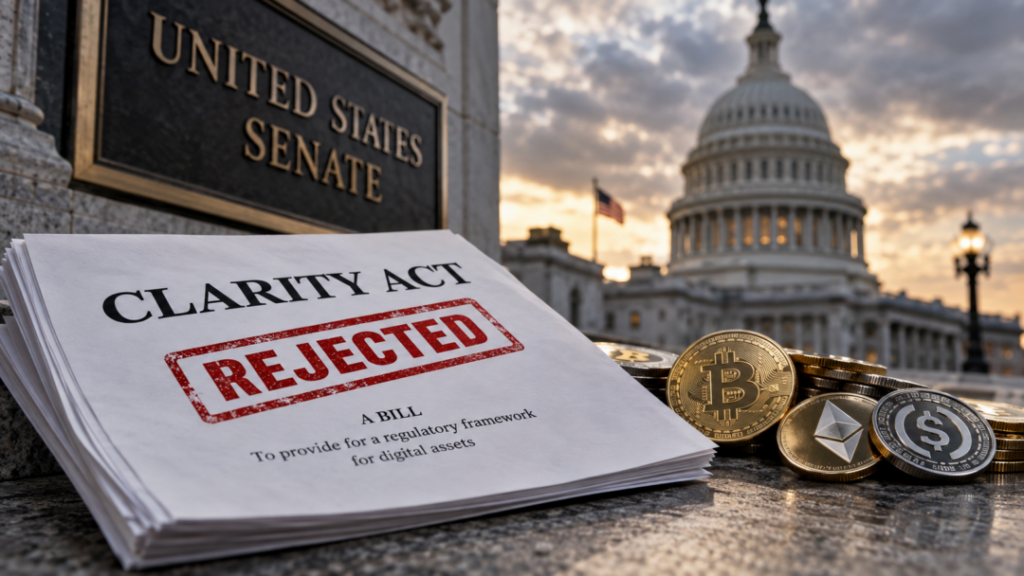
(Jeff Carter) – The Clarity Act died yesterday.
Like the SAVE Act before it, it was not dramatic, and it was killed by Democrats. A few Republicans crossed the aisle to vote with Democrats.
Is crypto dead?
No.
What will happen next?
Before the CLARITY Act, the GENIUS Act passed. It allowed for things like stablecoins, clear rules on custody and payments.
The difference between the two is that traditional finance was comfortable with GENIUS, but uncomfortable with CLARITY because it would bring in a lot of competition.
One great benefit of GENIUS is the adoption of the US dollar stablecoin across the globe.
That helps cement the US dollar dominance in world forex markets.
CLARITY failed because the crypto lobby overplayed its hand on ethics carve-outs, and the industry now has to live with executive-branch policy that can be reversed by the next election.
It doesn’t matter that there were a lot of people who thought the political forces opposing the CLARITY Act seemed unreasonable in their demands over “ethics”. That’s the excuse Democrats will use for killing it.
As we all know, ethics are squishy, especially when it comes to politics.
No doubt, there are plenty of people who do not “get” crypto, so this won’t seem like a big deal to them.
If you are a person who doesn’t understand crypto, I will try to sum up in very simple terms what it is.
Crypto will drive down the cost of financial services and make the entire financial system more efficient.
It’s like going from only having postal mail to email.
What do I think will happen with crypto?
I’d ignore the doomers who say it will die. I’d also ignore everyone who says it will go 100% offshore. As William Mougayar wrote, crypto doesn’t exist without the US.
The people this genuinely damages are US-based crypto entrepreneurs who wanted to build regulated institutional infrastructure.
They now face a longer wait for the legal ground to firm up, more expensive lawyers, less receptive venture capital, and continued temptation to redomicile.
That’s the real cost.
Bank participation stays capped. Big Banks all continue to explore crypto rails and tokenization but at limited scale, because their compliance officers don’t sign off on major capex against agency-guidance-only legal ground.
Pension and endowment allocation stays under 1% of AUM across the institutional universe. The IPS committees at CalPERS, TRS Texas, the Yale/Harvard endowments, and the big Australian supers all use “regulatory maturity” as a check-box.
They won’t sign off on 2-3% allocations without statute.
Tokenized-asset issuance slows in the US relative to EU/Singapore/UAE. The tokenized-Treasury market is growing regardless because it sits inside existing securities law, but the tokenized-equity and tokenized-fund frameworks that need CLARITY-style regime clarity stall.
BlackRock, Franklin Templeton, Apollo, and KKR continue building because they don’t have a choice.
The risk is they issue offshore where they can.
ETF expansion slows. Spot BTC and ETH ETFs continue trading; SOL ETFs (already SEC-approved as of 2025) continue.
But the next wave of crypto asset innovation, like multi-asset crypto ETFs, tokenized-equity ETFs, and DeFi-index ETFs, becomes harder to get through the process without a statute defining what a “digital commodity” is.
DeFi front-end risk stays elevated. Without CLARITY’s safe harbor for non-custodial protocols, US-based developers of Uniswap-style front-ends operate under continued interpretation risk.
Backend protocols are more portable than front-ends; the code stays where it is, and the interface layer moves offshore or gets abstracted.
The specific jurisdictions gaining relative share:
UAE — Dubai (VARA) and Abu Dhabi (ADGM) have executed one of the most aggressive institutional-crypto welcome mats in the world. Binance’s substantive operations, major market makers, and a growing chunk of derivatives-focused startups are there. Dubai gains institutional capital allocation, not just tourism.
Singapore (MAS) — strict but predictable. Wins the Asian institutional custody and tokenization race. Fund administrators, prime brokers, and family office crypto operations concentrate here.
Hong Kong — pivoted crypto-friendly in 2023, licenses issued, retail crypto trading allowed. Wins the mainland-adjacent liquidity flow that Singapore doesn’t get.
Switzerland — remains the default for token-issuing foundations and DAO wrappers. Not a growth story, just a stable jurisdiction for a specific legal function.
Democrats said that they were uncomfortable with the “ethics” part of the Clarity Act. It’s somewhat disingenuous.
Trump’s family has been very active in crypto, and so the Democrats wanted to make them pay.
Funny thing, Trump accepted expanded ethics language covering elected officials and their spouses, and Republicans incorporated 126 Democratic changes into the substitute text released Sunday night.
Every Democrat still voted no.
In the 17 years since digital assets were invented, the entire industry has struggled against the US government. Crypto lost its window to codify a friendly regulatory framework.
The Republican House got the job done. The Republican-led Senate failed.
There is real political risk now.
If in 2029 there is a Democratic Congress and a Democratic President, with anti-innovation and anti-crypto Senator Elizabeth Warren writing the rules.
This article was originally published via JeffreyCarter.substack.com on 9/16/2026. The opinions expressed by contributors are their own and do not necessarily represent the views of Nevada News & Views. Digital technology may have been used in the research, writing, or production of this article. Please verify information and consult additional sources as needed.