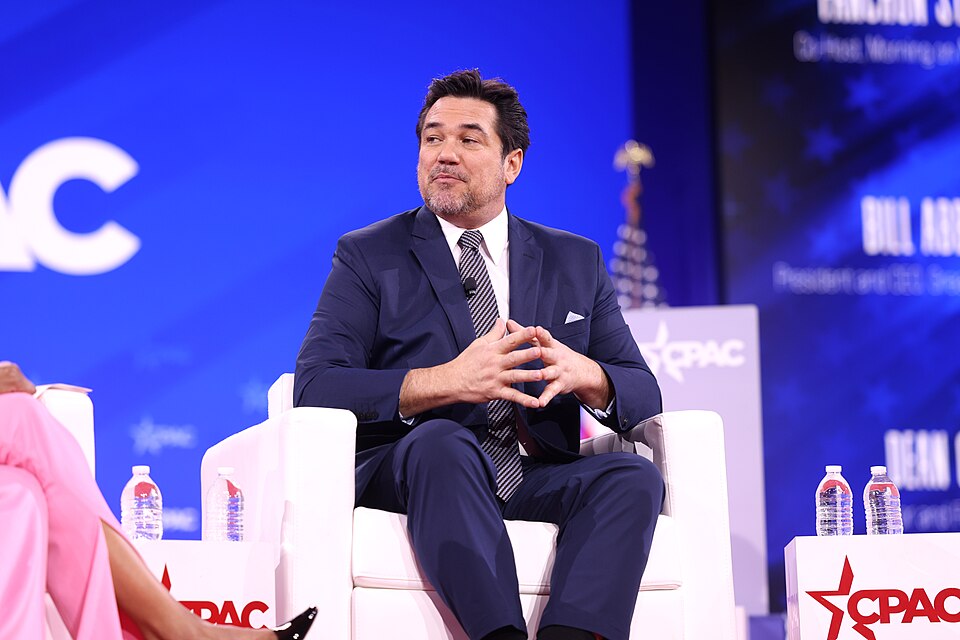
Dean Cain invokes truth, justice and accountability in his endorsement of David Flippo, but questions surrounding the candidate’s military record complicate the Superman narrative.
Dean Cain has a point about the difference between television and reality.
For four seasons, Cain played Superman, a character who caught criminals, delivered them to the authorities, and trusted the justice system to do its job.
In a column published Friday in Nevada News & Views, Cain uses that experience to criticize former Nevada Assemblywoman Teresa Benitez-Thompson and Attorney General Aaron Ford over decisions made by the Nevada Board of Pardons.
He concludes by endorsing Republican congressional nominee David Flippo.
But there is considerably more to this story than Cain’s script allows.
First, a disclosure of sorts: I have reported critically on Aaron Ford’s involvement in Nevada’s clemency process. I have also reported extensively on David Flippo’s military record, financial disclosures, and campaign representations.
Neither side gets a pass from scrutiny simply because the other deserves it, too.
And that is precisely where Cain’s argument begins to unravel.
Six Murderers, Six Votes, Six Different Stories
Cain describes six cases in which Ford’s office allegedly sided with convicted murderers over their victims. These are serious cases involving real victims, real families, and decisions that deserve public scrutiny.
But Cain’s own descriptions reveal that the six outcomes were not identical.
- Michael Gravely’s sentence was commuted to time served, resulting in his immediate release.
- Michael Cu’s sentence was modified to provide parole eligibility in 2035, not immediate freedom.
- Frank Timothy Blocks was released from parole supervision, rather than released from prison.
- Arlander Givens was denied clemency.
- Alberto Guerrero received a sentence modification affecting his parole eligibility. T
- Anthony Chernetsky’s application was allowed to proceed to another hearing. That was not a final decision granting his release.
Those distinctions are not trivial.
They are the difference between release from incarceration, future eligibility for parole, termination of supervision, continued consideration of an application, and an unsuccessful clemency application.
The Nevada Board of Pardons’ official December 16, 2025, results documents several of these outcomes.
Cain is entitled to oppose every one of these decisions.
But the public is entitled to know what actually happened.
A vote to make someone eligible for parole years in the future is not the same as opening the prison gates that afternoon. A motion that fails is not a successful release. Nor does advancing a clemency application to another hearing mean the applicant has been granted clemency.
Accountability begins with an accurate account of the record.
Accountability Shouldn’t Stop at the Candidate You Endorse
Cain closes his column by praising Flippo’s military service and presenting him as the candidate who will stand with law enforcement and victims.
Military service is an honorable qualification. Accuracy about that service matters, too.
In September, The Washington Post documented repeated claims by Flippo’s campaigns that he received a Bronze Star for valor.
He did receive a Bronze Star. But the award was for meritorious service, not the separate valor distinction recognizing heroism in combat.
The inaccurate characterization appeared in campaign materials spanning multiple election cycles. Flippo’s campaign acknowledged the errors and attributed them to staff mistakes.
But that explanation became more complicated when Nevada News & Views broke the story of two additional valor pins displayed on Flippo’s campaign hat on September 28.

The hat featured his Bronze Star pin alongside two separate “V” devices, despite his disclosed military record accounting for only one award with a valor designation.
A retired Air Force master sergeant raised questions about the discrepancy.
After the Washington Post’s reporting, Flippo began appearing in a plain green hat without the decorations.
When NPR questioned Flippo about the valor pins, he attributed them to his grandchildren., saying:
“You know if you’ve lived with grandkids, and you know, you kind of know, when you ask them to put those things on your hat,”
He then described having another hat without the V devices and concluded:
“So, the grandkids ended up doing that.”
NPR also credited Nevada News & Views with first reporting the discrepancy.
Nevada News & Views also reported that Flippo’s former commanding officer confirmed relieving him of command in 2008 because he had lost confidence in Flippo’s ability to lead.
These matters do not erase Flippo’s military service. But they are relevant to an endorsement that explicitly relies on that service as evidence of his qualifications.
Cain is asking Nevada voters to examine the records of Ford and Benitez-Thompson. Flippo’s record is no less deserving of examination.
Superman Lives in Southern Nevada — So Does Carrie Buck
There is another interesting question about Cain’s endorsement, and it has less to do with Superman than with Nevada’s political geography.
Cain moved from California to Las Vegas roughly three years ago.
He is no newcomer to conservative activism, and in August he publicly entertained the possibility of seeking political office himself.
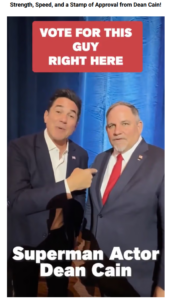
He has also been actively involved in Flippo’s campaign for months. An August 2026 campaign fundraising appeal promoted Cain’s endorsement under the subject line “A message from Superman.”
Meanwhile, Republican state Sen. Carrie Buck, a Henderson resident, is challenging Democratic Rep. Dina Titus in Nevada’s 1st Congressional District.
Cain, himself a Southern Nevada resident, has chosen to devote this particular column to Flippo, who is seeking a congressional seat representing Northern Nevada.
Both Buck and Flippo have received President Donald Trump’s endorsement. Trump endorsed Buck in April and subsequently endorsed Flippo ahead of Nevada’s June primary.
But Flippo has also attracted substantial outside political spending, national conservative attention, and now the prospect of a presidential campaign appearance in Northern Nevada.
As I reported earlier this week, Nevada’s 2nd Congressional District has become a national political battleground, with outside organizations investing heavily and Republican leaders announcing plans for a Trump visit.
That is an extraordinary concentration of attention on a district Republicans have held since its creation.
Buck, meanwhile, is challenging an entrenched Democratic incumbent in Southern Nevada.

The contrast extends beyond celebrity endorsements.
Initial reports placed Trump’s upcoming Nevada visit in Las Vegas. But at the Nevada GOP’s October 3 meeting, party chairman Michael McDonald announced plans for the president to campaign in Northern Nevada’s 2nd Congressional District.
Subsequent clarification indicated that Las Vegas had been dropped from the president’s itinerary in favor of Northern Nevada.
That raises a more concrete question about Republican campaign priorities: Why redirect presidential attention from Southern Nevada to a congressional district Republicans have held since its creation?
Superman was famous for rescuing damsels in distress. But with Carrie Buck facing an entrenched Democratic incumbent in his own backyard, Cain seems more interested in coming to Flippo’s rescue.
The Problem With the Superman Ending
Cain’s column ends with a simple moral proposition: people who commit terrible crimes should face consequences.
There is nothing controversial about demanding accountability for violent crime.
But accountability is not a principle that applies only to defendants in criminal cases or Democratic candidates seeking public office. It applies to people seeking the public’s trust, including candidates who invoke their military service as evidence of their character and qualifications.
It applies to elected officials exercising clemency authority. And it applies to political commentators who ask readers to accept their descriptions of these complicated legal proceedings.
I’ve spent the past several weeks doing what Clark Kent was supposed to do: examining records, asking uncomfortable questions, and reporting what I found, even when the subject was a Republican candidate.
Cain played the journalist. I’ve been doing the journalism.
And if there’s one lesson from Superman’s adventures, it’s that even the Man of Steel could be deceived by the wrong people.
Cain may want to revisit that lesson before lending his cape to David Flippo.
After all, kryptonite wasn’t Superman’s only vulnerability. Sometimes, it was misplaced trust.
The opinions expressed by contributors are their own and do not necessarily represent the views of Nevada News & Views. This article was written with the assistance of AI.