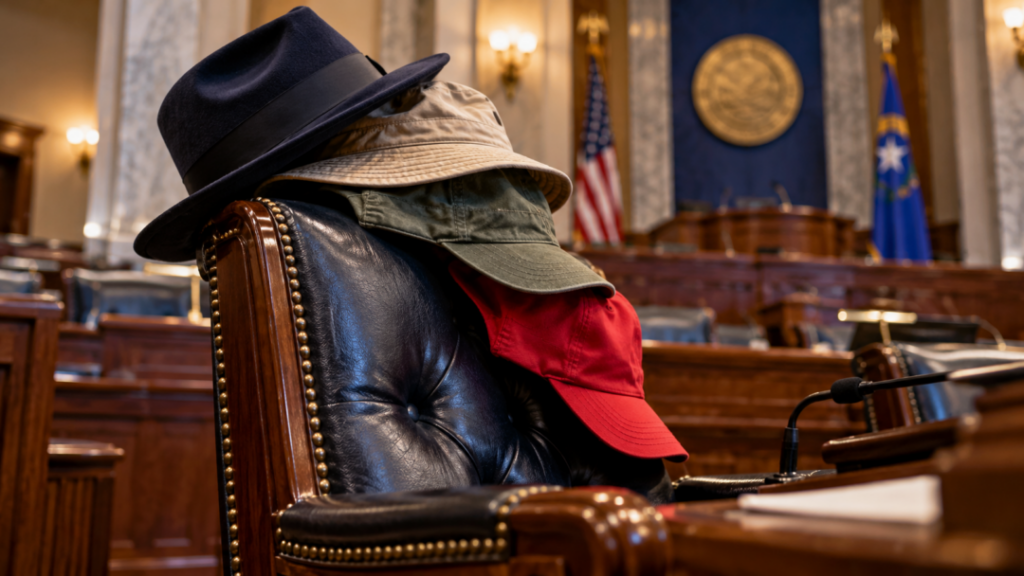
Early voting is underway in Assembly District 8, and voters deserve a straight answer to a simple question about Assemblyman Duy Nguyen: when he votes in Carson City, which hat is he wearing?
The public record shows at least four.
He is a state legislator. He is chief operating officer of the Asian Community Development Council (ACDC). He is CEO of One APIA Nevada.
And until July 2023, federal records list him as treasurer of a Super PAC that One APIA Nevada later funded with an $850,000 grant.
None of that is illegal on its face, but together it describes an officeholder whose public duties and private paychecks overlap far more than most voters realize.
A Citizen Legislature That Polices Itself
Start with what the law does and does not say.
Nevada’s ethics statute requires public officers to disclose private commitments, such as an employer’s interests, before acting on a matter.
But NRS 281A.420 says those provisions do not apply to state legislators and that the Commission on Ethics has no jurisdiction over them.
Legislators answer to the Legislature’s own Standing Rules, which the Legislature alone enforces.
That is why a search of the Commission’s database for Nguyen comes back empty: the Commission cannot make a finding.
What remains is the public record, and the voters’ judgment.
Two Employers, Sixty Hours a Week
Nguyen’s annual financial disclosures have listed the same two employers every year since 2022: ACDC and One APIA Nevada.
Their 2024 tax returns show what those jobs involve.
ACDC, a 501(c)(3) charity, reported paying him $125,000 as COO, at an average of 40 hours a week.
One APIA Nevada, a 501(c)(4) advocacy group, reported paying him $139,725 as CEO and director, at 20 hours a week.
That is $264,725 for 60 hours a week of nonprofit work, against Assembly compensation that his own 2025 disclosure lists at $12,420.40.
His nonprofit pay was roughly 21 times his legislative pay.
In fairness, Nevada has a citizen Legislature, outside jobs are legal, and Nguyen disclosed both employers.
The hours are also averages for 2024, an interim year, and One APIA announced in May 2024 that he would begin a planned sabbatical on June 1.
But the 2025 session ran 120 consecutive days of floor sessions, committee hearings and caucus work.
Assume just 40 hours a week of legislative duty on top of the 60 hours his employers reported, and the total is 100.
Because Nguyen signed One APIA’s return himself, under penalty of perjury, voters can fairly ask how the schedules fit together.
Big Budgets, Thin Safeguards
ACDC reported $6.3 million in revenue for 2024, 92% of it contributions and grants.
One APIA reported $4.0 million, up about 244% from the year before, in the year Nguyen himself was on the ballot.
ACDC’s website lists executives of Caesars Entertainment, MGM Resorts and NV Energy on its boards, and all three companies appear in Nguyen’s donor reports.
Both organizations told the IRS “No” when asked whether executive pay is set through independent review, comparison data and documented deliberation.
ACDC also answered “No” when asked whether its officers must disclose potential conflicts of interest each year.
From a Community Group to a Super PAC
Here the structure gets more tangled and intertwined.
One APIA Nevada’s 2024 return says its mission is to advance the interests of “all Asian Pacific Islander Americans in Nevada” and calls its work “non-partisan.”
Yet it reports one enormous grant: $850,000 in cash to “OAN APIA Nevada PAC,” labeled a “political purpose,” about 22% of everything the group spent that year.
Its “political purpose” spending totals $1.44 million, 38% of its expenses, and the return describes it only as “public education and advocacy activities.”
The same return answered “No” when the IRS asked whether the group engaged in political campaign activity.
Federal records show where the grant went (see the FEC independent expenditure filings).
One APIA Nevada sent $100,000 on October 17, 2024, and $750,000 on October 29, a week before Election Day.
ONE APIA PAC, a federal Super PAC at the same Las Vegas suite, took in $1.1 million from mid-October to late November, including $250,000 from the NEA Advocacy Fund.
It spent $1,090,948.52, nearly all of it on independent expenditures: television, streaming and radio ads, mailers and walk cards.
Every candidate it backed in 2024 was a Democrat: Kamala Harris, Sen. Jacky Rosen and Rep. Susie Lee (with about 72% to the presidential campaign of Kamala Harris).
So were those it backed in 2022 and 2020, according to ProPublica’s compilation of federal data.
Money is fungible, and nothing suggests the grant reached Nguyen’s own race. A 501(c)(4) may legally fund a Super PAC if politics is not its primary purpose, and by its own accounting One APIA stayed under half of its spending.
But Asian American and Pacific Islander voters are not a political monolith, and a group that says it serves all of them wrote its largest check of the year to elect one political party’s candidates in the closing days of the campaign.
Whether donors who donated for health care and voter education expected that is a question only they can answer.
Nguyen’s own paper trail runs through that PAC.
FEC records list him as its treasurer from October 18, 2020 to July 12, 2023, months into his first Assembly term.
In 2024 the FEC referred the PAC for failing to file timely reports on $219,317.91 of independent expenditures in 2020 and 2022.
The PAC told the FEC its prior treasurer was “no longer active,” and in March 2025 it paid a $12,700 settlement. Nguyen was not a named respondent.
One APIA announced on May 1, 2024 that he would begin a planned sabbatical June 1, yet the 2024 return lists him as CEO and director, and he signed it in November 2025, certifying the grant under penalty of perjury.
Assembly Bill 442: Where the Hats Met
The clearest collision came in 2025 with Assembly Bill 442, which requires a state agency that is late paying a nonprofit’s grant invoice to explain the delay in writing and report it to lawmakers.
Nguyen is named among its sponsors.
It covers only nonprofits with 501(c)(3) status. ACDC is one; One APIA is not.
The Assembly Committee on Government Affairs, where Nguyen is vice chair, heard AB 442 on March 28, 2025, and a representative who called ACDC her client testified in support.
Nguyen asked no questions, and neither the minutes nor the floor record of the 42–0 vote on May 29, 2025 shows a disclosure of his role at ACDC.
The Senate passed it 20–0, with one senator excused, and it takes effect July 1, 2026.
A unanimous vote is not evidence of wrongdoing. But ACDC is no stranger to government money.
A 2022 state Aging and Disability Services Division report lists a $69,036 COVID-19 vaccine-outreach subaward to an “Asian Community Development Center,” a name that apparently refers to ACDC, which ran vaccine clinics that year.
Sens. Rosen and Cortez Masto also announced a $300,000 federal citizenship grant for ACDC in December 2024.
If ACDC holds or seeks state grants, AB 442 helped Nguyen’s employer, and the Legislature’s disclosure rules called for him to say so.
If it does not, he can say that in one sentence.
The Record Voters Can Check
On the votes that divided the Assembly, Nguyen voted with his Democratic caucus every time: yes on AB 245 (27–15), barring those under 21 from certain semiautomatic rifles and shotguns; AB 105 (27–14–1), banning firearms near election sites; SB 89 (27–15), barring firearms after a hate-crime conviction; and AJR 1 (26–16), a proposed constitutional amendment to reset a property’s taxable value at sale.
Gov. Joe Lombardo vetoed the three gun bills, and AJR 1 died in the Senate.
Nguyen’s campaign spending points the same way: $10,000 to Aaron Ford’s gubernatorial campaign and $50,000, in two payments, to the Assembly Democratic Caucus, about 18% of the $284,708.57 he itemized this year.
Who Pays the Freight
Since January 2025, tobacco and nicotine interests have given Nguyen’s campaign $15,500: $10,000 from Philip Morris International’s U.S. arm, $4,000 from Altria and an affiliate, $1,000 from a vape company and $500 from RAI Services.
Nguyen sits on the Revenue Committee, which heard AB 279 on April 1, 2025, a bill to ban certain vapor products and restrict cigarette sales to people born after a set date.
According to the minutes, Nguyen made no comment, and the bill died at the committee deadline.
All of the tobacco money arrived after the session ended. Whether the two facts are related, the record cannot say.
Health-care money is prominent too: UnitedHealth Group gave $5,500, HCA’s political fund $5,000 and JML Surgical Center LLC $7,500.
His 2023 disclosure shows the Nevada Mining Association paid for a $776.45 tour of mining sites in Elko, and a mining company at that address later gave his campaign $1,000. Disclosing donors and trips is what the law requires, and Nguyen did so.
A donation is not a bribe, and none of this proves a vote was influenced. But voters can see the pattern and weigh it.
The $15,000 Question
One donor’s total needs an explanation.
JML Holdings LLC, a Nevada company formed in 2013 whose managing member is a trust, gave Nguyen $10,000 on October 30, 2025, and $5,000 on March 12, 2026.
Nevada law limits any one contributor to $5,000 for the primary and $5,000 for the general election, $10,000 for this cycle.
That is $5,000 over the limit, on the face of the filings.
A second company, JML Surgical Center LLC, gave $7,500 in January.
State records list a different manager and address, but federal court filings in an unrelated civil case list the two companies together with JML Surgical’s manager, represented by the same counsel.
If they are treated as one contributor, the total is $22,500.
No refund or correction appears in the campaign’s reports through its October 15 filing, and the next report is not due until January 15, 2027.
Nevada law bars candidates from accepting excess contributions; remedies range from a refund to civil fines, and criminal penalties are reserved for willful violations.
Nothing in the filings suggests intent, and a refund would cure the problem.
The Charafi Alternative
Republican nominee Joey Charafi offers a different profile.
A Las Vegas filmmaker, he is president of the Stop the Traffic Foundation Inc., a Nevada nonprofit incorporated in February 2025 and recognized by the IRS as a 501(c)(3) charity that month, with gross receipts of $50,000 or less.
It presses for tougher penalties for sex offenses against young children and stronger protections for trafficked minors.
Charafi first announced for Clark County Commission in October 2025, then filed for the Assembly on March 4, 2026, saying “writing and passing legislation is where real change happens.”
His platform calls for a statewide safe-haven network for trafficked children, a live public spending dashboard with independent audits of major state contracts, school choice, and less red tape for small business.
His campaign lists endorsements from the NRA Political Victory Fund, veterans’ groups and the Young Republicans, and says the Las Vegas Sun and Las Vegas Weekly editorial boards backed him in the Republican primary.
Through September 30 his campaign reported $7,498.66 in contributions of every kind; Nguyen’s itemized contributions alone were about 38 times that.
In full disclosure, Charafi’s own financial disclosure lists one income source, Wynn Resorts, in 2025, and his foundation, too, advocates legislation.
His campaign materials also describe him as CEO of Charafi Entertainment, a media production company that does not appear on that disclosure. His campaign had not responded to a question about the omission by press time.
Transparency Matters
Voters do not have to decide whether anything here is illegal.
They have to decide whether Nguyen should have stated plainly which hat he was wearing when a vote touched his other jobs.
On Assembly Bill 442, the committee minutes and the floor record show that he did not.
That silence matters because of how tangled the structure is.
A charity and an advocacy group, both led by Nguyen, share a donor base and a policy agenda.
A Super PAC on which he once served as treasurer was funded with an $850,000 grant from the advocacy group he leads.
Following that thread took two tax returns, five years of financial disclosures, federal and state campaign finance systems and a stack of legislative minutes.
If a determined independent researcher has to go that far down the rabbit hole, the average voter has no chance.
Transparency is not a partisan demand.
Whether a voter in District 8 is a Democrat, a Republican or a nonpartisan, that voter is entitled to know when a legislator’s other paychecks are on the table.
It is time for another candidate to take the reins of Assembly District 8. That candidate is Joey Charafi.
Early voting runs through October 30, and Election Day is November 3.
The opinions expressed by contributors are their own and do not necessarily represent the views of Nevada News & Views. Digital technology may have been used in the research, writing, or production of this article. Please verify information and consult additional sources as needed.