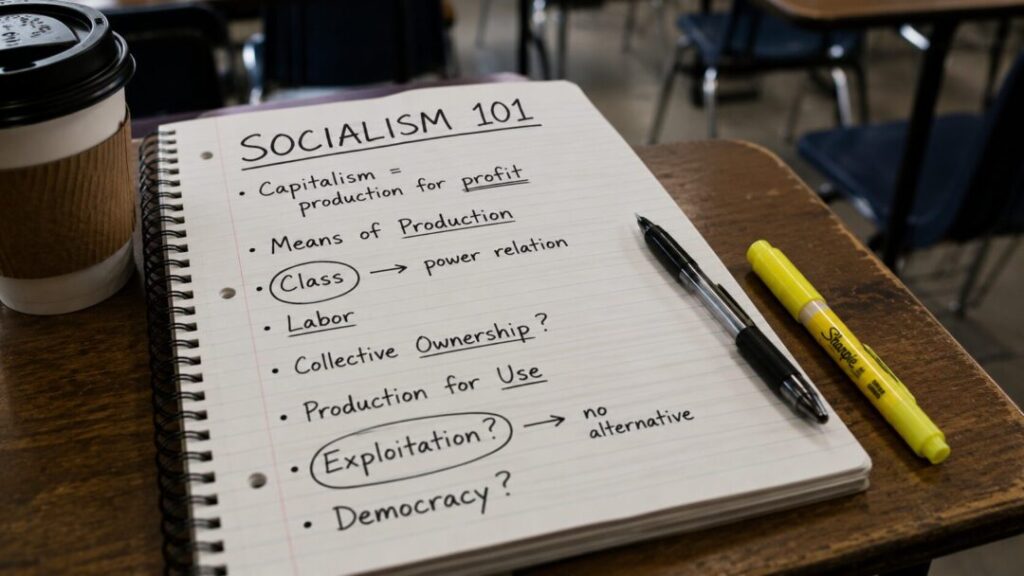
“Socialism 101.”
It's a monthly class, open to the public, put on by the Las Vegas chapter of the Democratic Socialists of America (DSA).
The room was full the night I went, around 35 people, and the mix of skeptics and hopefuls seemed pretty even.
The class was an hour and a half. Let's go through my class notes together.
Capitalism and Commodities
The facilitator opened with a definition.
“Capitalism is a political and economic system characterized by the following: production of commodities to be exchanged for profit.”
“Commodities are produced by workers who sell their labor power to capitalists for wages,” he continued, “And the means of production are the private property of capitalists.”
He said that our capitalist economy commodifies everything, workers sell their labor because they have no other choice, and capitalists own the means of production; factories and land.
“If you ever need anything like food, water, healthcare, clothing, you have to go to the market and you have to bring money… If you're poor and you don't have the money, that need is still there, but you simply do not have access to it because you don't have anything to exchange for.”
He called that last part exploitation; being forced into something because you have no alternative.
I had a little trouble here.
In a world without capitalism, food and medicine still don't fall from the sky. Somebody still has to grow it, mix it, and get it to you.
Needing to give something in order to get something you didn't produce yourself isn't a design flaw unique to capitalists. It's what scarcity looks like under any system.
But I let him keep going.
The Class System
From commodities he moved to class, which he said is the real engine underneath all of it.
“The capitalist society is organized around class,” he said. “What is a class? It's a relation to production.”
Working class people, he explained, “have no other way of surviving except by selling their labor to a business owner.” The capitalist class owns “the means of production… and will only give it to you for money so they can make a profit.”
He called that group “a minority that runs the whole show.”
That setup, he said, is why work is forced rather than chosen: “You're being exploited because you don't have any other [way of] getting what you need.”
Here's my problem with it. Exchanging one thing for another isn't proof of a rigged system.
It's just what work is, everywhere, under every economic arrangement that's ever existed, including the socialist ones.
The question that actually separates good economies from bad ones isn't whether people have to work. It's whether the work is worth doing, whether it pays enough for you to live, and whether you're free to walk away from a bad employer for a better one.
The way I see it, he's got it backwards. Having to work for things isn't exploitative. Real exploitation happens when your choice of where, when, and how to work is taken away because there's literally no other option.
In the system we have now, you can choose another job or another employer. In a socialist society, there is no “other employer”.
And nobody ever got around to explaining who fills that role instead.
Calling it a committee instead of a boss doesn't make the “upper class” disappear. It just changes the rules on how to become part of it.
“Not Communism”
Socialism, he said, is “social ownership of the means of production, production for use rather than profit.”
He added that this doesn't mean your personal stuff gets collectivized, just the factories and the farms.
That's when one attendee asked, “Who would own the farms?”
The facilitator's answer: “The foundational concept here is that it's going to be socially owned… essentially controlled democratically.”
That wasn't good enough for the man, so he pushed.
He told the room he grew up on a farm and ranch in an eight-by-thirty trailer, with his parents and three siblings.
“We worked hard,” he said. “And we paid everybody that worked with us incredibly well. We never lost an employee. Our country today, in every capitalist country in agriculture, demolishes all the socialist and communist countries in production and how they treat their farm workers.”
The response was… underwhelming.
“We're talking about under what conditions are things produced… Karl Marx would agree, he thought capitalism is incredibly powerful at unleashing production. But what we're thinking about now is, how about we take control of it now instead of the capitalists.”
Notice what happened there. He conceded the production point and changed the subject shifting control.
Another attendee had comment on the first man's reasoning for our agricultural success.
“I just wanted to say, in relation to us doing well with farms, there's a lot of labor exploitation happening there,” she said.
“You can say that there's laws for it all you want, but we exploit immigrant labor quite a lot. That's probably the number one reason why our production is so good, because we have undocumented, exploited workers working for pennies for us.”
Roughly 40 percent of hired U.S. crop workers currently lack legal work authorization, according to USDA data. So the underlying fact checks out. The conclusion built on top of it doesn't.
Exploitation of undocumented labor is the product of decades of federal immigration and labor policy, not proof that capitalism itself requires exploitation.
And illegal work is, well… illegal. Employers relying on it should face consequences.
It's also not what the farmer sitting a few feet away had just described: an employer who said he paid well and never lost anybody.
Both of those things are true at once, under the exact same economic system, and the class never circled back to reconcile it.
Defining “Class”
The next slide was “abolition of class and exploitation.”
Someone in the audience asked the big question: “What counts as a class?”
The facilitator's answer:
“For the sake of this presentation, we're taking a simplistic view of it because we're just trying to get to the root of the next slide, which is about class conflict.”
The whole presentation hinges on this two-class model, and when asked to define it, the answer was that the real version is too complicated to use tonight.
You can't build a case for reorganizing the whole economy on a category you've just admitted you simplified for convenience.
Then another attendee asked the question a room full of skeptics had been waiting for: how does this account for entrepreneurship?
“We're not going to have an economic system built on capitalists… it's collective social production,” he started.
“So entrepreneurship, where you have people coming up with businesses, and hiring employees… no. We can work collectively… but we're not going to allow for labor exploitation anymore, because this is a violent process that forces people into working with conditions they don't want to.”
The actual question was whether someone can start a business under socialism.
The actual answer was three sentences of throat-clearing that landed on “no, we're not going to allow it.”
My Sticking Point
Throughout the class, the facilitator kept describing this system where things “controlled democratically.”
I asked him directly: “What's the key difference between the democracy you're describing and the democratic republic we already have?”
“So in theory, yes, it's a democratic republic. But is it really? No, I would argue no, because these institutions were created by the ruling class to kind of keep us in check,” he said.
Then his real answer: “If they allowed us to kind of just vote our way into power, we'd be in power, but we're not.”
I'll say plainly what I think of that, but feel free to disagree: His is not a description of how a republic works.
He claims that the government Nevadans elect every two years is illegitimate by design, rigged from the start to keep them powerless.
I don't think that's the full story. Actually, I think Ben Franklin explained the difference much better…
“Democracy is two wolves and a sheep voting on what to have for dinner. Liberty is a well-armed sheep contesting the vote.”
The Senate and the separation of powers were intended to stop any faction, majority or minority, from steamrolling everyone else. That's the entire point of a republic, and it's why we're not a pure democracy where fifty-one percent gets to vote away the other forty-nine.
Is that a real debate? Yes; it goes back to the Federalist and Anti-Federalist papers, and reasonable people land on both sides of it.
But there's a difference between debating it and presenting a half-baked definition to a room full of first-timers as settled fact.
Even They Don't Agree
Later, one attendee asked why the historical infighting between “Lenin and Stalin and Maoism and Titoism and Castro,” when you'd expect a common cause to produce more unity than that.
The facilitator's answer was that unity was never really the goal.
“We will never unite because everywhere is kind of different,” he said. “This is a good thing… the only way that really happens in life is when it just gets dictated top down.”
But before we get rid of our entire economic system and government, don't you think you should have an agreed upon starting point among yourselves?
Near the end, the farmer spoke one more time.
“Thank you for showing mutual respect,” he told the room. “We live in a big, beautiful country. The fact that we can be here, and showing mutual respect, that's where you gain strength… It's good that people are speaking up. We have that right.”
Whatever anyone there believes about capitalism or socialism, that 35 people could argue it out in the open and still shake hands on the way out is worth something on its own.
That kind of argument, where people are free to agree or disagree without fear of prosecution, is a core part of what makes our country great. Not every country allows it.
It's the same freedom the class spent two hours arguing was rigged against the people using it.
I'll grant that our system isn't perfect. What I won't grant is the idea that it's more flawed than the alternatives being pitched to replace it.
The opinions expressed by contributors are their own and do not necessarily represent the views of Nevada News & Views. Digital technology was used in the research, writing, and production of this article. Please verify information and consult additional sources as needed.