Rosen voted for the bipartisan package to speed up energy and mining projects. Cortez Masto voted against it, even though several of her own bills were inside.
Nevada’s two Democratic U.S. senators both say the federal government takes too long to approve energy and mining projects. Last week they voted differently on a bill meant to fix that.
On November 19, the U.S. Senate passed the Bipartisan American Affordability and Jobs Act of 2026, known as BAAJA, by a vote of 62 to 33.
Sen. Jacky Rosen voted yes. Sen. Catherine Cortez Masto voted no.
The bill now goes to the House.
Voting Against Her Own Bills
The surprising part is what was in the package. It included several ideas Cortez Masto has pushed for years. Among them were her Mining Regulatory Clarity Act, her High-Capacity Grid Act, support for geothermal energy and parts of her FREEDOM Act to speed up environmental reviews.
Cortez Masto said her problem was not permitting reform itself.
“This country needs permitting reform,” she said in a statement.
Her objection was to changes in the National Historic Preservation Act. Tribal groups say those changes would weaken their voice on projects near sacred sites.
“But there is no reason to threaten Tribal sovereignty to accomplish these goals,” she said.
Same Concerns, Different Votes
Rosen’s office said she also worked with other Democrats to remove the disputed provisions. When that failed, she voted for the bill anyway.
Rosen pointed to Nevada’s solar and geothermal resources. She argued that slow federal approvals have held back projects, jobs and lower power bills.
Last week she said that “we cannot squander the opportunity to deliver results and lower costs for families.”
What the Bill Would Do for Nevada
The federal government controls roughly 80 percent of Nevada’s land. That means almost every mine, power line, solar farm and geothermal plant in the state needs Washington’s permission.
The average federal environmental review takes about 4.5 years, according to the Sierra Club.
Republican Sens. Shelley Moore Capito of West Virginia and Mike Lee of Utah wrote the bill with Democratic Sens. Sheldon Whitehouse of Rhode Island and Martin Heinrich of New Mexico.
It would change four major federal laws: the National Environmental Policy Act, the Clean Water Act, the Endangered Species Act and the National Historic Preservation Act.
The main goal is speed. The bill sets deadlines for federal reviews and gives approved projects more certainty that they won’t be stopped years later.
Several parts hit close to home. For Nevada mines, the bill includes Cortez Masto’s Mining Regulatory Clarity Act. It settles a long court fight over how companies can use nearby federal land for things like storing waste rock.
For geothermal energy, a big industry in northern Nevada, the bill would require more frequent federal lease sales, set deadlines for drilling permits and create a federal ombudsman to help projects through the process.
It would also make it easier to build big power lines across state lines, by simplifying federal approval and requiring regions to plan together.
Who Pays for Data Centers?
Data centers are coming to Nevada fast, and someone has to pay for the power plants and power lines they require.
In 2025, data centers used just 5 percent of NV Energy’s power. By 2046, they’re expected to use 64 percent, according to the utility’s own filings with state regulators.
Thirty-nine data center projects interested in Nevada have asked for nearly three times as much power as NV Energy produced at its peak last year.
BAAJA would require large data centers to pay the extra costs of connecting to the grid, instead of spreading those costs across everyone’s bills.
NV Energy CEO Doug Cannon has warned about that risk himself.
“We cannot go out and make all of this big investment and then have that data-center load not show up,” he said on Nevada Newsmakers last year.
If that happens, he said:
“all of a sudden those costs are shifted to our existing customers.”
Energy consulting firm Grid Strategies estimates the bill could shift more than $100 billion in costs onto data centers nationwide over 10 years, if states fully put it into place.
The Tribal Consultation Fight
The fight centers on Section 106 of the National Historic Preservation Act. It requires federal agencies to weigh how projects affect historic sites, often with input from tribes.
Tribal groups, including the Affiliated Tribes of Northwest Indians, asked Congress to remove the historic preservation section entirely.
The bill’s supporters disagree. Heinrich said the bill keeps required consultation, brings tribes in earlier and adds funding for preservation.
A last-minute compromise also fell apart. Democratic Sens. Jeff Merkley and Ron Wyden of Oregon objected to adding more changes, and tribal groups said those changes still did not go far enough.
Nevada is seeing this fight play out right now.
Since late September, members of the Yerington Paiute and Walker River Paiute tribes have camped at a construction site for NV Energy’s Greenlink West transmission line near Yerington, saying it runs through their ancestors’ burial sites.
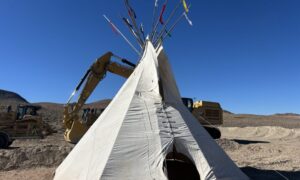
On Friday, a Lyon County judge granted NV Energy an injunction barring three protesters from blocking construction. But work in the disputed areas still can’t resume until the Bureau of Land Management finishes reviewing the site.
Nevada watchdog group Basin and Range Watch argues that Greenlink West will mostly connect to data centers and other industrial sites at the Tahoe-Reno Industrial Center.
NV Energy says Greenlink “is not a data center transmission project.”
Still, Cannon said data center growth means:
“there will be additional transmission infrastructure (needed).”
What Comes Next
The House still has to pass the bill, and both chambers must agree on the same version before it reaches President Trump. Congress ends January 3, so time is short.
Nevadans who want faster permits for mining, energy and power lines can call Nevada’s four House members and tell them how they feel before the vote.
The opinions expressed by contributors are their own and do not necessarily represent the views of Nevada News & Views. This article was written with the assistance of AI.