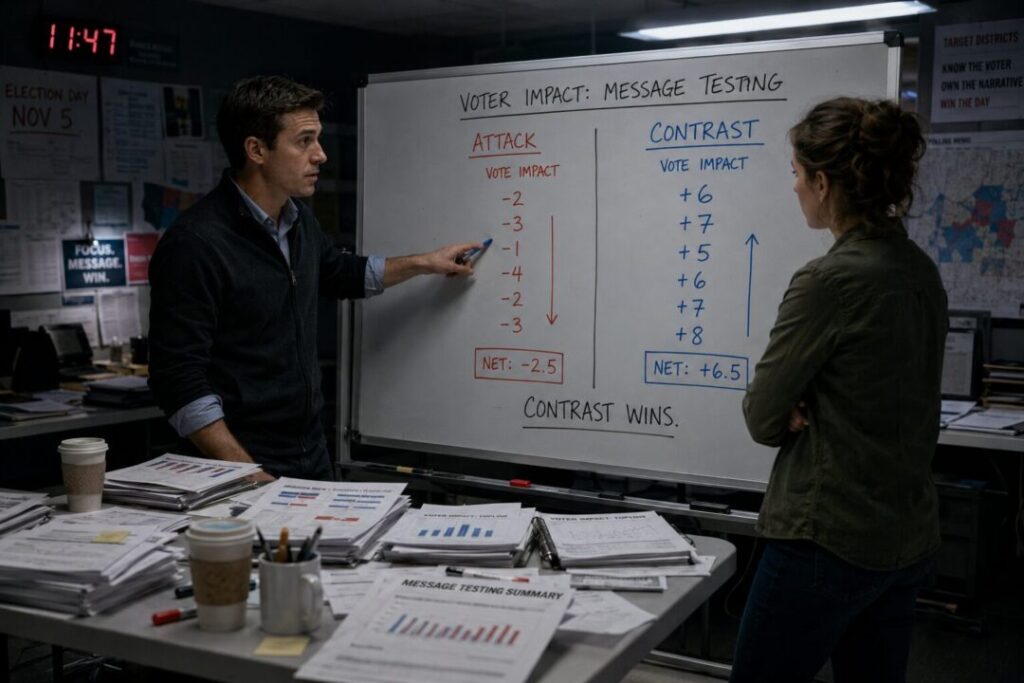
Want to Win in November? Science Says Stop Running Attack Ads
Voters are smarter than most political consultants give them credit for. And a new national study just proved it.
America’s New Majority Project ran a split-sample survey testing two types of political messages head-to-head on five big issues: taxes, healthcare, women’s sports, welfare reform, and immigration.
The result was the same every single time.
Fact-based contrast messages beat pure attack ads. Every issue. Every demographic. No exceptions.
This matters for every Republican candidate on the ballot in Nevada and across the country in 2026.
What’s the Difference Between “Contrast” and “Attack”?
An attack message tears into the opponent. It calls them out, uses sharp language, and makes claims the voter has no way to check.
It’s been the go-to for political operatives for decades.
A contrast message does something different.
It cites a real vote record. It names what the candidate actually did. It tells voters what the candidate stands for. And then it invites the voter to go check the facts themselves.
That last part turns out to be the game-changer.
The Numbers Don’t Lie
On healthcare — the top-ranked issue for voters — the contrast message earned 59% believability and a +23 net vote impact.
The attack message? Only 48% believability and +14 net impact. That’s a 9-point gap in who gets moved to vote for your candidate.
Among Independent voters — the ones who decide competitive elections — the gap was even bigger.
Contrast beat attack by 14 points on healthcare. By 11 points on taxes. By 9 points on women’s sports.
On women’s sports specifically, the contrast message hit 65% believability — the highest score in the entire survey. Even some Democrats believed it.
That’s a rare opening. And the data shows attack ads slam that door shut.
When you switch from contrast to attack on women’s sports, Democrat believability crashes from +4 all the way to -43.
In Nevada, where legislative races are decided by a few hundred votes in some districts, that kind of swing is the difference between winning and losing.
Why Voters Respond to Contrast
Think about it from a regular person’s point of view.
Your neighbor knocks on your door and says, “That other candidate is a terrible person who wants to destroy your family.”
You’re skeptical. You can’t verify it.
But if your neighbor says, “That candidate voted against the tax cut that saved you $1,200 last year — you can look it up on Congress.gov” — now you’re paying attention.
That’s checkable. That’s real.
That’s exactly what this research found. When you anchor a message in a documented record and invite voters to verify it, trust goes up.
And when trust goes up, vote impact goes up.
Critics of contrast messaging say it sounds weak. They say voters want fire and anger.
But the data flatly disagrees.
Pure attack ads never hit above 52% believability in this survey. Not once. Contrast messages didn’t score below 55% on any issue tested.
The Practical Takeaway for Nevada Races
The best political messengers — the ones who win — already knew this instinctively.
Ronald Reagan didn’t just attack Jimmy Carter. He said, “There you go again,” and then laid out the contrast. He invited voters to compare.
The research from America’s New Majority Project just put hard numbers behind what great communicators have always understood.
Show your record. Cite the vote. Tell voters what you stand for. Then let them check it.
That’s not soft. That’s smart. And right now in Nevada, smart wins races.
The opinions expressed by contributors are their own and do not necessarily represent the views of Nevada News & Views. Digital technology was used in the research, writing, and production of this article. Please verify information and consult additional sources as needed.