NIMBY Meets Orbit: Feds OK a Million Data Center Satellites.
Want to build a giant data center these days? Good luck finding a town that’ll let you.
On Wednesday, Washington offered the AI industry a new option. Build it in space.
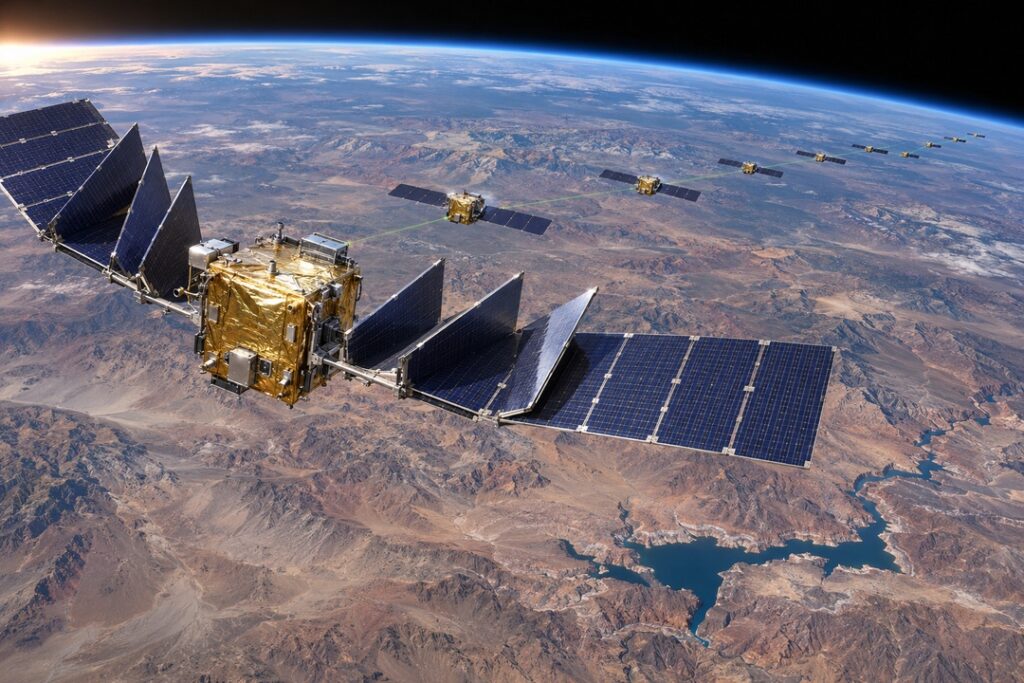
The Federal Communications Commission approved SpaceX’s request to launch up to 1 million satellites that work as computer centers in orbit. The project is called Starmind.
FCC Chairman Brendan Carr announced it on X with a simple headline: “DATA CENTERS IN SPACE.”
The FCC says it’s the first time the U.S. has ever approved a data center network in orbit.
Yes, you read that right. A million satellites.
Why This Matters Down Here
Data centers are giant warehouses full of computers. They run the internet and power AI. They also gobble up electricity. And many use a lot of water to keep the machines cool.
Folks are fed up with it.
On Nov. 3, voters in 10 states decided 41 local ballot measures on data centers. The anti-data center side won all but one, according to Ballotpedia.
Nevada was no exception. In Boulder City, nearly 71% of voters said no to opening about 14,000 acres of city land to data centers.
Statewide exit polls found 69% of Nevadans opposed a new data center in their own community. About a quarter of voters called it a crucial issue.
That’s not a small gripe. That’s a political earthquake.
You can see where this is headed. More rules. More red tape. More fights at every city council meeting.
Space Has What Nevada Doesn’t
Now think about the orbital option.
In the right orbit, the sun shines on these satellites nearly around the clock. That’s free power. Space is also cold, so the heat just radiates away.
No water from Lake Mead. No load on our power grid. No humming, windowless building next to an elementary school. And no neighbor has to look at one.
These aren’t little gadgets either. Each Starmind satellite will have solar wings about 75 meters across. That’s most of the length of a football field.
And it’s not just Elon Musk’s company.
A firm called Starcloud filed in February for up to 88,000 satellites of its own. Carr’s announcement noted that competing systems are in the works too.
That’s how the free market is supposed to work. People see a problem. Private companies compete to solve it.
Don’t Cancel the Groundbreakings Just Yet
Let’s be honest. FCC approval isn’t the same as liftoff.
Putting a million satellites in orbit takes a mountain of rockets and a whole lot of money.
Astronomers worry about clutter in the night sky. Others worry about space junk. And nobody knows yet if this will pencil out against good old-fashioned buildings on the ground.
So the data center fight in Nevada isn’t going away anytime soon. More than 80 of these projects are already running, being built, or planned here.
But here’s the point.
Voters didn’t say no to technology on Nov. 3. They said no to paying for it with their water and their power bills.
Politicians in both parties should take note. Folks don’t want the government picking winners and handing out tax breaks while families pay higher utility bills.
What they want is a smarter answer. Starmind might just be one.
The opinions expressed by contributors are their own and do not necessarily represent the views of Nevada News & Views. Digital technology may have been used in the research, writing, or production of this article. Please verify information and consult additional sources as needed.