From a Reno Facebook thread to Fox News, Republicans are blaming RINOs, busy moms, and soft immigration policy. The exit polls say otherwise.
Republicans are talking about the need for change after the midterms. Some have already decided that change means kicking more people out.
After Tuesday, Joey Gilbert, the Reno attorney and former boxer who ran for governor in 2022, posted on Facebook that it was going to be a long two years, that Republicans need “a new generation of leaders,” and that it’s “time for some real Republican Change.”
Gilbert backed David Flippo in this year’s congressional primary. Now he wants new leaders, without saying what that looks like.
Others were happy to fill in the blank. A commenter replied that:
“The time is right to kick all the RINOS out of the party,”
I replied that I was pretty sure that wasn’t the electoral lesson.
It isn’t one commenter. Nationally, the same reflex arrived within hours. Influencer Bo Loudon blamed “RINO Senators” who “stab President Trump and We the People in the back.” CNN found Trump-aligned hosts and influencers faulting the people around the president rather than the president himself.
And this isn’t new: after last year’s off-year losses, Axios reported that MAGA influencers offered a near-uniform diagnosis that candidates fell short because they weren’t MAGA enough.
The party lost voters. Apparently, the solution is fewer kinds of Republicans.
Meanwhile, on Fox News, Jesse Watters turned to podcaster Tim Pool to ask how Republicans could win back young men.
“I’m not sure they do,” Pool replied on Jesse Watters Primetime, before warning that plenty of young white men want to burn the Republican Party down.
Watters: How do Republicans, I can’t even believe I’m saying this, win back young men?
Pool: I’m not sure they do https://t.co/cgchRBl8mI
— Acyn (@Acyn) November 6, 2026
I’m concerned that Fox is looking to Pool for electoral analysis. But the larger problem is how quickly the conversation becomes a discussion of the people these commentators identify with, filtered through grievances they already hold.
Consider the messenger
Pool first gained attention livestreaming Occupy Wall Street, later worked for Vice and Fusion, and built an independent political media business. His career has involved cultivating a substantial online audience.
That makes him familiar with his viewers. Whether his perspective helps Republicans understand the voters they lost is another question.
In March 2024, Pool posted a two-word prescription: “Draft women.”
Later that month, he wrote: “i think its funny that women in nyc are getting punched in the face.”
i think its funny that women in nyc are getting punched in the face
— Tim Pool (@Timcast) March 28, 2024
When challenged, he framed the assaults as a consequence of the politics of the city’s residents. One of the victims had her face fractured, and teeth knocked out.
By Father’s Day, he was declaring June “Fathers Month,” because “Fathers are the most important aspect of a functioning society.”
Celebrating fathers is easy enough without turning their importance into a ranking. But a ranking is what he offered, and it has an obvious second place. If fathers are the most important aspect of a functioning society, mothers are, by his own measure, something less.
In March, he told his audience that women “vote for drama,” that they “don’t care about tax policy,” and that “we will burn for it.”
This is who Fox turned to for advice on winning back voters.
Women are voters, too
Why does the discussion of young men so readily become the centerpiece of the party’s recovery, while women’s rejection receives less attention?
Republicans should compete for young men. But voters under 30 made up only about 1 in 10 midterm voters, and young men are a fraction of that. Somehow they became the fire alarm.
 Women got a different explanation.
On election night, podcaster Katie Miller, wife of White House Deputy Chief of Staff Stephen Miller, told CBS’s Norah O’Donnell that:
“Moms are too busy raising their children and taking care of them to get to the polls.”
Losing young men is a crisis. Losing women is household chores.
Except women weren’t absent.
Women made up 53% of the electorate, and they backed Democrats 59% to 40% in the NBC News exit poll. That 19-point margin was 13 points wider than in 2024. Democrats haven’t done that well with women since 2018.
White women, who historically vote Republican, backed Democrats 52% to 46%. Suburban women went Democratic by 26 points. Among young women, CIRCLE found that 70% voted for a Democratic House candidate.
Women are the majority of voters, and they handed Democrats their widest margin.
That should interrupt the conversation.
When the movement hands its microphone to a man who laughed at women getting punched, and its election-night explanation for losing women is that moms were too busy, women notice. A party cannot keep rewarding contempt and then expect the people on the receiving end to call it leadership.
Women are not an abortion constituency, a demographic obstacle, or the people young men are having trouble dating. They are the majority of the electorate, and Republicans need to earn their votes.
Young men have interests beyond the podcast
The Facebook commenter’s answer is fewer Republicans. Podcaster Pool’s is that young men may already be gone. Neither matches what young men actually said.
CIRCLE found the economy, health care, and the Iran war among young voters’ top concerns, and 59% of young men backed Democrats, two years after most of them voted for Trump. Their complaint wasn’t a shortage of loyalty. It was the cost of building a life.
Pool also pointed to immigration:
“You have Trump come out and defend hospitality worker illegal immigrants; you have Vivek [Ramaswamy] defending H-1B,” he said.
Young men’s attitude, he said, is:
“‘You do not support America, you are basically just Democrats as it is.’ They’re nuclear.”
In other words, the party lost them by not being hard-line enough.
Pool is wrong, and the exit polls say so.
In the NBC News exit poll, 57% of voters said the administration’s immigration enforcement had gone too far. About one in five said it hadn’t gone far enough. Six in ten disapproved of how ICE was doing its job, and just 14% called immigration the country’s most important issue.
The voters who agree with Pool didn’t leave. Ninety-one percent of those who wanted tougher enforcement voted Republican. The voters who thought it had gone too far backed Democrats 89%.
Pool is describing the one in five who stayed and blaming the party for losing them. CIRCLE found the same pattern among young voters: those focused on immigration stuck with Republicans. The ones who left were voting on something else.
People noticed the priorities
Pool’s mistake is the movement’s mistake. The White House ballroom shows how badly enthusiasm inside it can misrepresent opinion outside it.
An April ABC News/Washington Post/Ipsos poll found that 56% of Americans opposed demolishing the East Wing to build the ballroom, while 28% supported it.
Republicans overall supported it 65%, but the split inside the party was stark. Support reached 77% among MAGA Republicans, including Republican-leaning independents who identified with the movement. Among non-MAGA Republicans, it was 31%.

Inside the movement, a triumph. Outside it, a very different reception.
The symbolism was hardly subtle. People worried about keeping their homes were watching the president remake his.
That poll doesn’t tell us how many votes the ballroom cost. It demonstrates how a narrow political culture mistakes itself for the electorate.
The mandate was not greater obedience
The Associated Press’s post-election voter survey found that more than half of voters considered government corruption crucial to their congressional vote.
About two-thirds said Trump had the wrong priorities. Approximately seven in ten wanted stronger congressional checks on the presidency, including about four in ten Republicans.
Those are difficult findings to reconcile with a prescription for stricter loyalty.
The survey also found that about two-thirds believed Trump’s policies had worsened the economy. The war mattered, but so did tariffs, everyday costs, and dissatisfaction with the administration’s priorities.
The RINO label is a convenient way to avoid engaging with those distinctions.
But calling someone insufficiently Republican does not make their concern disappear. It gives them another reason to take it elsewhere.
Nevada has room to rebuild
If Republicans want to know what voters rejected, they don’t have to guess. Flippo was a compact version of the national story.

He strongly supported the Iran war the national electorate turned against. He loaned his campaign more than $1.6 million but never formally filed the personal financial disclosure federal law requires.
The draft he finally shared listed as a major asset an Arizona land venture promising “constant” 20% returns, which a forensic accountant who testified in the Madoff case called “a huge red flag.”
His campaign reports credited donations to two people who had died. And his campaign claimed he earned a Bronze Star for valor. He didn’t.
When NPR asked why he wore two “V” pins, his campaign swapped the photo off his website and Flippo chalked it up to politics. He didn’t answer questions. He questioned the people asking them.
Mark Amodei saw it coming. The retiring congressman, who held the seat for 15 years, warned after the primary that with Flippo as the nominee, the district was no longer a Republican guarantee for the first time in its history.
He objected to Flippo’s habit of questioning opponents’ Republican credentials, refused to endorse him, and said he voted for a third-party candidate.
Days before the election, the Washoe County Republican Party voted unanimously that it “no longer recognizes Mark Amodei as a Republican.”
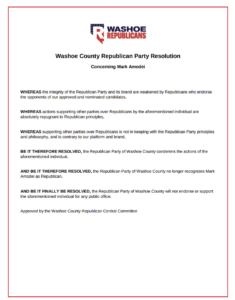
Amodei’s warning was right. The party disowned the man who sounded the alarm and embraced the candidate he warned about.
Corruption, an unpopular war, and a lack of transparency were exactly what voters nationally said they were voting against. Nevada’s 2nd District didn’t send a different message. It sent the same one, closer to home.
His defeat creates an opportunity to reconsider a political culture built around demands for loyalty and contempt for accountability. His victory could have encouraged Republicans to treat that culture as the blueprint.
Losing does not guarantee they will reconsider it. The immediate calls to expel more people suggest some would rather preserve the culture than examine its electoral cost.
The early national evidence describes a broad coalition problem. AP’s voter survey found Republican erosion among young voters, Hispanic voters, Black men, moderates, and lower-income voters compared with 2024.
Only about 1 in 10 Black men backed the Republican in their House race, down from roughly a quarter who supported Trump two years ago. I have yet to see the podcast pundits discuss that swing. Was it about the hospitality workers, too?
That calls for a serious examination of candidates, conduct, priorities, and results.
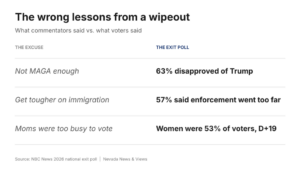
Instead, commentators keep interpreting the election through their own identity and grievances. Their urgent questions concern the people they identify with. Their proposed solutions preserve the politics they prefer.
Gilbert is right that Republicans need a new generation of leaders. But the answers offered so far, from the commenter, from Pool, from the Washoe County GOP, all point in the same direction: fewer people, louder grievances, stricter loyalty. Voters just rejected all three.
The electorate didn’t ask Republicans for a smaller club. It asked for a better one.
The opinions expressed by contributors are their own and do not necessarily represent the views of Nevada News & Views. This article was written with the assistance of AI.