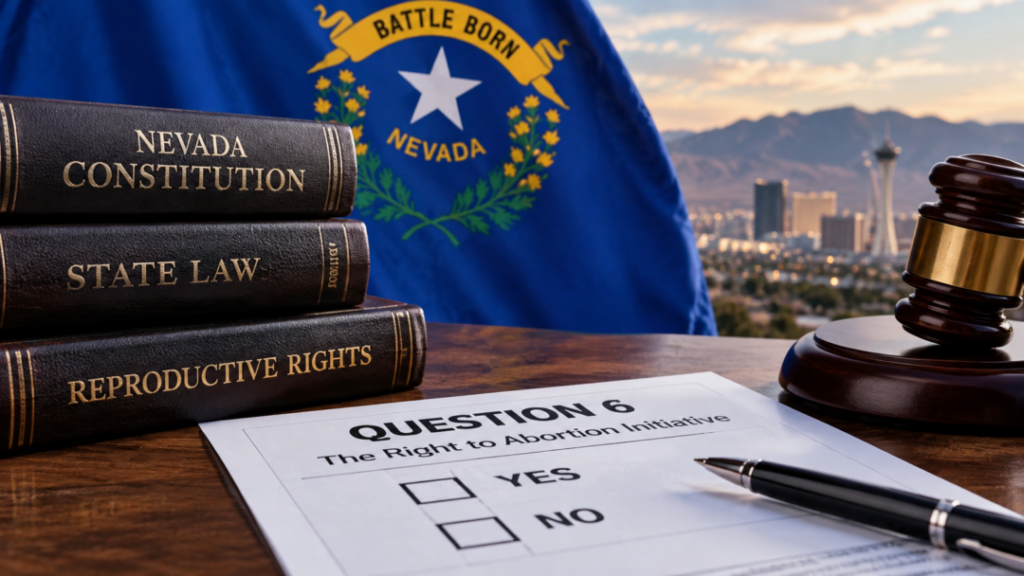
Nevada voters will have Question 6, the “Right to Abortion Initiative,” on their ballot again in November after having approved it in 2024.
In Nevada, voter initiated constitutional amendments must be approved twice, meaning Question 6 needs to be approved in 2024 and 2026 to amend the Nevada Constitution.
Voters passed Question 6 by 64.4% to 35.6% in 2024.
Current Nevada law provides that abortion is legal until 24 weeks of pregnancy.
In 1990, Nevada voters settled the abortion question by approving a referendum that legalized abortion up to 24 weeks, and prohibited the state legislature from amending or repealing the law unless it was placed on the ballot. Voters approved the referendum by 63.5% to 36.5%.
Nevada’s abortion statute, NRS 442.250, was drafted in 1973 by two Washoe County Assemblymembers, Democrat Robert Barengo and Republican Robert Broadbent. It was a bipartisan attempt to meet the standard set by Roe v. Wade.
It allowed abortion up to 24 weeks, and after that only to protect the life or health of the mother.
In 1985, the Legislature added a parental notification requirement for minors. The parental notification has been blocked by court orders and has never been enforced.
That’s been the settled law for 35 years and it’s voter-protected.
The U.S Supreme Court decision in Dobbs v. Jackson (2022) overruling Roe v. Wade (1973) had no effect on Nevada’s abortion statute, NRS 442.250, which can only be changed by another statewide vote.
The statute also comes with a few important guardrails, most tied to health risks: a licensed physician has to perform the procedure, abortion after 24 weeks must be deemed medically necessary to protect the mother’s life or health and performed in a hospital setting.
Question 6 doesn’t carry these guardrails forward.
Current law requires a licensed physician to perform an abortion. Question 6 provides for an abortion being performed by a “health care professional,” a term Nevada law defines
broadly to include dentists, chiropractors, nurses, optometrists, psychologists, and lab technicians.
Question 6 replaces the 24-week fixed period with “fetal viability”, defined as whatever the treating practitioner’s professional judgment deems it, with no hospital requirement.
The ability to make a judgment call on “viability” applies all the way to birth.
Opponents argue that a practitioner could judge a pregnancy well past 24 weeks not “viable,” perform the procedure in an outpatient clinic instead of a hospital, and never have that call reviewed.
The amendment grants the right to “all individuals,” not to women or pregnant patients– for a reason.
It’s the language used by reproductive rights litigators to argue that any age-based distinction, like notifying a parent before a minor’s abortion, is a form of unequal treatment under this amendment.
Nevada’s parental-notification rule has been fought over in court for decades. Question 6 would permanently take notification off the table.
The current law, NRS 442.250, is a fixed statute making abortion access legal in Nevada.
Question 6 replaces that with a constitutional right subject to “strict scrutiny,” the toughest legal test in constitutional law. Any health, safety, or licensing regulation touching abortion, now or years from now, has to survive a “compelling state interest” test, an extremely high legal bar.
Courts will decide what that standard allows each time it’s challenged—not voters.
As of July 15, the pro-Question 6 campaign had raised over $815,000 this cycle. This is on top of $13.2 million they raised in 2024, the last time this question appeared on Nevadans’ ballots.
Two opposition PACs have raised a combined $12,000.
Most Nevadans will only hear what the well-funded abortion rights advocates advertise. Voters are encouraged to read and understand the amendment’s text.
Nevada’s 1990 law isn’t going away. Abortion is legal in Nevada and will remain legal irrespective of the outcome on Question 6 in November.
The opinions expressed by contributors are their own and do not necessarily represent the views of Nevada News & Views. Digital technology may have been used in the research, writing, or production of this article. Please verify information and consult additional sources as needed.