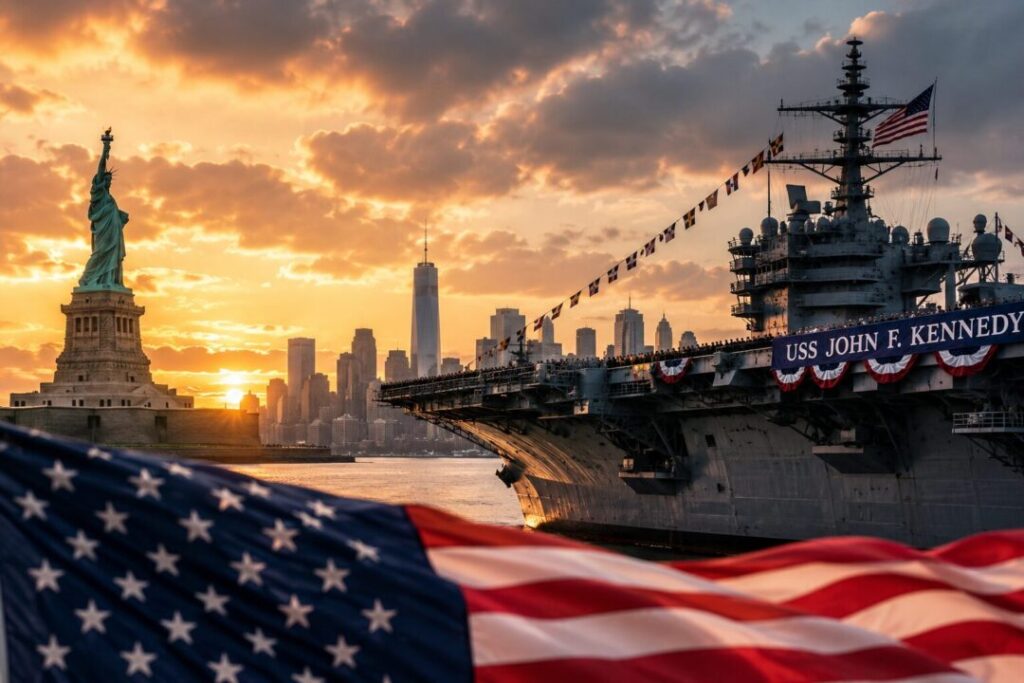
Forty years ago, President Ronald Reagan delivered a memorable 1986 Fourth of July address from the deck of the aircraft carrier U.S.S. John F. Kennedy in New York Harbor.
The speech was part of the broader “Liberty Weekend” celebration marking the Statue of Liberty’s centennial. The night before Miss Liberty was rededicated and her torch relit.
President Reagan paid tribute to the fifty-six men who came forward in Philadelphia to sign the Declaration of Independence pledging “their lives, their fortunes and their sacred honor.”
That pledge was more than rhetoric as each man knew that hanging was the penalty for high treason to the Crown. They were brave.
Their courage created a nation built on a universal claim to human dignity, on the proposition that every man, woman and child had a right to a future of freedom.
Reagan asked that we listen to the words again: “We hold these truths to be self-evident, that all men are created equal, that they are endowed by their Creator with certain unalienable rights, that among these are Life, Liberty, and the pursuit of Happiness.”
In his speech, the president spoke of national unity and warned us that the only permanent danger to the hope that is America, comes from within.
He recounted the story of two of our greatest Founding Fathers, John Adams and Thomas Jefferson. They’d worked closely together in Philadelphia for independence. But once that was gained and a government formed, partisan politics began to get in the way.
After a bitter and divisive campaign, Jefferson defeated Adams for the presidency in 1800. And the night before Jefferson’s inauguration, Adams slipped away to Boston, disappointed, brokenhearted and bitter.
For years their estrangement lasted. But then when both had retired, Jefferson at 68 to Monticello and Adams at 76 to Quincy, they began through their letters to speak again to each other.
Letters that discussed almost every conceivable subject: gardening, horseback riding, even sneezing as a cure for hiccups; but other subjects as well: the loss of loved ones, the mystery of grief and sorrow, the importance of religion, and, of course, the last thoughts and hopes of two old men, two great patriarchs, for the country that they had helped to found and loved so deeply.
“It carries me back,” Jefferson wrote about correspondence with his cosigner of the Declaration of Independence, “to the time when, beset with difficulties and dangers, we were fellow laborers in the same cause, struggling for what is most valuable to man, his right to self-government.”
It was their last gift to us, this lesson in brotherhood, in tolerance for each other, this insight into America’s strength as a nation, Reagan said.
And when both men died on the same day within hours of each other, that date was July 4th, 50 years exactly after that first gift to us, the Declaration of Independence.
Reagan concluded:
“My fellow Americans, it falls to us to keep faith with them and all the great Americans of our past. The things that unite us—America’s past of which we’re so proud, our hopes and aspirations for the future of the world and this much-loved country—these things far outweigh what little divides us.
And so tonight we reaffirm that Jew and gentile, we are one nation under God; that black and white, we are one nation indivisible; that Republican and Democrat, we are all Americans. Tonight, with heart and hand, through whatever trial and travail, we pledge ourselves to each other and to the cause of human freedom, the cause that has given light to this land and hope to the world.
Tonight there’s much to celebrate and many blessings to be grateful for.
So now, let’s have some fun— let the celebration begin!”
The opinions expressed by contributors are their own and do not necessarily represent the views of Nevada News & Views.