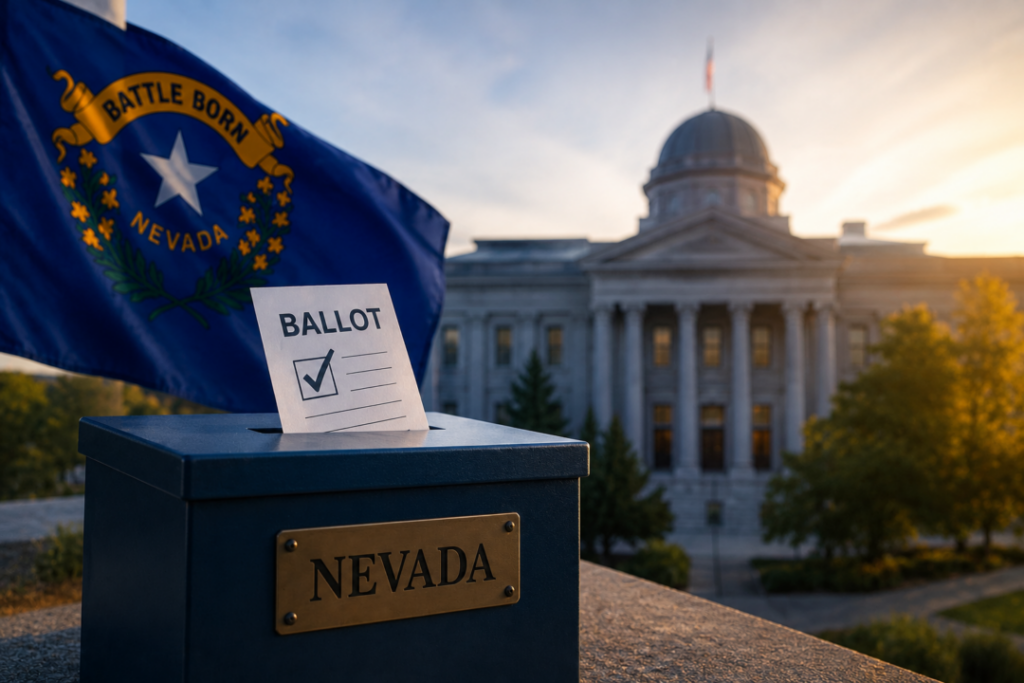
Nevada voters will revisit Question 7 in 2026, the voter ID initiative that passed in a landslide with 73.23% approval in 2024.
Because Question 7 changes Nevada’s constitution, it needs to pass twice. It now requires a second “yes” vote this November. If approved again, it becomes part of Article 2 of the Nevada Constitution.
Question 7 would amend the constitution to require all in-person voters present a valid photo identification before voting.
It lists eight approved forms of government-issued IDs, including driver’s licenses, passports, student and tribal photo identification. It also permits the Nevada Legislature to approve additional government-issued IDs.
In addition, it would require voters using a mail ballot to list the last four digits of their Nevada driver’s license number or the last four digits of their Social Security number—alongside their signature.
Thirty-six states have some form of voter ID law with no major complaints. Nevada is one of only 14 states to not require a form of identification while voting, and instead relies on a voter signature to verify voter identity.
Polls consistently show overwhelming support for voter ID.
A Pew Research survey last year found 83% of adults, and 71% of Democrats, favor it. CBS conducted a poll earlier this year and found that 80% support voter ID, a finding that transcends party lines.
Earlier polls done by Gallup and Monmouth also measured 80% and 81% support for voter ID.
A Nevada Independent poll in 2023 reported 74% of Nevada registered voters across all demographic groups support a voter ID requirement: 62% of Democrats, 93% of Republicans and 68% of independents/non-partisans.
At the urging of voters, Governor Joe Lombardo made voter ID a campaign promise during his 2022 gubernatorial campaign. He introduced it as part of his proposed Election Integrity Act in 2023.
Legislative Democrats failed to even consider the bill and described it as “dead on arrival.” Democrats have legislated a leaky election system to juice their votes.
The opinions expressed by contributors are their own and do not necessarily represent the views of Nevada News & Views. Digital technology may have been used in the research, writing, or production of this article. Please verify information and consult additional sources as needed.