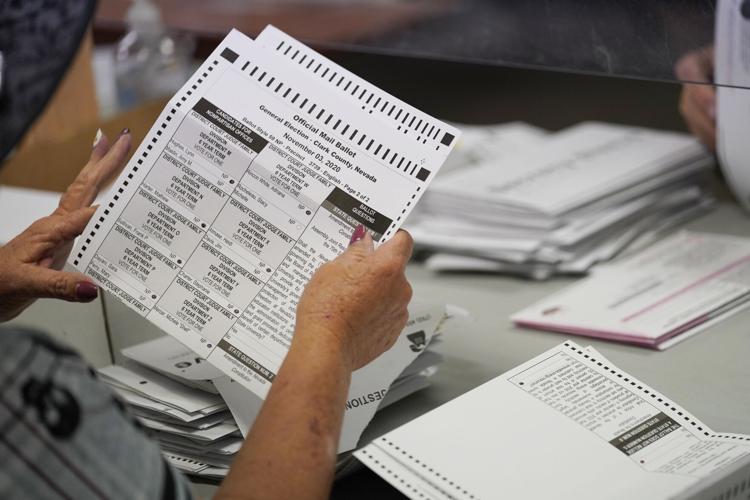
A Las Vegas homeowner’s decades-old registration problem mirrors the same dispute over what evidence is enough to clean Nevada’s voter rolls now playing out between Pigpen, Secretary of State Cisco Aguilar and the Trump administration.
A Las Vegas homeowner has been receiving election mail for a woman who moved out of his house nearly three decades ago.
The explanation for why she can apparently remain on Nevada’s voter rolls helps illustrate a much larger fight over voter-list maintenance — one that has put Nevada Secretary of State Cisco Aguilar at odds with both local election-integrity activists and the Trump administration.
Russell Lorenzen told KTNV’s Steve Sebelius that he purchased his Las Vegas home in 1997 and has received election mail addressed to the previous owner ever since.
For years, Lorenzen simply threw it away. But the issue took on greater significance after Nevada adopted universal mail voting, under which active registered voters are automatically mailed ballots.
Last week, Lorenzen received his sample ballot.
He also received hers.
The previous homeowner has not voted from Lorenzen’s address for at least 14 general elections, according to KTNV. Yet nearly 30 years after she sold the property, she still appears on the voter rolls.
A Las Vegas voter who has been receiving election mail for his home’s previous owner for nearly 30 years says he’s frustrated by the county’s failure to fix the problem. 🔗 in bio for more. https://t.co/dPztXfSMFz
— KTNV | Channel 13 News Las Vegas (@KTNV) October 7, 2026
A Las Vegas homeowner has been receiving election mail for a woman who moved out of his house nearly three decades ago.
The explanation for why she can apparently remain on Nevada’s voter rolls helps illustrate a much larger fight over voter-list maintenance — one that has put Nevada Secretary of State Cisco Aguilar at odds with both local election-integrity activists and the Trump administration.
Pigpen Has Run Into the Same Wall
For those involved with our own Citizen Outreach Foundation’s Pigpen Project, the problem is familiar.
The Pigpen Project was launched in 2023 specifically to identify registrations associated with people who appear to have moved and provide that information to election officials before ballots are mailed to outdated addresses.
The project has used government and public records, including the U.S. Postal Service’s National Change of Address data, Nevada voter-registration records, and registrations in other states.
In 2024, Citizen Outreach submitted roughly 33,000 challenges involving voters believed to have moved. But Aguilar’s office instructed county election officials that challenges must be based on “personal knowledge,” which it interpreted as firsthand observation or experience rather than information obtained from databases or third parties.
That created a peculiar problem.
Government records indicating that someone filed a permanent change of address weren’t necessarily enough. Neither, according to Pigpen, was knocking on the door and having the current resident confirm that the registered voter no longer lived there. Aguilar’s office treated such a statement as hearsay rather than the challenger’s personal knowledge.
The Lorenzen case brings that dispute out of databases and spreadsheets and puts it at a Las Vegas front door.
Here is a homeowner saying, in effect: I have lived here since 1997. The registered voter does not live here. I bought the house from her. And I am still receiving her election mail.
Yet even Lorenzen says he was initially puzzled when officials told him it was his responsibility to submit paperwork correcting a registration that wasn’t his.
“So none of this should be happening, right?” Lorenzen told KTNV.
This Does Not Mean Someone Voted Her Ballot
There is an important distinction.
An outdated registration — or even an improperly delivered ballot — is not evidence that an illegal vote was cast.
Nevada election officials use signature verification on returned mail ballots. A ballot with a missing or mismatched signature is set aside and must be cured before it can be counted. Aguilar and other officials have repeatedly cited those safeguards in arguing that receiving someone else’s ballot does not mean that person can successfully vote it.
But that answers a different question.
Signature verification is a safeguard at the back end, after a ballot has already been mailed and returned.
List maintenance is supposed to address the front end: Why is election material — and potentially a live ballot — being mailed to an address where the registered voter hasn’t lived for decades in the first place?
That distinction matters because Pigpen has already documented at least one case in which government database research identified a voter who appeared to have voted in both Nevada and Texas in the 2022 general election. According to records later obtained by the project, a Secretary of State investigator confirmed the voter admitted voting twice, although the Nevada Attorney General’s Office declined prosecution.
The original tip did not come from someone’s firsthand observation.
It came from comparing government records — precisely the kind of data analysis that has been at the center of the fight over what constitutes sufficient evidence for election officials to investigate.
Nevada Is Now Fighting Washington Over the Same Basic Question
That debate is no longer confined to Pigpen and the Secretary of State. Questions about the accuracy of Nevada’s voter database have surfaced in other litigation as well.
Nevada News & Views reported last month that Secretary of State candidate Brad Lee Barnhill filed a federal NVRA action seeking an audit of apparent duplicate voter-registration records identified through analysis of the Secretary of State’s own voter data.
At the same time, the Trump administration and Aguilar are engaged in a separate and much broader federal battle over Nevada’s voter rolls.
The Justice Department sued Nevada in December 2025 after Aguilar refused to turn over an unredacted copy of the statewide voter-registration database. DOJ sought the complete voter file, including information Nevada withheld as confidential, arguing that federal election laws give the attorney general authority to inspect the records while enforcing voter-list maintenance requirements.
Aguilar objected in part on voter-privacy grounds.
A federal judge dismissed DOJ’s case on Aug. 14, finding that DOJ had not established a sufficient basis for compelling Nevada to produce the unredacted voter file under the Civil Rights Act. DOJ appealed four days later.
The dispute did not end there. DOJ subsequently ordered Nevada to preserve its 2024 election records while the federal government appeals the dismissal.
The Justice Department has also taken the position that it can share statewide voter-roll information with the Department of Homeland Security to identify potentially ineligible voters. A May 2026 Justice Department legal opinion concluded that the Civil Rights Division has authority both to seek statewide voter lists and share that information with DHS for that purpose.
That has produced another Nevada dispute.
Federal officials have claimed their review identified thousands of potential noncitizens in Nevada voter records. Aguilar challenged those claims in July and asked the administration to provide the underlying identities and methodology, while saying his office was open to working with the federal government to remove ineligible noncitizens if evidence supported doing so.
Gov. Joe Lombardo entered that fight last week, urging Aguilar to work with the federal government and use the expanded SAVE system to verify voter citizenship.
So What Evidence Is Enough?
There are legitimate reasons removing voters from the rolls is difficult. Federal law is designed to prevent eligible voters from being improperly purged because they moved, missed an election or failed to respond to a piece of mail.
But Lorenzen’s case exposes the other side of those safeguards.
A system designed to avoid removing the wrong voter can also make it extraordinarily difficult to correct an obviously wrong address.
There is no evidence Lorenzen’s former homeowner cast an illegal ballot. That isn’t the issue.
The question is no longer whether Nevada should have safeguards before removing a voter. It’s what evidence could possibly be enough.
If 29 years, a home sale, at least 14 missed general elections, and the current homeowner personally telling election officials that the voter moved aren’t enough to get a registration corrected, what exactly is?
The opinions expressed by contributors are their own and do not necessarily represent the views of Nevada News & Views. This article was written with the assistance of AI.