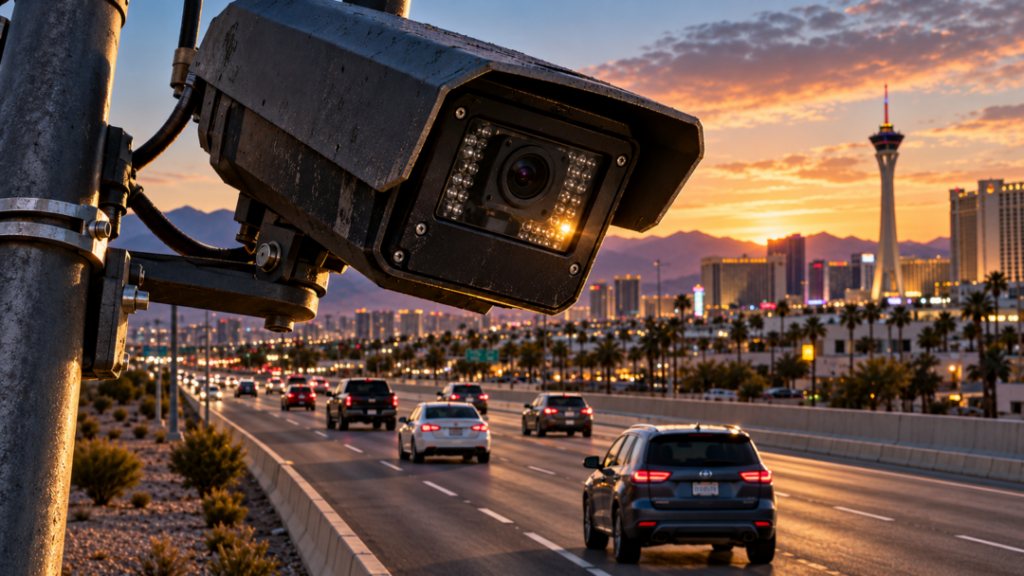
A recent video titled I Built My Own Flock Camera. Then Police Came to My Door raises an unsettling question:
If privately recording vehicles on public roads is suspicious enough to trigger police attention, why should corporations and government agencies be permitted to conduct the same surveillance on a massive scale?
The video follows a technology creator who constructed a camera capable of performing many of the same basic functions as a Flock Safety automated license-plate reader.
By combining an ordinary camera with readily available software, he demonstrated how vehicles could be identified and their movements recorded.
His experiment reportedly attracted police attention after he used the system to document police vehicles.
The important lesson is not that all police officers or license-plate readers are inherently bad.
These cameras can help locate stolen vehicles, find missing people and identify suspects connected to serious crimes.
The issue is whether Nevada has established sufficient limits on how information about innocent motorists is collected, searched, shared and retained.
The answer is no.
Nevada currently has no comprehensive state law regulating Flock cameras and similar automated license-plate readers.
State legislators have proposed requirements involving annual reports and independent audits, but those protections have not yet become statewide law.
Meanwhile, the technology has expanded throughout Southern Nevada.
The Las Vegas Metropolitan Police Department entered an agreement with Flock in 2023, and hundreds of cameras are now believed to operate around the Las Vegas Valley.
Some cameras are controlled by law enforcement, while others may be operated by businesses, homeowners’ associations or other private organizations.
These systems do more than photograph license plates.
They can record a vehicle’s color, make, model, location, direction of travel, distinguishing features and the precise time it passed a camera.
When numerous cameras are connected, individual observations can become a searchable history of someone’s movements.
That power creates opportunities for abuse.
A national investigation identified former, suspended or unauthorized law-enforcement personnel who retained access to Flock accounts or used shared credentials. Some allegedly searched the vehicles of spouses or romantic partners.
Weak access controls, inadequate audits and delayed use of multifactor authentication contributed to the problem.
Nevada should not wait for a similar scandal before acting.
Lawmakers should require a warrant for searches intended to reconstruct a person’s movements over an extended period, except in emergencies involving an immediate threat to life.
Every search should require an active case number, the user’s identity and a documented law-enforcement purpose.
Access must be limited to authorized personnel using individual accounts, government email addresses and multifactor authentication.
Agencies should automatically terminate access when an employee leaves, changes assignments or is suspended.
Nevada should also establish short retention periods for data involving vehicles that are not connected to an investigation.
Flock has announced plans to reduce its default retention period and require criminal case numbers, but company policies can change.
Legal protections should not depend on the promises of a private corporation.
Independent audits should be mandatory, with public reports identifying how often databases are searched, how many outside agencies receive access, how frequently incorrect alerts occur and whether disciplinary action resulted from misuse.
Officers must also independently confirm alerts before stopping or detaining drivers.
Reno recently ended its Flock contract, although it approved a different license-plate-reader system with additional privacy conditions. Clark County School District Police also decided not to pursue continued access to the Flock network.
These decisions show that Nevada communities are beginning to demand greater scrutiny.
Nevadans strongly support law enforcement, but supporting the police does not require accepting unlimited government surveillance.
Conservatives, libertarians and civil-rights advocates should agree that innocent people should not be tracked without meaningful safeguards.
Nevada should remain the Silver State – not become the Surveillance State.
Public safety and personal liberty can coexist, but only when government power is transparent, limited and accountable to the people.
The opinions expressed by contributors are their own and do not necessarily represent the views of Nevada News & Views. Digital technology may have been used in the research, writing, or production of this article. Please verify information and consult additional sources as needed.