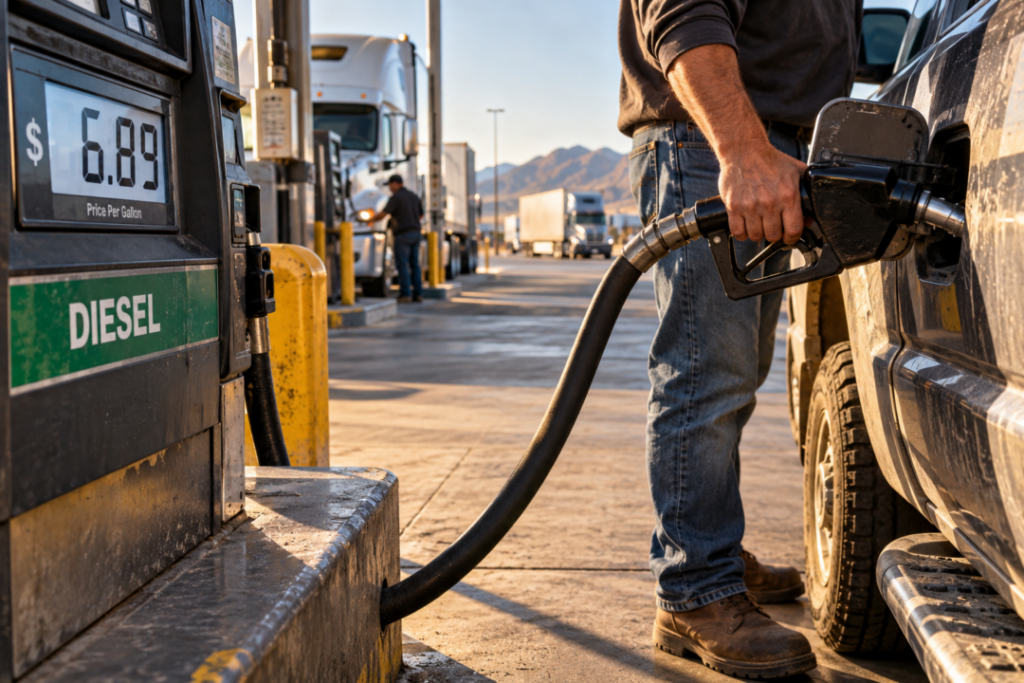
Nevada Families Are Getting Hammered at the Pump. Here’s One Way to Fight Back.
If you drive a diesel pickup, run a small trucking outfit, or own a farm, you already know the number. And it’s ugly.
Diesel has reportedly topped $6 a gallon in parts of the country. Local reports have put it near $7 in some Nevada spots.
That doesn’t just hit truckers. It hits everything a truck delivers.
Which is pretty much everything.
I’ve been fighting high fuel prices here since last December. Now President Trump has handed Nevada a potential new tool for a little temporary relief.
What the President Did
According to the White House, the President signed an executive order on October 5 dealing with “dyed diesel.” Here’s what that is.
Red diesel is the same fuel you put in your truck. The only difference is a red dye.
It’s meant for tractors, generators and construction equipment. And because it’s off-road fuel, it’s sold without road taxes. The dye lets inspectors check your tank.
Using red diesel on the highway is normally against the law.
But under the President’s order, as it’s been reported, the feds will hold off collecting their roughly 24-cent-a-gallon tax on highway use through the end of the year.
The order also reportedly encourages states to take matching steps.
That’s real relief. But it’s only part of the deal.
Nevada’s Half of the Equation
Nevada has its own tax on diesel. It’s in the neighborhood of 27 cents a gallon. And state law still bans red diesel on our highways.
A Washington order doesn’t change a Nevada statute.
So what can Nevada do?
A few states have already moved, mostly to help farmers get the harvest in.
Their approaches vary. Some pause enforcement for certain haulers. Some go further.
Nevada’s governor has emergency powers under state law. And Gov. Lombardo has used them before.
When the CALNEV pipeline went down in 2023, he declared an emergency and stepped in to keep fuel moving.
That’s a governor who understands what high fuel prices do to working families.
Whether a short pause on dyed-diesel enforcement makes sense for Nevada is his call. He’s got the tools, the facts and the experts. I’ll follow his lead.
But if he decides to use them, I’ll be right there behind him.
Where the Legislature Comes In
But this shouldn’t rest on one man’s shoulders.
Emergency powers are meant for emergencies. They’re supposed to be short. And they’re not designed to rewrite tax law.
That’s the Legislature’s job. And we learned this the hard way during COVID.
Gov. Sisolak ran Nevada by emergency order month after month. And he kept extending those orders without a vote of the Legislature.
Many Nevadans – myself included – thought he went way too far and abused his powers.
So in 2021, lawmakers introduced bills to put a time limit on emergency orders. After a set period, the Legislature would have to sign off.
Common sense, right?
But those bills never even got a hearing by the Democrats who controlled the Legislature.
My opponent in the Senate District 8 race, Marilyn Dondero Loop, just sat in Carson City through all of it. I don’t know of a single time she pushed back. Not a peep.
Apparently she’s OK with a “king” – as long as it’s HER king.
Anyway, a diesel pause that ends December 31 is the right way to use emergency powers. It’s short. It’s tied to a real problem. And it has a hard ending date.
That’s the difference between relief and overreach.
Two Candidates, Two Directions
That’s not the only place my opponent and I part ways.
Dondero Loop voted for SB48 in 2019, a diesel tax increase.
Then last year, she voted for AB530, which kept automatic gas tax hikes in Clark County on autopilot.
When fuel costs went up, her answer was to make them go up more.
Mine is the opposite. And it isn’t new.
Last December, I wrote right here at Nevada News & Views that Nevada didn’t need the “Hollywood Handout” that Sen. Dondero Loop supported.
It needed energy independence from California.
Some folks treated that like a talking point. It wasn’t.
In August, I laid out the pipeline projects that could finally loosen California’s grip on our gas tanks.
Fuel from Texas by way of Phoenix. More fuel from Utah.
And just two weeks ago, I put out a six-point plan for fuel security.
It calls for faster permits, a direct pipeline from Phoenix to Las Vegas, a fuel terminal in Wells for Northern Nevada, and more fuel storage here at home.
That includes emergency fuel reserves for police, fire, hospitals and school buses so when the next outage hits, Nevada isn’t running on fumes.
Gov. Lombardo gets it.
He created a Fuel Resiliency Committee to find a way out from under California’s thumb. I’ve cheered that work on from the start.
So here’s my commitment.
When I get to Carson City, I’ll push to cut Nevada’s fuel taxes.
I’ll fight for the pipelines and storage that end our dependence on California.
I’ll support a time limit on emergency orders.
And I’ll work to give the state a clear, legal way to offer quick relief the next time prices spike.
Families shouldn’t have to wait on a crisis declaration to catch a break at the pump.
A Few Honest Caveats
I won’t oversell this red diesel break.
It isn’t sold at your neighborhood gas station. It’s mostly found at farm co-ops, bulk dealers and commercial fuel stops.
The diesel at your regular pump stays the same, taxes and all.
And for now, the federal tax is deferred, not forgiven.
Those are reasons to get the details right. Not reasons to sit on our hands.
They’re also exactly why the lasting fix is cutting the tax on ALL diesel. Not just the red stuff.
Fuel is the cost behind every other cost. Groceries. Construction. School buses. Deliveries.
You want life to be more affordable? It starts with fuel.
The President opened a window. Nevada will decide whether to step through it. Either way, I’ll keep fighting on both fronts.
Tax relief for today. Pipelines and storage for tomorrow.
The opinions expressed by contributors are their own and do not necessarily represent the views of Nevada News & Views. Digital technology may have been used in the research, writing, or production of this article. Please verify information and consult additional sources as needed.