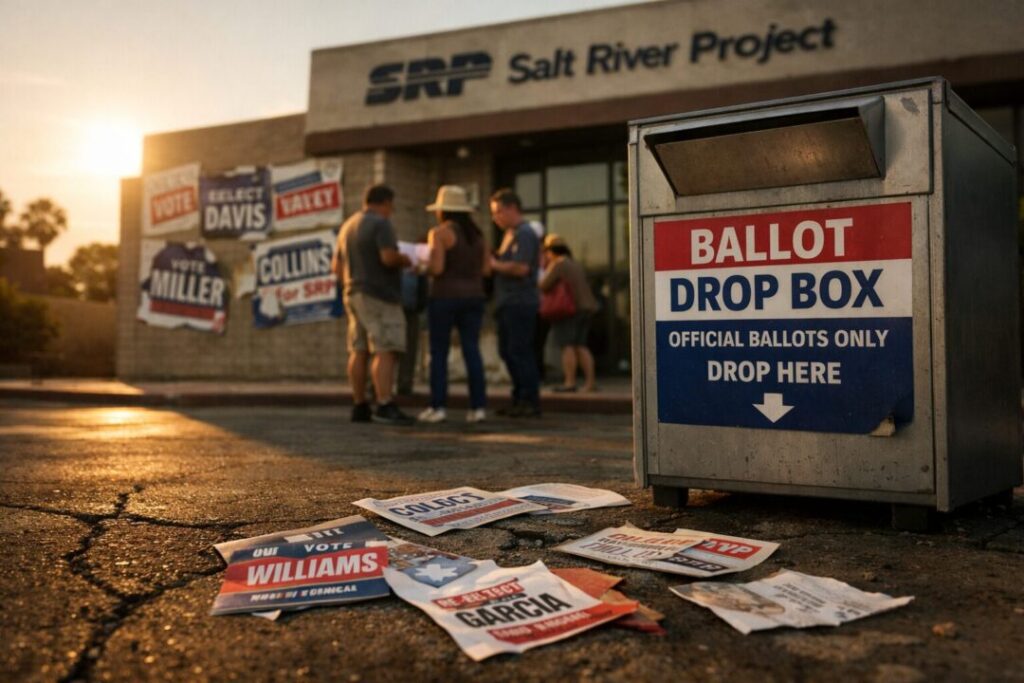
Most voters never think twice about utility board elections. But in Arizona, one small race is suddenly getting a lot of attention.
A group called Turning Point Action is pouring time and energy into a little-known election for the Salt River Project, a public utility that serves about 1.1 million people in the Phoenix area.
The goal isn’t just to win a few seats. It’s to test a strategy they believe could decide much bigger races later this year.
Tyler Bowyer, chief operating officer of Turning Point Action, says this race is about turnout.
In his words, not showing up now would be “catastrophic” for future elections. He sees it as a dry run for November, which he calls the most important election in Arizona history.
That might sound like a lot of hype for a utility board. But there’s more going on here than meets the eye.
The Salt River Project helps manage electricity and water across a large part of the state.
That means decisions about energy policy, including natural gas and renewable energy, can have real impact on families and businesses.
And like many issues today, energy has become political.
Turning Point is backing a slate of candidates tied to a group called Arizonans for Responsible Growth.
That group supports keeping a mix of energy sources, including natural gas, instead of going all-in on renewables.
On the other side, candidates are backed by environmental groups, including one linked to activist Jane Fonda. They want to push faster toward clean energy policies.
So even though it’s a local board election, the bigger debate is clear. It’s about how fast to move away from traditional energy and how much government should steer that decision.
There’s another twist. Not everyone gets to vote. Only landowners can vote in this election. That means many residents who pay utility bills don’t have a say.
It’s a rare system, and it changes how campaigns operate. Instead of mass turnout in cities, campaigns must focus on property owners who carry more weight in the vote.
That setup may benefit conservatives, since landowners tend to lean more right than the general population. But it also makes turnout harder to predict.
Still, one thing is already clear. Interest in the race is surging.
According to Jimmy Lindblom, president of Arizonans for Responsible Growth, about 50,000 ballots had already been submitted before Election Day.
That’s a huge jump from past elections, which drew around 16,000 total votes.
In other words, this once-ignored election is now a real contest.
Even Lindblom admits that Turning Point’s involvement has been a mixed bag.
It helped boost awareness, but it also energized opposition on the left. That’s often how politics works. One side mobilizes, and the other side responds.
From a conservative viewpoint, this is exactly the kind of grassroots fight that matters. Instead of waiting for high-profile races, activists are building momentum from the ground up.
That idea should sound familiar here in Nevada.
We’ve seen how low-turnout elections can shape big outcomes.
Local boards, commissions, and even utility decisions can affect everything from energy costs to water policy. Yet most voters ignore them.
Groups that show up early and stay engaged often win. It’s that simple.
Critics say focusing on a small election like this is a distraction. They argue energy policy should be handled at higher levels, not by a limited group of voters in a niche race.
But supporters see it differently. They believe every level of government matters. And if you can turn out voters in a tough, low-profile race, you can do it anywhere.
That’s the real story here.
This isn’t just about a utility board in Phoenix. It’s about building a machine. One that identifies voters, gets them to the polls, and keeps them engaged.
If it works, don’t be surprised to see the same playbook used in states like Nevada, where turnout and organization often decide elections long before the headlines catch up.
The opinions expressed by contributors are their own and do not necessarily represent the views of Nevada News & Views. Digital technology was used in the research, writing, and production of this article. Please verify information and consult additional sources as needed.