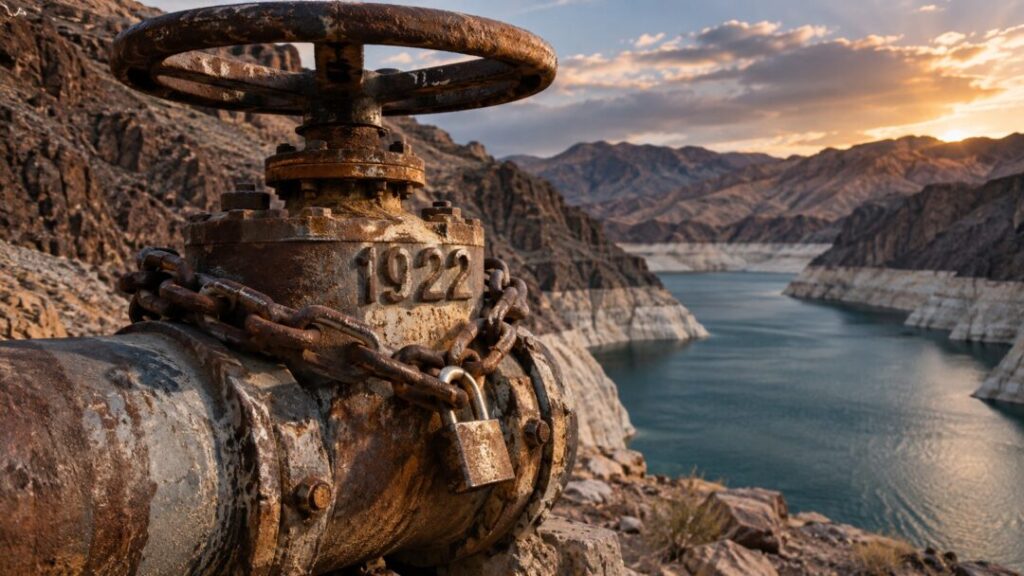
(McKenli Williams) – On November 24, 1922, Secretary of Commerce Herbert Hoover gathered seven men from seven western states in an old adobe building in New Mexico.
After months of frustrating negotiations, they struck a deal to divide the Colorado River.
The Colorado River Compact was born of good intentions, but 104 years later, it has outlived the West it was written for.
The mandates that enforce it are failing a river now categorized as endangered.
When the states and federal government had a chance to try something new earlier this year, they chose more mandatory cuts – because if one century of top-down management hasn’t worked, another one might, of course.
Before the compact, the Colorado River was governed by prior appropriation, the western rule of first in time, first in right.
California was growing so fast that its neighbors feared it would claim every water right before their smaller populations could.
The solution was an interstate compact written by a commission Hoover chaired.
The compact splits the states into an Upper Basin (Wyoming, Colorado, Utah and New Mexico) and a Lower Basin (Nevada, Arizona and California) with each basin entitled to 7.5 million acre-feet (MAF).
An acre-foot is the water needed to cover an acre, roughly a football field, one foot deep.
The compact doesn’t divide the water among individual states, so they negotiated their own shares.
In the Lower Basin, California got 4.4 MAF, Arizona 2.8 MAF and Nevada just 300,000 acre-feet.
In the Upper Basin, shares are percentages of the river: Colorado receives 51.75%, Utah 23%, Wyoming 14% and New Mexico 11.25%.
Overall, Nevada receives a mere 1.8% of the entire Colorado River.
The problem lies not with the river, but how the compact was written.
The commission relied on data from unusually wet years, assuming that 18 MAF flowed annually.
However, over the past two decades, the inflow has been closer to 13 MAF.
Although Hoover called the compact the settlement to 25 years of disputes, a century later, the fighting hasn’t stopped. There is just less water to fight over.
The reason is that the compact was not built to adapt. It forces everyone to fit inside 1922 allocations.
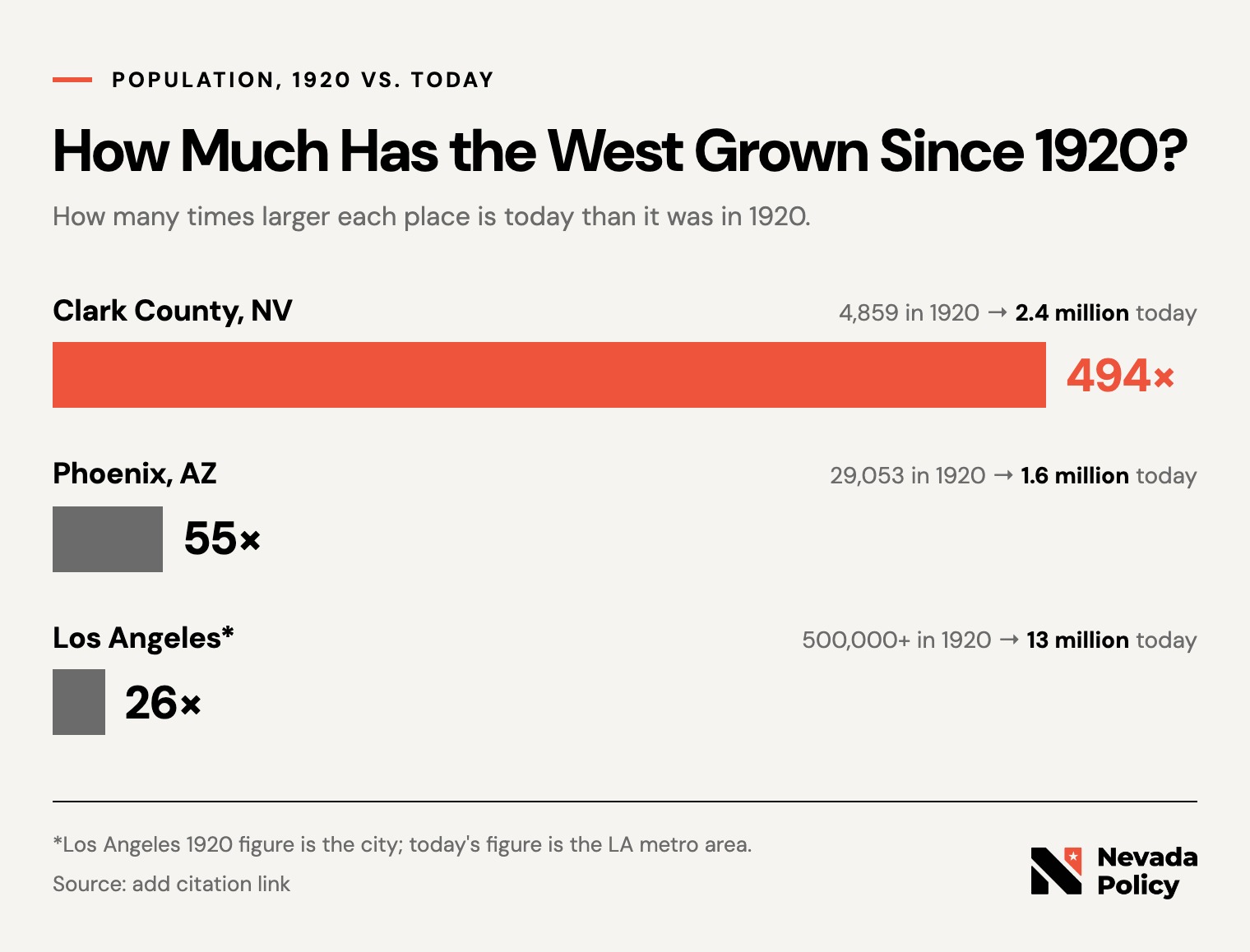
Consider how much the west has changed.
In 1920, Phoenix had 29,053 people, today it has 1.6 million.
Clark County, NV had 4,859 residents and now has 2.4 million.
Los Angeles was already booming in 1920, with over 500,000 people, but the LA metro area has grown to 13 million people.
Yet the water allocated to each state hasn’t changed.
Industry followed the population. Agriculture came to the arid southwest.
It uses three times as much water as all the region’s cities and industries combined.
Alfalfa, one of the thirstiest crops in America, consumes a third of the Colorado River’s flow.
A field of cattle feed in the desert draws from the same fixed pool as a growing city, and nothing in the compact’s design weighs one against the other.
Some cities have done their part.
Phoenix uses less water today than it did several decades ago, despite rapid growth. Las Vegas has mandated that lawns be ripped out to stay within its allocation.
California tells a different story.
Farmers in the Imperial Valley are entitled to 3.1 MAF per year.
In 2022, farmers from one family used 260,000 acre-feet, more than the entire Las Vegas metro area.
While an area of two million people banned lawns and recycled 99% of its water, the same system let one family outweigh the saving of an entire region.
Under the current system, conservation is a mandate, not a reward.
That’s because Washington holds a de facto monopoly over the river with the authority to decide who gets what.
In a 1963 Supreme Court case Justice Douglas warned that the government had unprecedented “power and command” over water in the west.
When the government gets to control who gets the water and how much, instead of solving the shortage it disincentivizes real conservation.
Las Vegas is the prime example.
It returns nearly all of its indoor water to Lake Mead and consistently uses less than its share, yet it still faces cuts.
Instead of continuing with government control, which hasn’t accomplished much in the 104 years since the 1922 compact, we should consider letting water be traded and priced through a market.
If a farmer in Yuma, Arizona, fallows an alfalfa field and sells part of his water to a neighboring city, he profits and the city gets the supply it needs.
Markets send water to its highest and best use, while rewarding people who conserve.
Honest pricing is the other benefit.
When water is artificially cheap, there’s no reason to conserve it.
A recent study found that nearly a quarter of the agricultural water diverted from the Colorado River in three states is provided free by the Bureau of Reclamation.
Municipal districts pay an average of $512 per acre-foot, compared with just $30 for agricultural districts.
Critics of water markets say water is too vital to trade, or that cities will drain farming communities.
But the river is already allocated without anyone’s consent, through mandates and priorities set in the early 1900s.
A voluntary lease at least lets farmers, cities, and residents choose, and transparent trading rules can address the legitimate concerns without dismissing the idea.
The next century of the Colorado River shouldn’t be decided by seven men negotiating a federal mandate, but rather by the millions who depend on it every day.
This article was originally published via NevadaPolicy.org on 11/23/2026. The opinions expressed by contributors are their own and do not necessarily represent the views of Nevada News & Views. Digital technology may have been used in the research, writing, or production of this article. Please verify information and consult additional sources as needed.