(Iris Stone and Dan Burdish) – It all started when the Help America Vote Act was passed in 2002 followed in 2004 by the creation of the Help America Vote Verification system.
Nevada is one of the worst states when it comes to verifying people without driver’s licenses who apply to register to vote.
The information that the public can view is not transparent. We just know how many monthly transactions are processed for each state that participates in this verification process. And we know how big the problem is for each state.
Background of HAVA
When the Help America Vote Act of 2002 (HAVA) federal law was passed, it made significant changes to the voting standards required of the states. Highlights of HAVA are:
- It eliminated punch-card and lever-based systems
- It created the Election Assistance Commission (EAC) to assist with federal elections
- It established minimum election administration standards including election procedures, voting machines, registration processes, and poll worker training
- Required States to develop a single, uniform, official, centralized, interactive statewide voter registration list
- Required proof of identity for first time voting after registering by mail
- Required use of provisional ballots
- Required all voting systems to be auditable and produce a permanent manual paper audit capacity
Background of HAVV
In August 2004, the Social Security Administration (SSA) developed a new verification process known as the Help America Vote Verification (HAVV) system to comply with the requirements of HAVA.
States are required to verify the driver’s license number against the federal Motor Vehicle Administration’s (MVA) database. When there is a match, there is no further issue. The individual remains registered to vote.
However, when an applicant for voter registration does not have a driver’s license, the state may request a 4-digit Social Security Number (SSN) verification through HAVV.
Specifically, the state submits 1) the last four digits of the SSN, 1) name, 3) and date of birth to the MVA for verification with Social Security Administration (SSA). In addition, SSA is required to report whether its records indicate that the person is deceased.
Next the HAVV system provides a set of responses concerning the submitted data.
If there is a match, then there is no problem, the person is legitimately registered.
When there is no match, HAVV provides feedback on why there is no match.
Here is where the concern comes in.
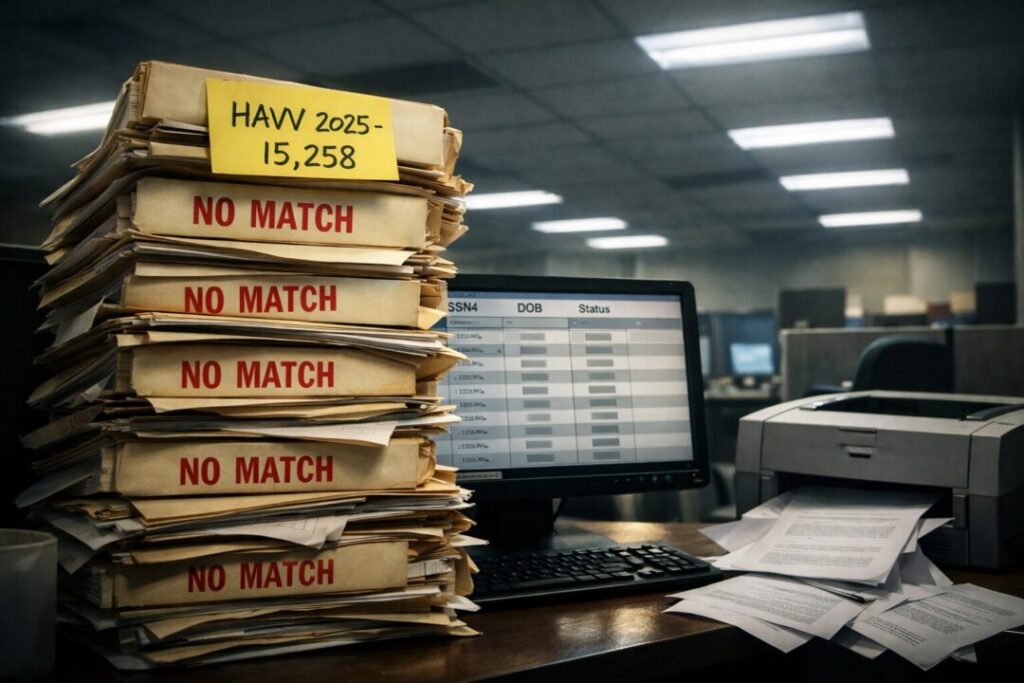
In 2025, Nevada submitted 17,856 cases where a registrant had no driver’s license. Of those, 15,258 were “no match” records. That’s 85%.
In other words for 15,528 individuals in Nevada were registered to vote even though they had no matches in the Social Security database. Nevada’s Secretary of State does not report what he does with the registrants that do not obtain a match. Are they verified? Are they currently registered? No one seems to know the answers.
Forty-Five states participate in the HAVV verification process. Nevada consistently ranks as one of the worst “no-match” states. For example, in 2025 and 2024 Nevada ranked second worst after Maryland.
Here are the last several years’ submissions. We compare total submissions to how many were returned as “no-match”:
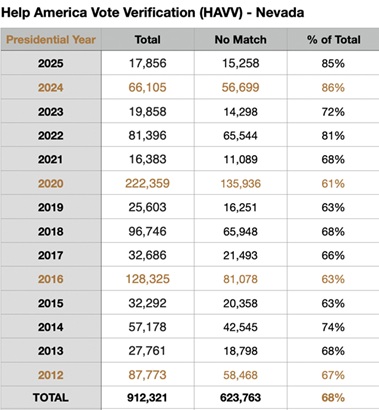
Clearly those volumes and percentages are concerning.
Solution? The SAVE system to the rescue
1) We understand there must be privacy for the person whose registration is being verified, but nothing prevents election officials from listing the number of No-Match records that were removed from the voter list.
We need more transparency.
Our request is simple: Please provide proof that “no-match” records are either resolved positively or removed from the voter registration list.
Allow confidential review by outside auditors to review the data and certify its accuracy.
2) Better yet. In 2025, significant functionality was added for state and county election officials to use the SAVE system at no cost to the states … not to be confused with the Save-Act-now-renamed-the-Save-America-Act that is currently under review in the Senate.
The U.S. Citizenship and Immigration Services (USCIS) created the SAVE system which provides point in time immigration status and U.S. citizenship information to federal, state, local, territorial, and tribal agencies.
Approximately 1,200 agencies nationwide use SAVE (for years) to support their benefit eligibility and licensing determinations. It has been expanded to allow state and county election officials to use it.
Nevada should start using this capability since it provides more thorough verification for eligible voter status.
For example, HAVV does not verify proof of citizenship. SAVE does.
Why isn’t Nevada or its counties using the SAVE system?
Ms. Stone and Mr. Burdish run Citizen Outreach’s “Pigpen Project” to assist election officials in cleaning up Nevada’s voter rolls.