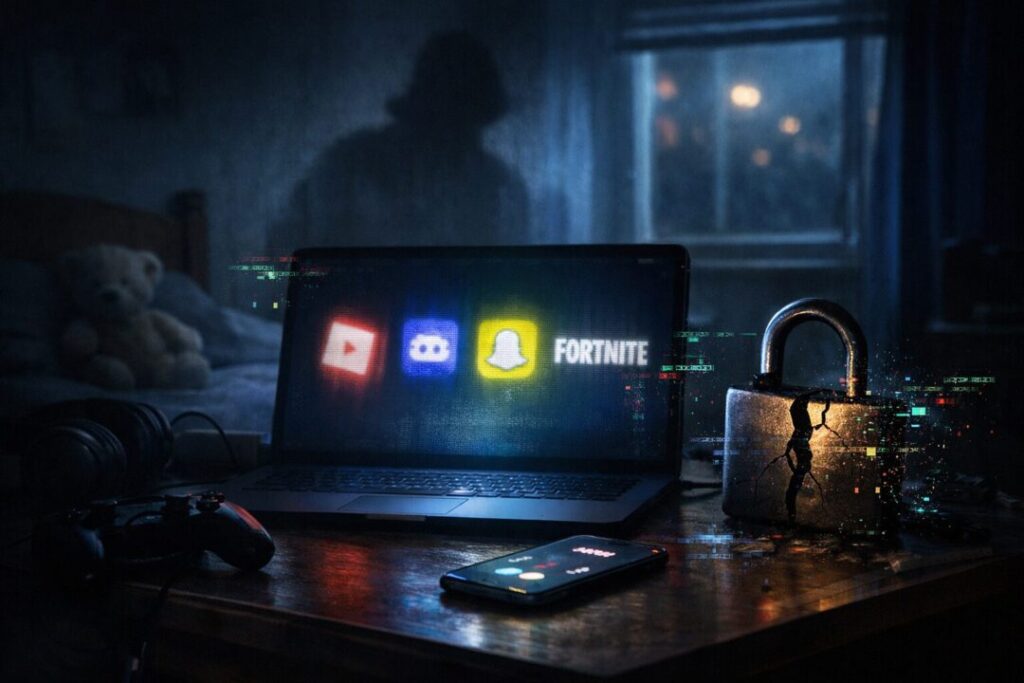
At this point, it should be more than clear to parents that the apps their kids use every day aren't just idle games or chat rooms with school friends.
They're places where adults with bad intentions can find children, build trust, and do real harm.
We all know this isn't a theory. It's happening, and it's happening on platforms families recognize.
A report from News 3 LV highlighted a Florida case where authorities say a man used Snapchat, Fortnite, and Roblox to coerce a child into creating sexually abusive material.
According to Florida Attorney General James Uthmeier, the predator's process was slow and deliberate. Friendly chats. Shared interests. Then came pressure.
That pattern shows up again and again.
Roblox is now facing multiple lawsuits from families who say their children were targeted through in-game chats.
CBS News reported on one case involving a known sex offender who allegedly used Roblox to contact a young boy.
An investigation by Rolling Stone described how predators move easily between games, servers, and chat tools, often blending in as just another player.
Many predators move conversations off games and into private chat apps, like Discord.
Discord is a prime example of how these apps can be weaponized. Here's the timeline so far:
2022–2024:
Child safety groups and law enforcement began reporting a steady rise in cases where adults used Discord to groom minors.
Often, contact started in a game and then shifted to private Discord messages where monitoring is limited.
2024–2025:
Federal investigations uncovered several online exploitation rings that relied on Discord as a main communication tool.
Courts later sentenced offenders for coercing and exploiting minors through private chats.
Late 2025:
Discord began testing age-verification systems in some areas, asking certain users to upload government ID to prove they were adults.
Then came a major setback.
A third-party service handling those ID checks was breached, exposing images of roughly 70,000 government IDs, according to reporting by Ars Technica.
While Discord said its own systems were not hacked, the leaked data included real photos and personal details, raising serious privacy concerns.
Early 2026:
After public backlash, Discord announced global “teen-by-default” safety settings.
The company says teen accounts now have tighter limits on who can message them and what content they can access unless age is verified.
According to Discord, the changes are meant to protect minors. Critics argue they came only after pressure from parents, media, and lawmakers.
What Nevada Parents Should Know
Kids across Nevada are using the same apps as kids everywhere else.
Predators don't care about state lines, and online crimes often cross multiple jurisdictions before police can step in.
These companies make billions of dollars from children’s screen time. With that profit should come responsibility.
It's only fair to expect that they put in the time and funds required to keep them as safe as possible.
At the same time, predators are not loyal to one app. They go wherever kids are. And there's constantly something new and popular with the kids.
The problem isn’t technology itself. It’s access, and how easily predators can hide in massive online spaces.
And here’s the hard truth: government moves slow. The internet moves fast.
By the time a new law is written, debated, and enforced, predators have already adapted.
So we know throwing more regulations at the problem won't necessarily fix it, and we know there's always someone out there looking to easily interact with and abuse our children.
So what do we do?
If you're a parent, you don't need anyone to tell you that protection has to start at home.
Parents staying involved. Checking apps. Having uncomfortable conversations. Teaching kids that strangers online are still strangers.
It also means checking what safety measures already exist that you might not know of. Stronger parental controls. Locked-down privacy settings. Limiting who can message your child. Turning off features kids don’t need.
Just as important, it means pushing back. When companies fail to protect kids, families should leave platforms, demand transparency, and support competitors that take safety more seriously.
Market pressure works faster than bureaucracy ever will.
And tech companies should be stepping up voluntarily.
If they want families to trust their platforms, they should build safety in from day one, not bolt it on after lawsuits and data breaches.
That means real moderation, clear reporting systems, and keeping sensitive data out of risky third-party hands.
For Nevada families, this isn’t about banning games and online activity or living in fear.
It’s about staying alert, staying engaged, and refusing to let billion-dollar companies off the hook while parents do all the heavy lifting.
Technology will keep changing, but one thing never should: protecting the children comes first.
The opinions expressed by contributors are their own and do not necessarily represent the views of Nevada News & Views. Digital technology was used in the research, writing, and production of this article. Please verify information and consult additional sources as needed.