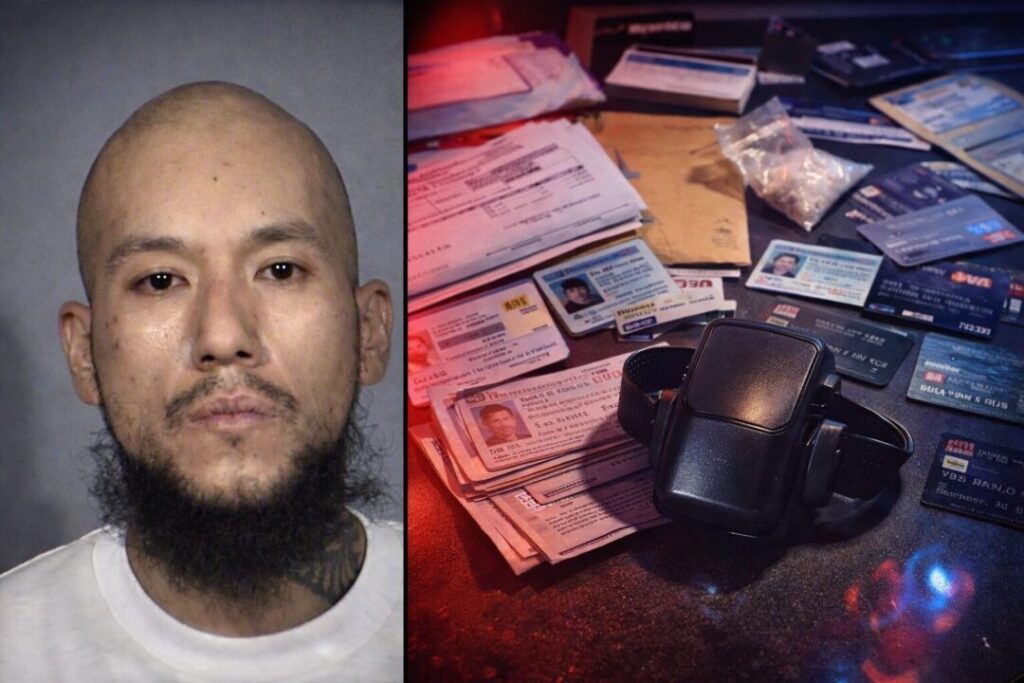
Just days ago, Sheriff Kevin McMahill received national praise for refusing to release a criminal with at least 35 prior arrests.
He ended up out of jail anyway.
Now, that same man is back in custody once again, and this time the charges are even worse.
BREAKING: Las Vegas Metro police just re-arrested a 35-time offender on 27 new charges, weeks after a judge ordered his release to electronic monitoring despite Sheriff Kevin McMahill’s refusal. https://t.co/7ijN8s5aT1
— David Charns (@davidcharns) March 18, 2026
The suspect is Joshua Sanchez-Lopez, a 36-year-old convicted felon with a staggering criminal history.
We’re talking at least 35 prior arrests, including prison time for drugs and involuntary manslaughter.
Earlier this year, he was arrested again. A judge set bail at $25,000 and ordered that he be released on electronic monitoring.
Sheriff McMahill refused.
Why?
Because Sanchez-Lopez had already shown he couldn’t be trusted on that very system.
According to Metro, his past included:
- Repeated failures to appear
- Violations of electronic monitoring
- High-speed chases while fleeing police
- Even pointing a handgun at an officer
Metro concluded releasing him would create an “unreasonable risk to public safety.”
After the standoff, Goodman moved Sanchez-Lopez into the court’s own pretrial release program, which also uses GPS monitoring.
In other words, even though Metro refused, the court found another way to put him back on the street.
And that’s exactly what happened.
Sanchez-Lopez was no longer in jail.
And Now We Know They Were Right
Today, Sanchez-Lopez was re-arrested on 27 new felony charges. This is his 36th arrest.
Twenty-seven new charges. His thirty-sixth arrest.
The new charges reportedly include:
- Mail theft
- Credit and debit card fraud
- Drug possession
- Child abuse
Police say he was found with stolen financial information, fake IDs, and methamphetamine.
“I don’t know how else to bring this to the public’s attention,” Sheriff McMahill. “This is not effective management.”
A System That Keeps Repeating Itself
Why are we giving second, third, and thirty-sixth chances?
Sheriff McMahill has been blunt about the problem. He’s said his department cannot safely supervise certain offenders on electronic monitoring.
And cases like this show why.
You don’t need a law degree to understand it.
If someone keeps breaking the rules, why keep letting them out?
Judges vs. Law Enforcement
Who gets the final say?
Judges, who order release conditions, or law enforcement, who actually have to supervise these individuals?
Metro has taken this fight all the way to the Nevada Supreme Court, arguing that the sheriff has a legal duty to protect public safety and should not be forced to release dangerous offenders.
The public defender’s office disagrees, arguing that judges have the authority to decide who gets released.
That legal fight is now sitting with the Nevada Supreme Court.
But while lawyers argue, reality keeps moving.
Enough Is Enough
A repeat offender made it back onto the streets despite clear and direct warning from law enforcement that he posed a threat.
Now he’s back in custody with 27 new charges.
How many chances is too many?
And more importantly…
Who’s going to be held accountable when the system gets it wrong?
The opinions expressed by contributors are their own and do not necessarily represent the views of Nevada News & Views. Digital technology was used in the research, writing, and production of this article. Please verify information and consult additional sources as needed.