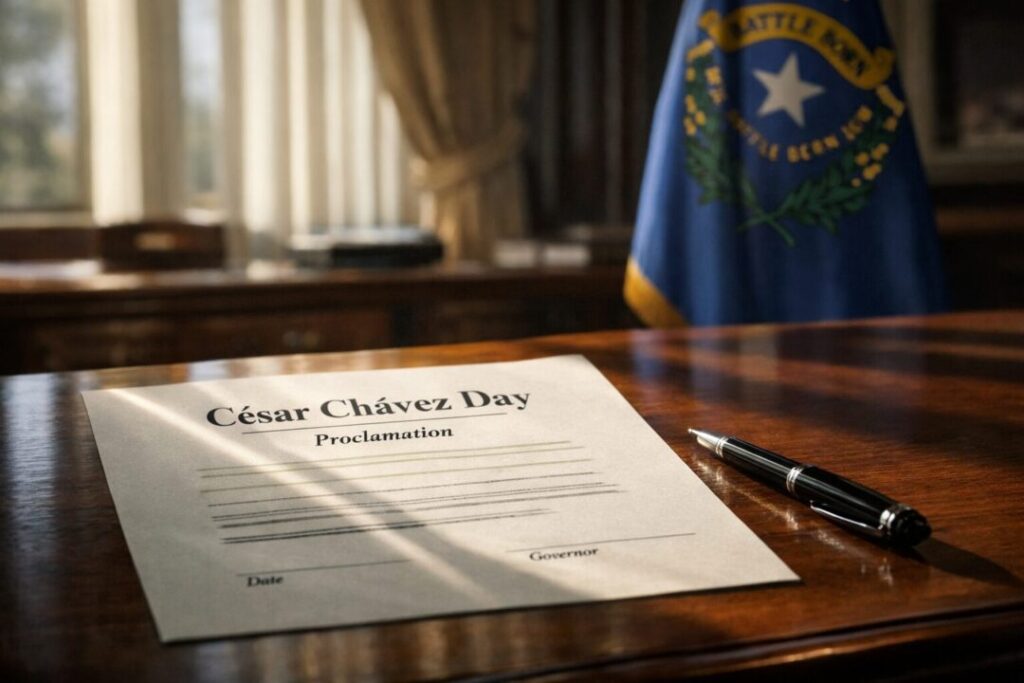
It’s not every day a governor refuses to sign a long-standing state proclamation. But that’s exactly what happened this week in Nevada.
Governor Joe Lombardo announced he will not sign the annual César Chávez Day proclamation after serious new allegations surfaced about the late labor leader.
For years, Chávez has been honored as a symbol of farmworker rights. His birthday, March 31, is recognized across the country. But now, that legacy is under new scrutiny.
Earlier this month, longtime labor activist Dolores Huerta said she was one of several women and girls who were sexually abused by Chávez.
Huerta worked closely with him for decades and said she stayed silent for 60 years because she feared speaking out would harm the farmworker movement.
“I carried this secret for as long as I did because building the movement and securing farmworker rights was life’s work,” Huerta said in a public statement.
Those claims have sent shockwaves through groups that once celebrated Chávez without question.
Across the country, some events marking César Chávez Day have already been canceled. Here in Nevada, Lombardo made it clear where he stands.
In a statement, the governor said that as someone who spent a career in law enforcement, he understands how painful it can be for victims to see public honors given to someone accused of abuse.
He added that the state legislature now has a responsibility to review whether César Chávez Day should remain in Nevada law.
That decision reflects a broader principle that’s getting more attention lately.
Public honors matter. They send a message about what a community values and who it chooses to elevate.
And when serious allegations come to light, especially involving abuse, many voters expect leaders to take a step back and reassess.
That’s where the debate gets tricky.
Some argue that removing or questioning a holiday tied to Chávez risks erasing an important part of labor history, especially for Latino communities.
Others say honoring someone accused of serious wrongdoing sends the wrong signal, especially to victims.
For many, the issue comes down to accountability.
You can acknowledge what someone did without putting them on a pedestal. A state holiday is not just a history lesson. It’s an endorsement.
And in a time when voters are already skeptical of government priorities, decisions like this carry weight. People want to know their leaders are paying attention, not just going through the motions.
Nevada has dealt with its share of tough calls before, whether it’s budget decisions, public safety, or education policy.
This one touches on culture and values, which can be even more personal.
Lombardo’s decision doesn’t erase Chávez from history. But it does signal that honoring someone at the state level is not automatic. It’s something that has to be earned and, when necessary, reconsidered.
Now the question shifts to lawmakers in Carson City. Will they keep César Chávez Day on the books, or will they take a closer look at what that recognition means today?
The opinions expressed by contributors are their own and do not necessarily represent the views of Nevada News & Views. Digital technology was used in the research, writing, and production of this article. Please verify information and consult additional sources as needed.