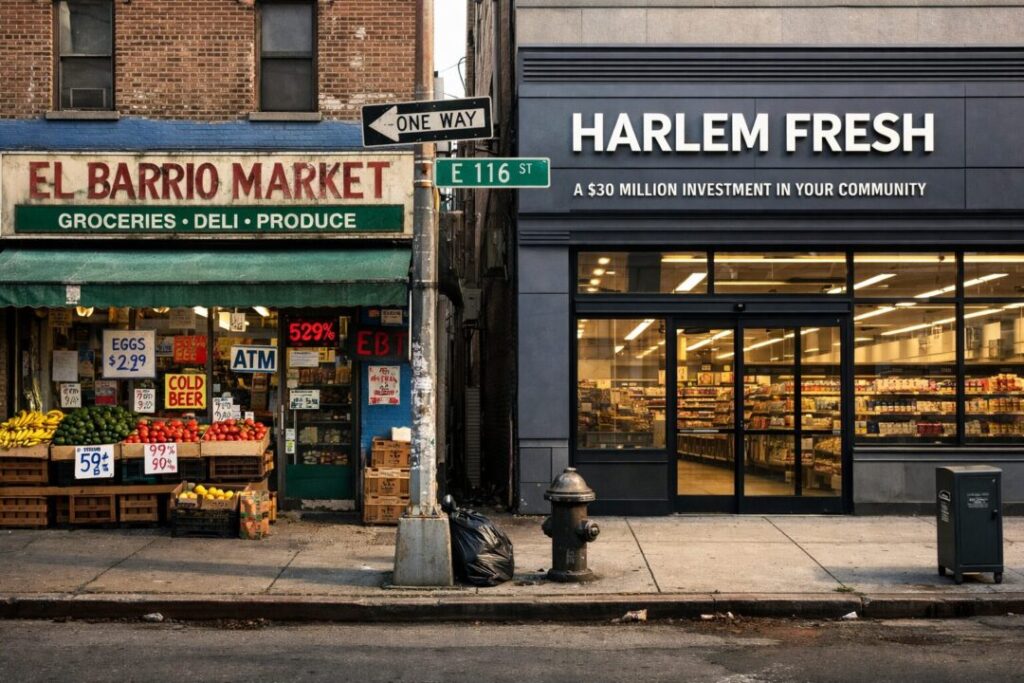
New York City leaders say they want to make groceries cheaper. Most people can get behind that; everyone feels the pinch at the checkout line these days.
But the way Mayor Zohran Mamdani plans to do it is raising a lot of red flags.
He wants to build a government-backed grocery store in East Harlem. The price tag? About $30 million in taxpayer money.
Mayor Zohran Mamdani that the first city-owned grocery store – which carries a whopping $30 million expected price tag – won’t open until 2029. https://t.co/JbqTCnyE1X pic.twitter.com/EFwYLtKCJS
— New York Post (@nypost) April 14, 2026
The store would sit on city-owned land and pay no rent and no property taxes. It would also be run with union labor.
A Costly Experiment
The theory is to use public money to build a grocery store, then subsidize it so prices can be lower.
That means the city would be competing directly with small, local grocery stores.
The difference is that those small stores pay taxes, rent, and all the usual costs of doing business.
The city-run store would not.
Is it really fair to use taxpayer money to undercut the same businesses that keep neighborhoods running?
Even New York City Council Speaker Julie Menin has said she is concerned about the impact on local stores.
There is also the issue of cost. Thirty million dollars is a lot of money for one store.
And there is no guarantee it will actually bring prices down long term without more subsidies.
What Actually Works
East Harlem has struggled for years with access to affordable groceries. Smaller stores often have higher prices because they can't buy in bulk like large chains.
But we already have examples of solutions that work.
Discount chains like Aldi have moved into the area and offer lower prices without taxpayer support. Their business model focuses on efficiency, fewer brand options, and lower overhead.
That's how a real business keeps prices down.
Not with subsidies, but through competition.
A Nevada Perspective
Here in Las Vegas, we have seen how government spending decisions can either help or hurt small businesses. Tax policy, zoning rules, or subsidies, the same principle applies.
When government picks winners and losers, it often distorts the market.
Think about a local grocery store owner in East Harlem. They pay rent, cover payroll, and try to keep prices low.
Then the government opens a competing store next door that doesn't face any of those roadblocks.
That's not a level playing field.
Nevada has generally taken a different approach. Lower taxes and fewer barriers have helped attract businesses instead of replacing them.
Better Options on the Table
Critics of the plan say there are smarter ways to spend that $30 million.
For example, the city could help existing stores upgrade their equipment. That could lower costs and improve food quality.
That works with the market instead of against it.
Good Intentions, Risky Results
This debate is really about how far government should go in trying to control prices and shape the economy.
Supporters say the plan helps working families. Critics say it risks wasting money and hurting the very businesses that serve those families every day.
Good intentions aren't enough.
What matters is whether the policy actually works without creating bigger problems down the road.
The opinions expressed by contributors are their own and do not necessarily represent the views of Nevada News & Views. Digital technology was used in the research, writing, and production of this article. Please verify information and consult additional sources as needed.