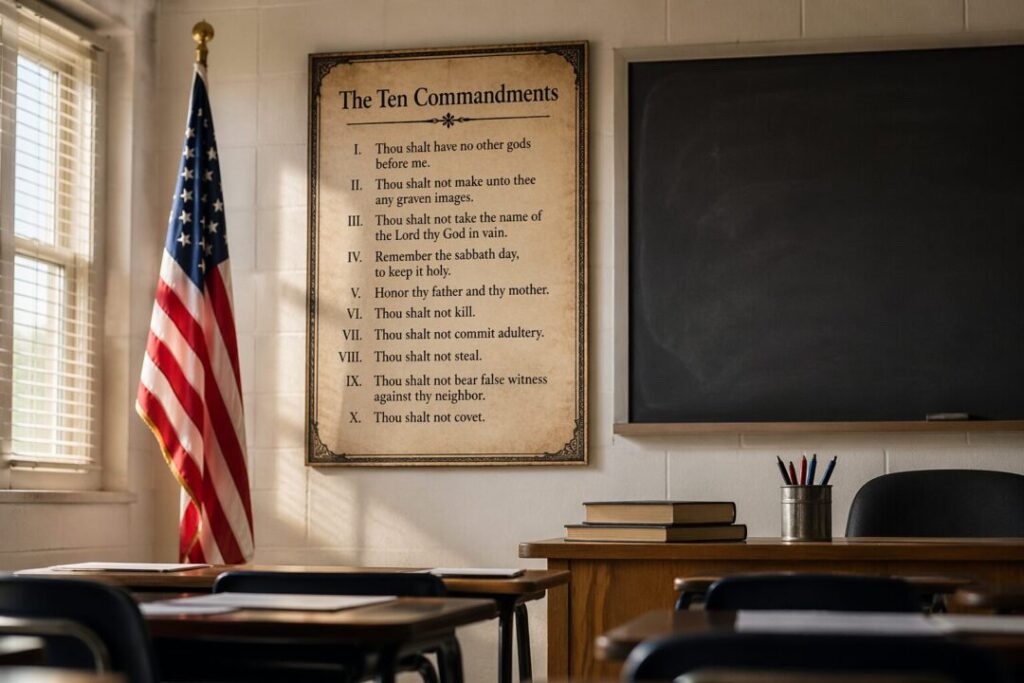
For decades, Americans have been told that faith has no place in the public square, especially in our schools.
But a growing legal battle over the Ten Commandments is challenging that assumption, and it may soon reach the highest court in the nation.
At the center of this issue are new state laws, particularly in states like Texas, Louisiana, and Arkansas, that require the Ten Commandments to be displayed in public school classrooms.
Supporters argue this is not about imposing religion on students, but about restoring historical context and moral foundations that have long influenced American law and civic life.
Critics, however, claim it violates the Constitution’s Establishment Clause.
Recently, a federal appeals court allowed Texas to move forward with its law, marking a significant turning point and setting the stage for what could become a landmark Supreme Court case.
To understand why this matters, it’s important to remember the legal history behind it. In 1980, the U.S. Supreme Court struck down a similar Kentucky law, ruling that posting the Ten Commandments in classrooms did not serve a clear secular purpose. That decision became a cornerstone of how courts interpreted separation of church and state in public education for decades.
But that legal framework is now being re-examined.
In recent years, the Supreme Court has shifted toward a more historical interpretation of the Constitution, particularly when it comes to religious expression. Rather than strictly limiting religious references in public spaces, the Court has increasingly considered whether such expressions align with the nation’s historical traditions. That shift is now reshaping how lower courts evaluate cases like this one.
Supporters of the laws argue that the Ten Commandments are not being presented as religious instruction, but as historical context.
They point out that many foundational principles in American law, such as prohibitions against theft, perjury, and murder, trace back to moral codes that include the Ten Commandments.
In their view, acknowledging this history is no different than teaching the philosophical roots of democracy or the Constitution.
Critics argue that public schools must remain strictly neutral and that displaying religious texts risks alienating students from different faith backgrounds.
They believe schools should avoid any appearance of endorsing religion.
However, that argument is increasingly being questioned in states across the country.
Nevada, for example, finds itself watching this debate closely. While Nevada has not passed a statewide mandate requiring the Ten Commandments in classrooms, it reflects the broader cultural and legal tension playing out nationwide.
As a diverse and rapidly growing state with strong debates over education standards, school governance, and parental rights, Nevada could quickly become part of the national conversation if the Supreme Court takes up the issue.
Local school districts across the state would likely face pressure from both sides, those advocating for historical displays and those insisting on strict secular policies in classrooms.
This is not just a legal debate; it is also a cultural one.
Across the country, parents and communities are increasingly asking what values are being taught in schools and who gets to decide them. For many, the discussion around the Ten Commandments represents a broader concern about the direction of public education.
At its core, the question before the courts is whether acknowledging a historical moral code amounts to unconstitutional religious establishment, or whether it is simply an honest reflection of America’s cultural and legal heritage.
If the Supreme Court agrees to hear the case, the decision could have sweeping implications. A ruling in favor of the states could open the door for greater religious expression in public schools and other government settings.
A ruling against them could reaffirm decades of precedent limiting religious displays in public education.
Either way, the outcome will not be small or symbolic. It will define how far the separation of church and state extends in modern America, and whether states like Nevada and others will have more authority to reflect historical moral teachings in their classrooms.
What is clear is that this issue is far from settled.
And as it moves closer to the Supreme Court, it is forcing the nation to confront a question that has never truly gone away: what place does faith have in the public schools of a free society?
The opinions expressed by contributors are their own and do not necessarily represent the views of Nevada News & Views. Digital technology was used in the research, writing, and production of this article. Please verify information and consult additional sources as needed.