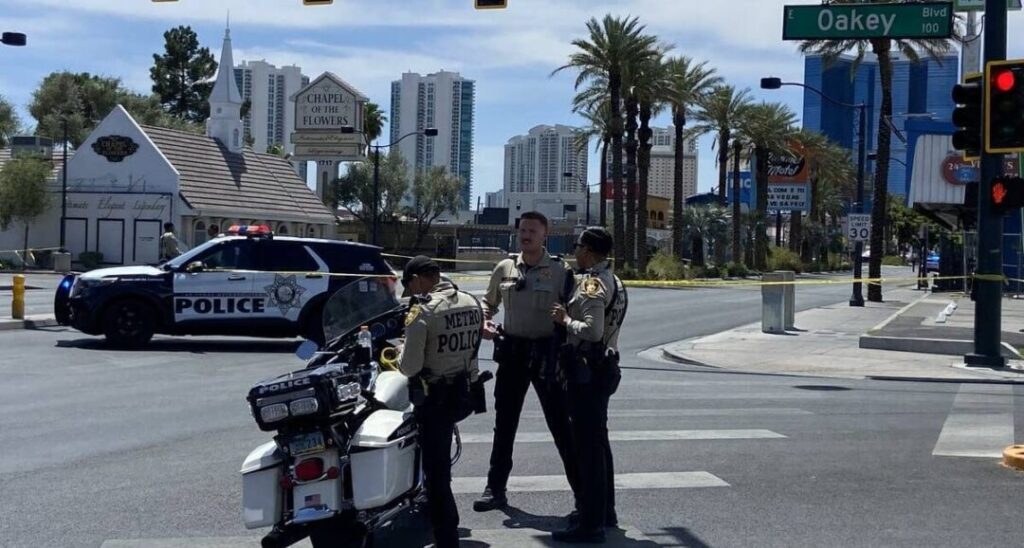
A Judge Approved An Ankle Monitor For A Man Who Shot His Coworker. The Sheriff Said No.
A man walks into his workplace, Atomic Golf, and starts shooting. He yells for a coworker to open a door, then shoots her in the chest when she does. He fires 11 rounds total, reloading along the way, then barricades himself in an office for six hours while SWAT and crisis negotiators try to talk him down. He refuses to cooperate.
Now ask yourself: should that man go home with an ankle bracelet while he awaits trial?

District Court Judge Joe Hardy said yes.
On May 19, 2026, Hardy signed off on releasing Andrew Todd Mullen to “High-Level” electronic monitoring, the program that lets defendants go home with a GPS ankle bracelet instead of staying in jail.
Clark County Sheriff Kevin McMahill said absolutely not and refused to put Mullen in the program.
It Wasn't Always This Loose
Here's what makes this even harder to swallow. Back on April 21, a Justice Court judge, Diana Sullivan, took this case seriously.
Mullen's attorney asked her to lower his $150,000 bail, arguing Mullen suffers from PTSD after his military service and needs treatment instead of jail. Sullivan said no. She noted those factors were already part of the arrest report and didn't change her view that Mullen remained “a potential danger to the community.”
Bail stayed at $150,000, with high-level electronic monitoring and a stay-away order from Atomic Golf if he posted bond.
So a Justice Court judge looked at this case and treated it like the serious threat it was. Somewhere between then and May 19, the case moved to Judge Hardy's courtroom, and Hardy dropped Mullen's bail all the way down to zero dollars, while keeping the same ankle monitor condition.
Dropping bail to nothing essentially clears the path for release. That's when Hardy approved Mullen for the EMP program.
The Sheriff's Case
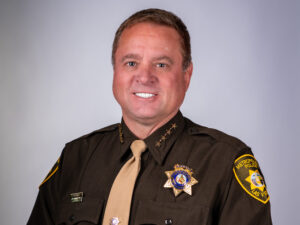 McMahill's team reviewed Mullen's background, as Nevada law requires.
In a letter to Judge Hardy obtained by Nevada News & Views, the sheriff's office wrote that Mullen “showed complete disregard to public safety” during the Atomic Golf incident, detailing how he isolated his target before opening fire and then barricaded himself for roughly six hours while refusing to negotiate.
The letter goes on to say LVMPD's investigation found Mullen:
“was ready to use deadly force against officers who would enter that door to conduct a lawful arrest.”
On top of that, Mullen had an active failure-to-appear warrant out of Nye County.
Based on all those factors, McMahill concluded that putting Mullen on an ankle monitor:
“poses an unreasonable risk to public safety.”
Under Nevada law, NRS 211.250 and 211.300, that means Mullen doesn't qualify, full stop. The sheriff doesn't need anyone's permission to make that call; the law requires him to make it.
Then The Judge Pushed Back
Instead of accepting that authority and legal basis, Judge Hardy's court issued an Order to Show Cause on May 28, demanding that LVMPD explain why Mullen was still sitting in jail.
This is the same playbook conservatives have already seen with Judge Eric Goodman and the Sanchez-Lopez case: a judge orders a dangerous person released, the sheriff refuses on safety grounds, and the judge tries to force the issue with the threat of contempt.
In that case, the judge found a workaround to release Sanchez-Lopez anyway, and he went on to be arrested a 36th time on 27 new felony charges, proving McMahill's risk assessment right.
Read our prior coverage:
- Sheriff McMahill Draws National Praise for Refusing to Put Repeat Offender Back on the Street
- Governor Lombardo Backs Sheriff McMahill in Court Standoff, and It’s Personal
- Repeat Offender Back in Jail: 27 New Charges Follow McMahill’s Refusal to Release
McMahill's lawyers filed a detailed response on June 1, walking through the law step by step.
The bottom line: no court has ever ruled that a sheriff exceeds his authority by refusing to accept someone into his own monitoring program when that person poses an unreasonable risk.
Multiple judges, including Judge Erika Mendoza in a separate case, have already agreed with that reading of the law.
The Result
Next, the court changed course. Hardy's court modified Mullen's release conditions to a different supervision program called PCU Level 4, run through the court system instead of LVMPD.
Mullen still got out of jail, but not through the sheriff's program. Judge Hardy simply maneuvered around Sheriff McMahill because the sheriff wouldn't back down or nulify his own legal authority.
What's Next
The Nevada Supreme Court is still sitting on two big writ petitions that will decide whether sheriffs statewide can keep doing what McMahill did here. Every case like Mullen's adds more weight to that decision.
Nevadans should keep watching the Supreme Court docket and should also keep an eye on which judges keep approving these kinds of releases in the first place.
Writing to state lawmakers ahead of the 2027 legislative session to lock NRS 211.250 and 211.300 firmly in the sheriff's favor would help make sure this kind of judgment call stays with law enforcement.
Because the next time a sheriff flags someone this dangerous, a judge shouldn't get to overrule him and hope for the best.
The opinions expressed by contributors are their own and do not necessarily represent the views of Nevada News & Views. This article was written with the assistance of AI. Please verify information and consult additional sources as needed.