Moratoriums, ballot measures, and angry residents signal a political fight that’s just getting started.
What’s Going On
Nevada is in the middle of a data center gold rush. Tech giants and AI companies are lining up to build massive facilities across the state. These are huge, warehouse-like buildings that store and process the digital information powering everything from your phone to artificial intelligence.
But communities across Nevada are saying: not so fast.
Reno became the first city in Nevada to hit pause, extending a moratorium on new data center approvals through August 2027 — or until the city adopts new regulations, whichever comes first.
Down south, Boulder City’s Planning Commission voted to reject a proposed AI data center after more than three hours of public opposition. Boulder City voters will also get a say on the November 2026 ballot on whether to prohibit data center construction in the city altogether.
And just this week, the Clark County Commission approved an expansion of Switch’s massive Las Vegas campus — but commissioners made clear they want new rules for future projects.
Henderson is also weighing a 180-day moratorium on new data center permit applications, with the city council set to take it up on July 21.
Why Conservatives Should Pay Attention
Here’s the thing. This isn’t just a green energy debate. This is a property rights, local control, and limited government issue wrapped in a tech industry bow.
On one hand, data centers represent private investment and job creation. Companies like Switch are spending their own money, building on private land, and bringing high-paying jobs. That’s the free market doing what it does.
On the other hand, these facilities put real pressure on shared public resources. Data centers already consume close to a quarter of Nevada’s electricity, according to a 2026 Desert Research Institute study that projects the figure will more than double by 2033. When private companies strain the electric grid or draw down water resources, it becomes everybody’s problem — and often, the bill lands on regular ratepayers.
Google’s Henderson facility consumed at least 205 million gallons of water in 2024 alone, using older cooling technology that has since been banned for new projects. That’s your water.
What People Are Saying
Not everyone is against data centers. Supporters point to the economic benefits. The Boulder City developer said the facility would employ up to 40 full-time workers with salaries exceeding $100,000 and generate millions in revenue for the city.
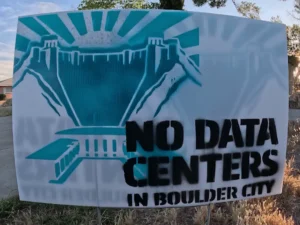
But residents aren’t buying the sales pitch. Boulder City resident Brynn deLorimier started an online petition that collected over 6,200 signatures. She and her neighbors see this as a question of what kind of community they want to be.
“This is one of the hottest topics in the country… This town is not ready, it is not,” said Lorene Krumm, chair of the Boulder City Planning Commission.
Clark County Commissioner James Gibson put it plainly:
“They consume water, and they tie up the production capacity of the energy supplier in the valley, which creates a hardship on all of the rest of us and the way that we develop.”
A May 2026 Gallup poll found that seven out of ten Americans oppose building data centers in their local area — more than the 53% who opposed nuclear power plants in the same survey. That’s not a fringe position. That’s a supermajority.
The Bigger Picture
This is an emerging political frontier. States and cities across the country are wrestling with the same question Nevada is: Who sets the rules when a billion-dollar industry wants to move into your backyard?
South Dakota passed a law allowing local governments to regulate or ban data centers. Ohio voters may decide on a statewide initiative to ban data centers requiring 25 megawatts or more of power. The regulatory patchwork is growing fast.
Back home, the Nevada Legislature meets again in 2027. That session could bring statewide data center regulations — for better or worse. The question is whether those rules will protect taxpayers and communities, or simply rubber-stamp whatever the tech industry wants.
Its Already a Campaign Issue
This isn’t just a zoning fight anymore. It’s showing up on the campaign trail — and in the voting booth.
Clark County’s only Republican commissioner, April Becker, voted with the unanimous board this week to approve Switch’s southwest Las Vegas expansion. But she drew a clear line between a responsible operator and the broader concern.
“I think this is an example of where we can look at what they’re doing right,” Becker said. “And I think it should be utilized throughout the country as an example.”
That’s not a blank check for the industry. It’s a case-by-case judgment — exactly the kind of common-sense conservatism voters expect from their elected officials.
Meanwhile, during the Democratic primary for NV-02, candidates were already making data centers a campaign issue. Teresa Benitez-Thompson, the former Assembly Majority Leader, who ultimately became the Democratic nominee, has been talking about it at nearly every stop.
“We need to call a timeout on data centers and stop and look at the policies that have enabled — especially within the past couple of years — these data centers to mushroom up under our noses overnight,” Benitez-Thompson said.
“The concerns that we hear about the use of water and the use of vital resources in Nevada are very important.”
 Morgan Wadsworth, a 27-year-old UNR student and sixth-generation Nevadan who also ran for the seat, was even more blunt.
“They’re not bringing jobs, period. We don’t have the infrastructure to support them, or the resources. It’s extremely irresponsible to allow these data centers to come here en masse the way they are and give away our public lands to become a corporate playground and a dumping ground for tech billionaires.”
The issue cuts across party lines. Boulder City — one of the most conservative communities in Southern Nevada — has been one of the loudest voices pushing back.
What You Can Do
If you care about local control and protecting taxpayer-funded resources, now is the time to get involved. Show up to city council meetings. Contact your county commissioners. If you live in Boulder City, pay attention to the November ballot question.
The tech industry has lobbyists. Your neighborhood has you.
This issue isn’t going away. It has every sign of becoming a defining issue in the NV-02 congressional general election this fall — and potentially in the governor’s race as well. Voters across Nevada are already asking hard questions about water, power, and who gets to decide what gets built in their backyard.
And when the Nevada Legislature convenes in 2027, expect data centers to be front and center. The patchwork of local moratoriums and county-by-county decisions is already creating pressure for a statewide framework. Lawmakers will have no choice but to address it.
The rules being written right now — or not written — will shape Nevada for decades. This is shaping up to be one of the defining political battles of the next election cycle. Make sure the people making those decisions actually live here.
The opinions expressed by contributors are their own and do not necessarily represent the views of Nevada News & Views. This article was written with the assistance of AI. Please verify information and consult additional sources as needed.