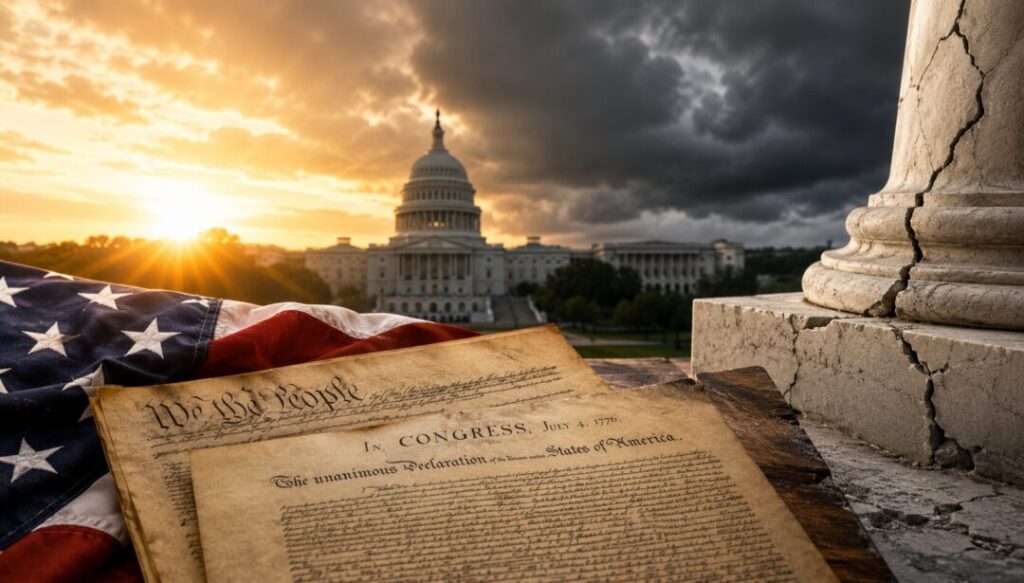
(Shane Harris) – President Donald Trump’s incisive critique of communism and its creeping influence in American politics and culture grabbed most of the headlines from his pair of speeches this weekend – particularly as it contrasted with New York City Mayor Zohran Mamdani’s remarks on July 3.
But the most important moments in Trump’s oratory were those where he articulated how the greatness of America is defined by the greatness of its people. It is only thanks to the individual courage and heroism of generations of patriots that freedom has been preserved.
What the country saw in Mamdani and Trump’s speeches was two conflicting visions about what it means to be an American and what the last 250 years of history represent.
Which vision ultimately wins out will determine what kind of country we become – and whether the America that celebrates 300 years of independence looks anything like the country that celebrated 250 years or the country that was born on July 4, 1776.
To Mamdani, as to the modern left and most of the Democrat Party, the American story is one of victimhood and oppression.
In an angry, spiteful attack on the country that gave him a home and the opportunity to become the elected leader of its largest metropolis, Mamdani derided America as “a nation of contradictions.”
He smeared its builders, innovators, and entrepreneurs – those who create jobs and opportunity for anyone willing to work hard – as cruel and exploitative.
Mamdani cleverly framed his remarks within the language of America’s aspirational creed, but that thin veneer does little to mask the underlying call to all-out Marxist class warfare.
To hear Mamdani tell it, the villains of America’s last 250 years are the landlords, business owners, and anyone guilty of the unforgivable crime of amassing wealth through hard work – what the rest of us know as “the American Dream.”
He delivered this diatribe from behind George Washington’s desk – a visual symbol that, to Mamdani and his ilk, the semiquincentennial is not about celebrating America’s past and the foundations of the country. Rather, it is about ripping down those foundations and replacing them with something entirely new and totally divorced from the founding promise laid out in the Declaration of Independence.
Mamdani hammered home this implicit threat with perhaps the most chilling line in his remarks: “The truth, my friends, is that America is exceptional because here, nothing is fixed into place.”
That statement is a direct repudiation of the Declaration, which affirms that certain rights are “unalienable.”
Yes, the signers were taking the audacious step of declaring a rebellion against the most powerful empire on earth, but they were doing so to build a nation where certain things are indeed fixed into place – among them the right to “life, liberty, and the pursuit of happiness.”
They also were doing so in order to protect and fix into place those uniquely American traditions and institutions that had evolved from more than a century of European influence in this new land.
Mamdani, however, completely dismisses these traditions and institutions.
Addressing “our newest Americans,” Mamdani tells them that they have “the power to determine what America means.”
Consider, for a moment, how truly radical that is: Mamdani is asserting that the newest arrivals in our land have the power and the right to fundamentally alter what it means to be an American.
What he is advocating for is not the classic analogy of the “melting pot,” but the full-scale replacement of American identity with something totally foreign.
But as much as Mamdani tried to stoke the flames of anti-Americanism and sectarianism, he was dramatically undercut and overshadowed by the two-part rhetorical tour de force from President Trump.
Trump’s remarks – on Friday at Mt. Rushmore and on Saturday at the Lincoln Memorial – stand on their own as a brilliant exposition on the significance of 1776, what makes America exceptional, and how we can keep our exceptional identity for the next 250 years. But they also delivered a devastating counterpunch to the ideology that Mamdani and his socialist compatriots are mainstreaming.
Trump did take some time to directly address the rising threat of socialism and communism and how that ideology is totally antithetical to the Declaration and everything good about America.
His line that “you can be a communist or you can be a patriot – you cannot be both” was particularly memorable, and conservatives should embrace that framing.
But the true power of Trump’s speeches was how they worked in concert with one another to articulate what it means to be an American.
Trump’s thesis, outlined on July 3, was that America is great because her people are great – and that greatness is a reflection of the American people’s conception of themselves.
We are a strong nation when we honor our heroes and teach our children to live up to the example set by figures like those memorialized in stone on Mt. Rushmore.
“The triumph of American independence was the result of the most extraordinary people in history, the most extraordinary culture in history, and the most extraordinary ideas in history, all creating the most extraordinary republic ever,” Trump said.
“Tonight, on the threshold of our 250th year, we stand beneath the monument of these heroes, a true group of unbelievable people, and we rededicate ourselves to being a nation as big, bold, noble, and as great as these American giants.”
“Liberty has prevailed here because of the culture and character of the people who declared it, defended it and preserved it,” he continued. “The identity of a nation is the destiny of a nation, and America has a destiny like no other because we are a people like no other.”
This is the direct opposite of what Mamdani’s speech asserts. Mamdani says that America is a nation of victims who are oppressed by “nativists” and anyone with wealth or power. Trump counters that America is a nation of “dreamers and believers, warriors and explorers, doers and fighters.”
The dazzling spectacle on the National Mall on Saturday served as proof of Trump’s thesis.
“Americans must never forget that we are a historic and heroic people, with a historic spirit and heroic purpose on this beautiful earth of ours,” Trump said. “We are made of the courage and the fire and the flesh and the blood of the best and the bravest people this world has ever produced.”
In classic Trump fashion, the President recounted the stories of some of those brave Americans and welcomed living legends who were in attendance – men like Colonel Paris Davis, who received the Medal of Honor for his actions in Vietnam; 104-year-old Ken Schubring, who survived the Japanese attack on Pearl Harbor; 107-year-old Navy Lieutenant Arthur Rose, who took part in the D-Day landings; and Apollo 17 astronaut Jack Schmidt.
In another powerful throughline in the speech, Trump displayed several noteworthy American flags, including the flag that flew victorious over Saratoga in 1777, the first flag to fly over the Brooklyn Bridge, the flag that went down with the Arizona at Pearl Harbor, the flag that flew atop Iwo Jima, and the flag that flew on the Wright Brothers’ airplane.
These flags are tangible artifacts of American exceptionalism.
They are a reminder that while the Declaration of Independence is a collection of ideas worthy of continual celebration, America is not just an idea. It is a nation, a people with a history and culture. It is a physical place with institutions, traditions, customs, and laws worth defending.
That is the crux of the conflict between Mamdani’s and Trump’s visions for America.
Mamdani asks Americans to trade their birthright for endless victimhood and grievance politics. Trump, meanwhile, challenges Americans to remember that liberty was not inherited by accident.
It is the legacy of 250 years of hard work and sacrifice, and it is the responsibility of all of us in the present to pick up that mantle and carry it forward.
The choice of which vision to follow should not be a difficult one.
Shane Harris is the Editor-in-Chief of AMAC Newsline. The opinions expressed by contributors are their own and do not necessarily represent the views of Nevada News & Views. This article was originally published via amac.us on 7/7/26.