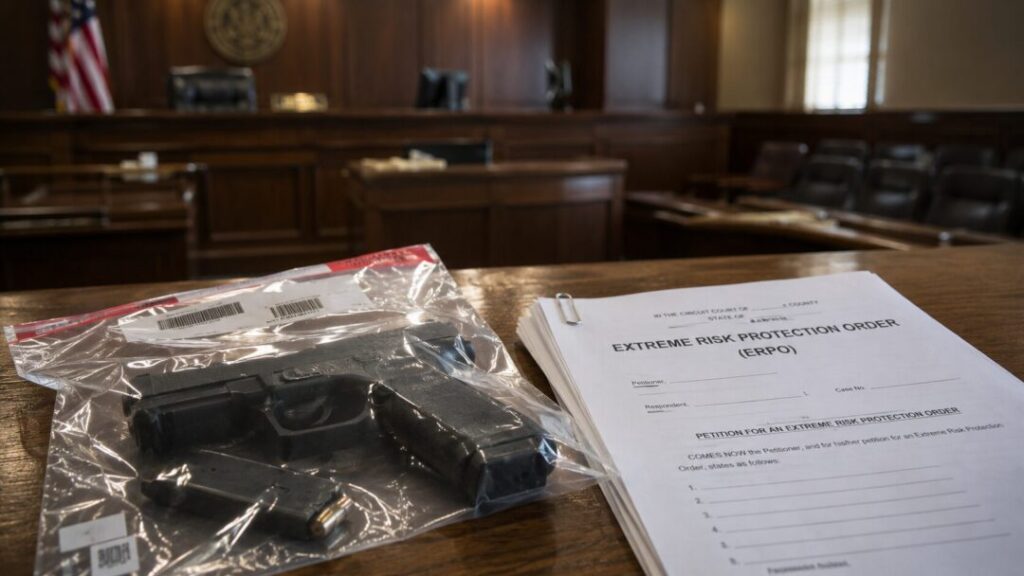
Red flag laws allow courts to take guns away from people who might hurt themselves or others. These are also known as Extreme Risk Protection Orders, or ERPOs.
In the last five years, the Supreme Court has made three big decisions affecting these laws.
There are two main sides involved in this debate. Gun rights groups want to protect the constitutional right to own firearms. Gun safety groups want to stop violence by using these emergency laws.
Both sides study the same court cases but often see the results differently.
The first key case was Caniglia v. Strom in 2021.
Police officers entered a man's house in Rhode Island to seize his guns after he had an argument with his wife. They took the weapons without getting a warrant first.
All nine Supreme Court judges agreed this was wrong. Police cannot enter a home to grab guns unless a judge signs an order.
Gun rights groups liked this decision. They felt it protected private property and limited police power. Gun safety groups also agreed with the outcome. Most ERPO laws already require judicial approval anyway.
Both sides agree that officials cannot just walk in and take weapons without oversight.
Next came New York State Rifle & Pistol Association v. Bruen in 2022.
This ruling changed how courts judge all gun laws. Before this, courts balanced public safety against individual rights.
Chief Justice Thomas wrote that laws must match America’s historical tradition. Courts must find old rules from when the Constitution was written or from 1868, when the 14th Amendment extended the Bill of Rights, including the 2nd Amendment, to the states, that support modern restrictions.
Gun rights groups cheered loudly. The Second Amendment Foundation said this would help “win firearms freedom one lawsuit at a time.” They sued to stop many red flag laws, arguing no similar old laws exist.
Gun safety groups worry about relying on history that is as much as 200 years old. However, they argue that founding-era laws existed where judges could force dangerous people to post bonds or hand over weapons.
Currently, lower courts are split on whether this history matches today’s laws.
The third case is United States v. Rahimi from 2024.
A man challenged a federal ban preventing people with domestic violence restraining orders from having guns. The Supreme Court said yes, courts can disarm people who pose a credible threat to others. Eight justices voted to uphold the ban, while one disagreed.
Gun safety groups celebrated this victory. Everytown stated that sheriffs refusing to enforce red flag laws are acting “irresponsibly.” They believe removing guns prevents tragedy.
Gun rights groups expressed deep concern. The Second Amendment Foundation warned that taking away rights without a criminal conviction violates the Constitution. They worry judges will mix pieces of old laws to approve new restrictions unfairly.
Justice Thomas noted in his dissent that stripping rights without charges is legally shaky. However, most agree Rahimi received a full hearing before losing rights.
Many state red flag laws take guns immediately, allowing hearings later, which remains a point of conflict.
Current positions highlight ongoing tension.
Gun rights advocates focus on procedure, especially due process. They worry about seizures happening before any hearing takes place. They also note that civil court findings remove rights without criminal records.
Gun safety groups focus on the potential victims. They report over 40,000 people die from gun violence yearly. They trust courts to follow fair steps like quick hearings and requiring clear proof.
Even with these disagreements, some goals overlap.
Both sides generally agree judges should oversee firearm removals. They agree hearings must happen quickly after seizure, though gun rights groups insist hearing must take place before guns are seized. Strong proof standards help prevent unfair targeting.
Organizations on both sides keep litigating in local courts. The Firearms Policy Coalition and NRA continue filing challenges, while Everytown and Giffords defend existing statutes.
The Supreme Court has not yet picked a pure red flag law case to review directly.
Until then, red flag laws remain active in many states while legal battles continue to shape their future application across the country.
The opinions expressed by contributors are their own and do not necessarily represent the views of Nevada News & Views.