How Will Senators and Representatives Vote?
(Jeff Carter) – Over the last 110 years, we have chipped away at the Constitution and the founding structure of America. We are a republic, but some of those changes have altered how that republic actually functions.
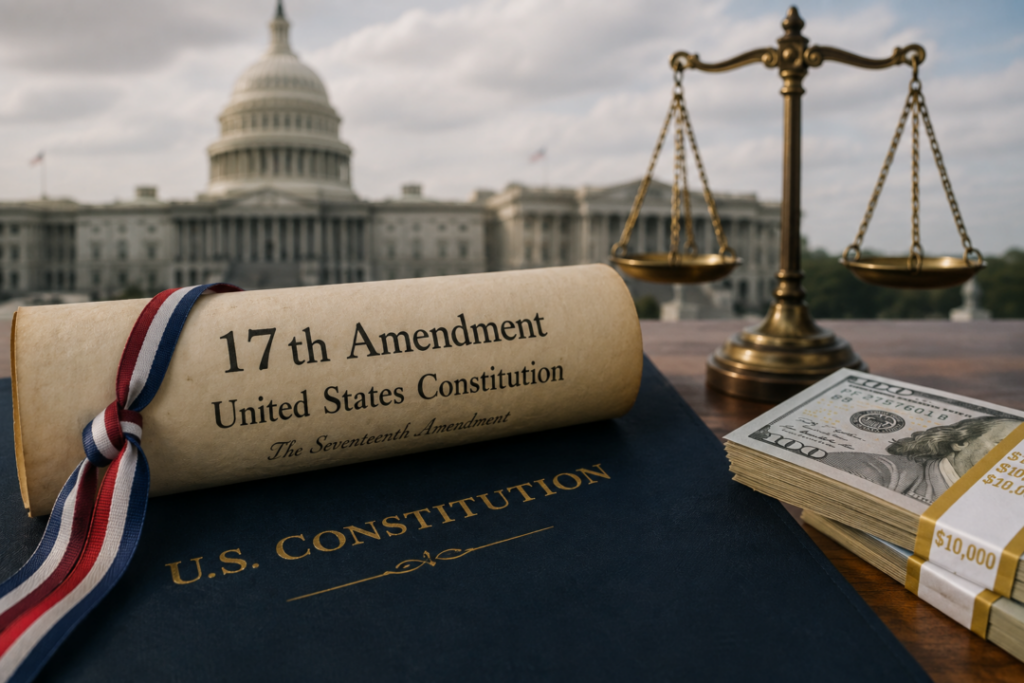
One important example is the 17th Amendment, which established the direct election of U.S. senators. Under the original Constitution, senators were chosen by state legislatures and were therefore accountable to the states themselves—not directly to the popular vote.
That change fundamentally altered the Senate. In some respects, it turned the Senate into a second House of Representatives, albeit with longer terms and different constitutional powers.
Why does that matter?
Look at the fiscal condition of states such as California and Illinois. The United States itself is carrying roughly $40 trillion in debt. These are not abstract numbers. Eventually, someone has to pay the bill.
During my foray into politics, I learned something else: a surprising number of people involved in government and politics are not particularly good at basic financial math. In fact, Nevada Treasurer candidate Drew Johnson couldn’t even calculate the price of a bond. He said, “Bond prices are just out there. You know what you are going to get.”
And that matters because government finance ultimately comes down to math.
Consider what happens when a state or municipality becomes financially distressed.
There are numerous municipal-bond ETFs, mutual funds, and institutional investors that hold municipal debt. Many investment mandates require them to remain invested in the asset class. As a result, they can continue purchasing small amounts of debt from financially troubled issuers such as Illinois or Chicago.
For an individual investor, that may seem irrational. But from a portfolio-management perspective, owning a small position in a risky issuer can make sense. If that bond defaults, the loss may have only a modest effect on the portfolio’s overall return.
That can keep the game going for a surprisingly long time.
Eventually, however, the numbers have to work. If a state cannot raise taxes enough to balance its finances and can no longer access the debt markets on reasonable terms, something has to give. Default, restructuring, or some form of federal intervention becomes increasingly difficult to avoid.
And then comes the political question:
What will Congress do?
There will undoubtedly be members of Congress who argue that a bailout is necessary for the “public good.” The political pressure would be enormous.
But how would Nevada legislators respond to a bailout of California or Illinois? Would they vote to commit Nevada taxpayers’ resources to states that had pursued fundamentally different fiscal policies?
I suspect the answer would often be no.
And that gets to the heart of the argument for repealing the 17th Amendment.
Under the original system, senators were selected by state legislatures. Their political accountability ran through the states. That created an institutional connection between the Senate and the fiscal interests of the individual states.
Would state legislators from fiscally responsible states necessarily support bailing out states that had spent far beyond their means?
Even if they belonged to the same political party?
I’m not convinced they would.
A state legislator ultimately answers to voters in his or her state. Those voters may have little appetite for using their tax dollars to rescue another state from years of irresponsible spending.
That is the question the 17th Amendment raises: did direct election of senators strengthen American democracy—or did it weaken one of the Constitution’s original mechanisms for keeping the federal government accountable to the states?
The opinions expressed by contributors are their own and do not necessarily represent the views of Nevada News & Views. This article was originally published via JeffreyCarter.substack.com on 9/1/2026. Digital technology may have been used in the research, writing, or production of this article. Please verify information and consult additional sources as needed.