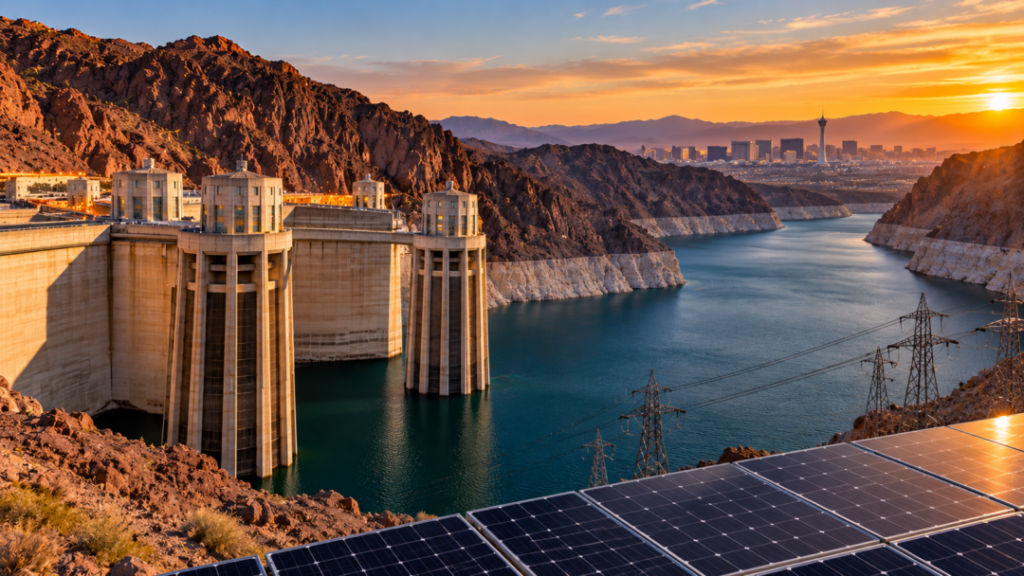
I’ve lived in Las Vegas for 25 years, and lately I’ve been thinking more seriously about something most of us would rather not think about.
Lake Mead keeps shrinking.
The Colorado River Basin has now been suffering through a drought lasting more than a quarter-century. Conditions became even worse in 2026. In August, the Bureau of Reclamation reported that Lake Mead had reached a record-low elevation.¹
The bathtub ring around Lake Mead has become part of the Southern Nevada landscape. We hear constantly about water shortages, declining reservoir levels and negotiations among seven states over who gets how much water.
I began to wonder what a falling Lake Mead would mean for our electricity.
Hoover Dam is right down the road. It has been generating electricity since the 1930s. If Lake Mead keeps falling, there eventually won’t be enough water pressure to operate its turbines normally.
Could a shrinking Lake Mead leave Las Vegas short of electricity?
Hoover Dam really is losing generating power
Hoover Dam's 17 commercial generators have a maximum combined capacity of 2,074 megawatts. How much they can produce depends heavily on Lake Mead's elevation: higher water means more pressure at the turbines.
The Bureau of Reclamation says the prolonged drought has already reduced Hoover's generation by about 30 percent.²
At around 1,035 feet above sea level, Hoover's older turbines face a serious problem called cavitation.
I had to look up cavitation. When pressure through a turbine gets too low, vapor bubbles form in the water. Their collapse against metal surfaces can pit and erode the equipment.
Continued operation under severe cavitation can damage the very turbines producing the power.
So lower lake levels mean more than a gradual loss of output. Some turbines may eventually be unable to operate safely.
Reclamation's updated analysis estimates that, with the existing turbine configuration, Hoover's generating capacity at a Lake Mead elevation of 1,035 feet could fall to about 382 megawatts.²
The federal government is investing approximately $52 million in Hoover infrastructure, including plans to replace as many as three older turbines with wide-head turbines designed for lower lake levels.²
Hoover already has five wide-head turbines, which can operate down toward approximately 950 feet without the excessive cavitation damage that threatens older equipment.²
Reclamation calls 950 feet Hoover's minimum power pool, the lowest Lake Mead elevation at which the dam can produce hydroelectric power.
At that elevation, Reclamation's technical analysis estimates only about 117 megawatts of physical generating capacity.³
That is a small fraction of Hoover's 2,074-megawatt maximum.
Below approximately 950 feet, water could still be released through Hoover Dam, but those releases would no longer generate hydroelectric power.
At roughly 895 feet, the dam would reach dead pool: water could no longer flow downstream through its existing outlets by gravity.³
If Lake Mead falls far enough, Hoover could cease to be a meaningful source of electricity. The question for Las Vegas is how much it relies on that power today.
Las Vegas doesn't run on Hoover Dam
For years, I thought of Hoover as our local power plant. Its electricity actually serves customers in Nevada, Arizona and California.
Southern Nevada draws on a much larger electrical system, and NV Energy has its own substantial generating fleet.
As of the end of 2025, NV Energy reported 5,351 megawatts of company-owned generating capacity in Southern Nevada.⁴
For comparison, Southern Nevada's record peak electrical load was 6,168 megawatts.⁴
That 817-megawatt gap between owned capacity and record peak load does not mean the utility lacks enough power. NV Energy also uses contracted renewable projects, purchased electricity and the interconnected Western grid.
Hoover is one part of that supply. Losing its output would require replacement power, but it would not suddenly turn out the lights in Las Vegas.
Replacing Hoover's declining hydropower would have a cost. That is the consequence I am more likely to see on my electric bill.
Nevada is already building more power
NV Energy's approved resource plan includes new generation and storage that do not depend on a full Lake Mead.
Three large solar-and-battery projects total more than 1,000 megawatts of solar generation and more than 1,000 megawatts of battery capacity.⁵
Dry Lake East, about 20 miles northeast of Las Vegas, is planned for 200 megawatts of solar plus a 200-megawatt battery capable of storing 800 megawatt-hours.
Boulder Solar III is planned for another 128 megawatts of solar and a 128-megawatt battery capable of storing about 511 megawatt-hours.
Libra Solar is planned for 700 megawatts of solar backed by a 700-megawatt battery capable of storing 2,800 megawatt-hours.
Those projects are scheduled to enter service between the end of 2026 and the end of 2027.⁵
The batteries matter most when summer demand stays high after solar production starts to fall.
Sunshine at noon in July is plentiful. Several hours later, it can still be 110 degrees while hundreds of thousands of air conditioners are running.
Large batteries can store some afternoon solar power for that evening peak.
Then there's natural gas
Natural gas remains an important part of Nevada's power supply because gas-fired plants can run when solar production falls.
NV Energy can dispatch natural-gas generation when it needs more electricity, particularly during summer peaks.
Gas generation, purchased electricity, batteries and new facilities can replace declining Hoover hydropower, but the utility must pay for them.
My electric bill
I recently wrote about the peculiar experience of sending thousands of kilowatt-hours of electricity from my rooftop solar panels to NV Energy and still receiving a $288 electric bill.
That exercise taught me considerably more about Nevada electricity rates and net metering than I ever expected, or wanted, to know.
That experience also changed how I think about my rooftop solar system. It reduces today's bill and gives me some protection against future electricity prices.
My system produced roughly 15,300 kilowatt-hours during its first year.
There are limits to that protection. Under my net-metering arrangement, NV Energy does not pay the full retail rate for exported electricity, and my panels do not eliminate every fixed or demand-related charge.
Even so, the electricity I use directly from my roof becomes more valuable as grid prices rise.
Growth will test Nevada's grid
Another pressure on Nevada's electrical system is growth. More Southern Nevada homes mean more air conditioners, while major commercial and industrial customers, particularly data centers, could add much larger loads.
NV Energy's resource planning identified 12 prospective data-center projects requesting 5,900 megawatts of capacity by 2033.⁶
Most of that prospective data-center growth is associated with Northern Nevada rather than Clark County.
It still matters here because new loads elsewhere in Nevada can affect statewide generation, transmission and investment decisions.
A request for electricity is not a forecast of actual use. Projects can be delayed, downsized or canceled, and NV Energy discounts prospective projects in its load forecasts.
Still, 5,900 megawatts of requested capacity deserves attention. Nevada will need enough generation and transmission for whatever share of it materializes.
New transmission to move the power
NV Energy is building major high-voltage lines to connect more of the state's electrical system and reach new generating resources.
Greenlink West is an approximately 350-mile, 525-kilovolt transmission line running between the Las Vegas area and Yerington. NV Energy expects it to enter service in May 2027.
Greenlink North will add approximately another 235 miles of 525-kilovolt transmission between Ely and Yerington, with service expected in December 2028.⁷
NV Energy says Greenlink will provide access to areas containing approximately 4,000 megawatts of undeveloped renewable-energy resources.⁷
Those lines matter because new power plants help only if their electricity can reach customers.
What happens on a 115-degree afternoon?
That is when the grid faces its hardest test.
Air conditioners across the valley push Southern Nevada's electrical demand to its peak.
Late afternoon and early evening can be especially difficult: temperatures remain high while solar production begins to decline.
The North American Electric Reliability Corporation's summer reliability assessment identified about 5 p.m. as the Southwest's highest-risk period for unserved energy. It found adequate expected resources under the conditions it studied, but warned that widespread heat, wildfires and limited imports could strain the system when neighboring areas also need power.⁸
Las Vegas can ordinarily import electricity, but Arizona and California may have little to spare during a Western heat wave.
That is a real vulnerability, though it does not mean a blackout is imminent.
Will Lake Mead leave Las Vegas without power?
The more pressing questions are whether Nevada can add power and transmission fast enough, and what that work will cost.
The Colorado River drought and Lake Mead's decline are serious. Hoover is already losing generating capability. Near minimum power pool, its contribution to the Western grid would be very small.
Even so, the evidence I found does not suggest Southern Nevada will routinely lose electricity because Lake Mead is too low.
The Colorado River has a limited supply of water. Nevada has several ways to replace lost electricity: solar farms, batteries, natural-gas plants, geothermal generation, transmission lines and purchases through the Western grid.
Some of that construction is already underway. Keeping the supply reliable will take planning and money.
What I'm watching now
After 25 years in Las Vegas, I'm not packing the moving van because of the electrical grid.
I am watching Lake Mead's elevation and Hoover's generating capacity, along with the schedules for NV Energy's solar, battery and transmission projects.
I am also watching how quickly data centers and other large users connect to the grid.
And I will keep watching my electric bill.
After looking at the evidence, I think higher costs are a more likely consequence of Southern Nevada's changing power supply than a chronic shortage of electricity.
Fortunately, there's one power plant NV Energy can't raise the fuel price on.
It's sitting on my roof.
Sources and Notes
1. Colorado River drought and Lake Mead. U.S. Bureau of Reclamation, 2026 Colorado River Basin operational materials and reservoir reporting. Reclamation describes the basin's continuing multidecadal drought and exceptionally poor 2026 hydrology.
2. Hoover Dam capacity, drought losses, cavitation and turbine improvements. U.S. Bureau of Reclamation, Enhancing Hoover Dam's Infrastructure and Energy Reliability, May 21, 2026. Reclamation reports Hoover's historical maximum 2,074-MW capacity, an approximately 30 percent generation decline, severe cavitation expected in older turbines below 1,035 feet, an updated 382-MW capacity estimate at 1,035 feet, approximately $52 million in infrastructure investment and wide-head turbines capable of operating near 950 feet.
3. Minimum power pool and dead pool. U.S. Bureau of Reclamation, Post-2026 Colorado River Reservoir Operations DEIS, Technical Appendix 15, Dams and Electrical Power Resources, and Reclamation's Hoover Dam project information. Reclamation identifies approximately 950 feet as the minimum power-pool elevation and estimates 117 MW of physical generating capacity there. Hoover's dead-storage elevation is approximately 895 feet.
4. Southern Nevada electricity demand and owned generating capacity. NV Energy, Power Facts, data through Dec. 31, 2025. Southern Nevada record peak load: 6,168 MW. Company-owned Southern Nevada generating capacity: 5,351 MW.
5. New solar and battery resources. NV Energy, Integrated Resource Plan. Dry Lake East: 200 MW solar/200 MW battery, 800 MWh; Boulder Solar III: approximately 128 MW solar/128 MW battery, 511.4 MWh; Libra Solar: 700 MW solar/700 MW battery, 2,800 MWh. Scheduled service dates range from late 2026 through late 2027.
6. Data centers. NV Energy Integrated Resource Plan materials. Twelve prospective data-center projects requested approximately 5,900 MW of capacity by 2033. Most of the prospective data-center growth is associated with Northern Nevada. Requested capacity should not be treated as guaranteed future consumption.
7. Greenlink Nevada. NV Energy, Greenlink Nevada. Greenlink West: approximately 350 miles, 525 kV, expected May 2027. Greenlink North: approximately 235 miles, 525 kV, expected December 2028. NV Energy says Greenlink will provide access to areas containing about 4,000 MW of undeveloped renewable resources.
8. Summer reliability. North American Electric Reliability Corporation, Summer Reliability Assessment, Southwest analysis. NERC identifies the late-afternoon period, around 5 p.m., as particularly challenging as solar production declines while cooling demand remains high, and identifies extreme regional heat, wildfire and limited imports as potential reliability stresses.
The opinions expressed by contributors are their own and do not necessarily represent the views of Nevada News & Views. Digital technology may have been used in the research, writing, or production of this article. Please verify information and consult additional sources as needed.