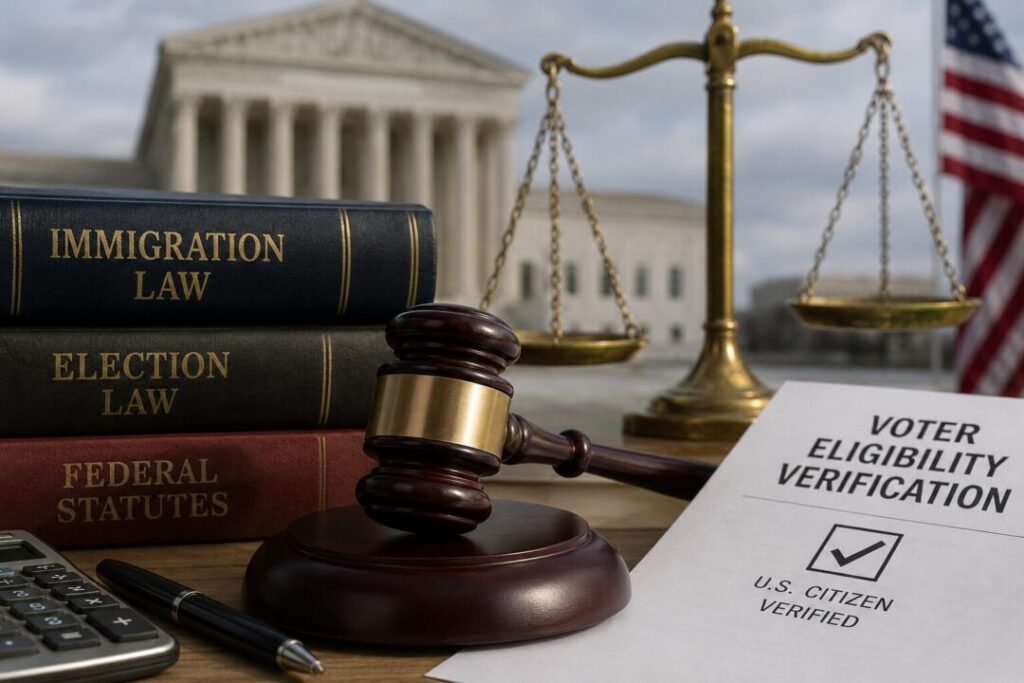
(Hans von Spakovsky, Daniel Mares) – If you want a glimpse of what’s wrong with the federal court system today, this recent opinion in League of Women Voters v. U.S. Department of Homeland Security by federal Judge Sparkle Sooknanan, preventing the Department of Homeland Security from helping states verify the citizenship of registered voters, is a prime example.
In addition to being filled with partisan diatribes against the Trump administration, Sooknanan, a Biden nominee to the U.S. District Court for the District of Columbia, doesn’t even discuss two relevant federal statutes that authorize exactly what the government was doing and indulges in a bizarre and incorrect reading of a clearly controlling third statute.
To understand this controversy, you first need to know about the Systematic Alien Verification for Entitlements database, which was created by Congress in the 1986 Immigration Reform and Control Act. SAVE, which is run by the DHS, enables federal, state, local, and tribal governments to check the immigration status of individuals applying for public assistance.
Pursuant to a settlement agreement between Florida and the DHS executed in November, the agency agreed to modify the SAVE system to allow for, among other things, integration with the Social Security Administration to allow searches with full and partial Social Security numbers and bulk upload verification requests, so that SAVE users don’t have to input verification requests one at a time.
The lawsuit was the result of the Biden administration doing everything it could in defiance of federal law to prevent state officials from using the SAVE system.
Yet Sooknanan held that the 2025 modified SAVE system violated the Social Security Act because SSNs and related records must remain confidential and cannot be disclosed by authorized persons.
Sooknanan also asserted the modified system violates the federal Privacy Act, claiming that disclosing SSNs, citizenship indicators, and related data to state election officials was not a compatible “routine use” allowed by federal law.
Sooknanan rejected the government’s argument that immigration statutes independently authorized the overhaul and claimed, bizarrely, that the most relevant statute, 8 U.S.C. § 1373, did not override the Privacy Act or Social Security Act on which she was basing her ruling, despite the clear text of that statute that does exactly that.
We will explain why her legal analysis is totally wrong, but first we must note — and this may explain her completely faulty legal analysis — that Sooknanan’s opinion is replete with anti-administration language that raises serious questions about her partisanship and lack of objectivity.
Sooknanan claimed that agencies were “scrambling to comply with an Executive Order aimed at reshaping federal elections” and had “haphazardly combined and repurposed the private information of millions of Americans.” She also concluded that “the federal government has knowingly trampled on the privacy rights of American citizens in a manner that threatens the sacred right to vote” and described one of the government’s arguments as “bordering on the absurd.”
If anything is “absurd,” it is her opinion.
Honest critique is expected from a judge, but this deeply flawed opinion’s condemnation of the government’s effort to ensure illegal immigrants are not registering and voting reveals her true motives.
You don’t have to take it from us. Take it from Judge T. Kent Wetherell II of the Northern District of Florida, who this month ordered the DHS to comply with the 2025 settlement agreement notwithstanding Sooknanan’s contrary order — a settlement that Sooknanan just waved off.
In his opinion, Wetherell wrote, “having reviewed Judge Sooknanan’s order … the Court makes explicit what was implicit in the approval of the settlement agreement—the modifications to the SAVE system, including the bulk-upload and SSN-search features, do not violate the Social Security Act or the Privacy Act.”
Wetherell found Sooknanan’s analysis of 8 U.S.C. § 1373 to be unpersuasive because she focused her view on the “purpose” of the statute rather than its plain text. She had to do that to get around the plain language of § 1373:
“Notwithstanding any other provision of Federal, State, or local law, a Federal, State, or local government entity or official may not prohibit, or in any way restrict, any government entity or official from sending to, or receiving from, the [DHS] information regarding the citizenship or immigration status, lawful or unlawful, of any individual.”
It should be obvious to anyone with any common sense that “Notwithstanding any other provision” of federal law means that the statute overrides any limits in the Privacy Act or the Social Security Act cited by Sooknanan.
And the federal officials referred to in the statute would include judges, who would likewise be prohibited by this clear and unambiguous language from “in any way” restricting state election officials from receiving citizenship and immigration status information.
If that is not plain enough, the statute also directs that the DHS “shall respond” to any inquiry from government officials and agencies “seeking to verify or ascertain the citizenship or immigration status of any individual within the jurisdiction of the agency for any purpose authorized by law.”
The eligibility of individuals registering to vote is obviously “within the jurisdiction” of state election officials, and since it is a felony under both federal and most state laws for an illegal immigrant to register and vote, it is also clear that trying to verify that an applicant is actually a citizen is “authorized by law.”
Wetherell also found no Privacy Act violation because the SAVE modifications fall into the “routine use” exception because confirming the identity and citizenship or immigration status of potential noncitizens is well within the statutory purposes for which SSNs are maintained.
By the way, in her attempt to prevent state election officials from using Social Security and immigration data to verify voter eligibility, Sooknanan didn’t even mention the National Voter Registration Act of 1993 or the Help America Vote Act of 2002.
Both laws require states to maintain accurate voter registration lists, and it is the federal government’s responsibility to enforce those requirements.
It follows that this would include providing state election officials with relevant information on the eligibility of potential voters, such as whether they are illegal immigrants, because providing such information would negate the need to file enforcement actions and prosecutions later on for violations.
HAVA requires applicants registering to vote to provide either a driver’s license serial number or the last four digits of their Social Security number. It directs states to “enter into an agreement with the Commissioner of Social Security” so that SSA can verify the accuracy of the information provided by the applicant.
Rather than violating the Social Security Act as Sooknanan wrongly claimed, the improvements in the SAVE system, by incorporating Social Security data, were fulfilling the purpose of HAVA with this provision.
No doubt, that is why in a 75-page opinion, Sooknanan doesn’t mention HAVA, not even once.
Wetherell points out that he “is not bound by Judge Sooknanan’s order” and says, politely, that “with all due respect,” he “disagrees” with her conclusions. Wetherell acknowledges that this puts the government “in a bind because they are subject to two contradictory orders.”
“One of the orders,” Wetherell says, “has to give.” But he is not “persuaded” that his order, telling the government it must continue to provide state election officials with relevant citizenship information on registered voters, “is the one that should give.”
He is absolutely right, and everyone who believes in election integrity and in judges who don’t engage in tortured readings of federal statutes to achieve partisan ends should agree.
Hans von Spakovsky is a senior legal fellow in the Edwin Meese III Institute for the Rule of Law at Advancing American Freedom, and Daniel Mares is a legal intern at the institute. In Focus delivers deeper coverage of the political, cultural, and ideological issues shaping America. Published daily by senior writers and experts, these in-depth pieces go beyond the headlines to give readers the full picture. You can find our full list of In Focus pieces here. The opinions expressed by contributors are their own and do not necessarily represent the views of Nevada News & Views. This article was originally published via washingtonexaminer.com on 7/16/2026.