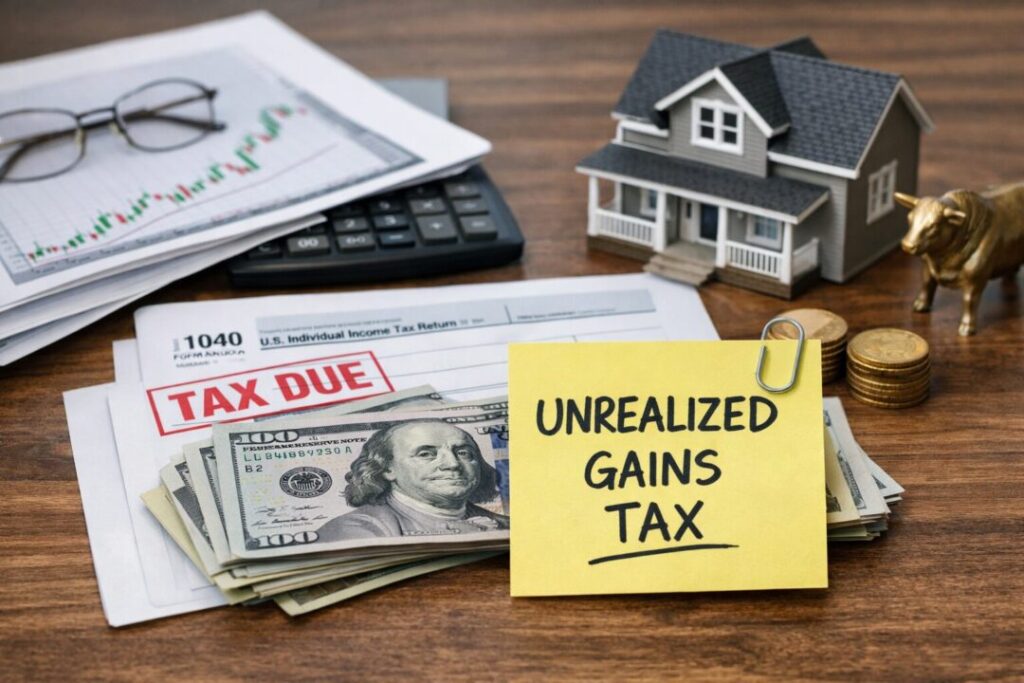
Around the world, governments are beginning to experiment with a radical new idea: taxing people not on money they earn — but on value that only exists on paper.
Recent legislation in the Netherlands proposes taxing annual increases in the value of investments even if the owner never sells the asset. In the United States, policymakers have explored similar concepts in proposals that would include unrealized gains in taxable income for certain wealthy individuals.
Supporters present these ideas as ways to target the ultra-rich. But once a government establishes the principle that value — not transactions — can be taxed, the implications reach far beyond billionaires.
“You can owe money without earning money.”
For most of modern history, taxes have been tied to events. You earn money — you pay tax. You sell an asset — you pay tax.
An unrealized gains tax abandons that foundation. Under this system, you owe taxes not when you profit, but when a spreadsheet says you could profit. The moment government taxes value instead of transactions, ownership itself becomes taxable.
Consider a simple example. A teenager buys a collectible card for $50. A collector offers $500, but the teen refuses to sell because it is sentimental.
Under an unrealized gains tax, the government treats the card as if it produced income. To pay the tax, the card must be sold. Ownership ends because taxation begins.
Now replace the card with a house. A retired couple lives in a paid-off home. Housing prices surge, doubling the value on paper. They didn’t sell it. They didn’t profit. Yet they owe taxes on wealth they never received, forcing debt or sale.
The same applies to small businesses. A strong year produces a high valuation and a tax bill. The next year a recession hits and the value collapses, but the tax remains. The government taxed a peak that never became income.
This changes a basic principle of a free society. Traditionally, you pay tax when you choose to act. Under unrealized gains taxation, you pay tax simply because something you own exists at a higher estimated value.
You can owe money without earning money. You can lose assets without selling them. You can be taxed on events that never occurred.
This is no longer a tax on profit. It is a government claim on everything you own — indefinitely.
The opinions expressed by contributors are their own and do not necessarily represent the views of Nevada News & Views.