(Shane Harris) – Freshly declassified information released this week by Director of National Intelligence Tulsi Gabbard has further exposed Democrats’ first impeachment effort against President Donald Trump in 2019 as totally bunk – and vindicated his claims that the inquiry was politically motivated from the start.
To understand just how outrageous the entire impeachment scam was, it helps to rewind the clock seven years and remember what Democrats were alleging.
In September 2019 – with Trump fresh off several high-profile policy victories and gearing up for a re-election bid – House Democrats formally launched an impeachment inquiry following reports about a July 25, 2019, phone call between Trump and Ukrainian President Volodymyr Zelenskyy.
At the center of the controversy was a whistleblower complaint alleging that Trump had urged Ukraine to investigate Joe Biden and his son, Hunter, while the administration was withholding nearly $400 million in congressionally approved military aid.
Democrats argued that this sequence of events suggested Trump was using the power of his office and U.S. foreign policy tools to solicit foreign interference in the upcoming 2020 election.
The first great irony, of course, is that even if Trump did tell Zelenskyy to investigate the Bidens, he would have been completely justified in doing so.
Hunter Biden was paid millions of dollars per year by a notoriously corrupt Ukrainian oil and gas company Burisma despite have no experience in the industry.
Smoking-gun emails also revealed how Hunter introduced Ukrainian businessmen to his father while he was vice president in an apparent influence-peddling scheme.
Perhaps most shockingly of all, during a Council on Foreign Relations event in 2018, Joe Biden openly bragged on camera about forcing the Ukrainian government to fire the prosecutor who was investigating Burisma and his son.
Nonetheless, in December 2019, the Democrat-controlled House of Representatives approved two articles of impeachment against Trump – abuse of power and obstruction of Congress. The case then moved to the Senate, where he was ultimately acquitted in February 2020.
Democrats’ entire case rested on the reliability of the whistleblower who alleged the impropriety. But as Gabbard revealed this week, the whistleblower wasn’t reliable at all.
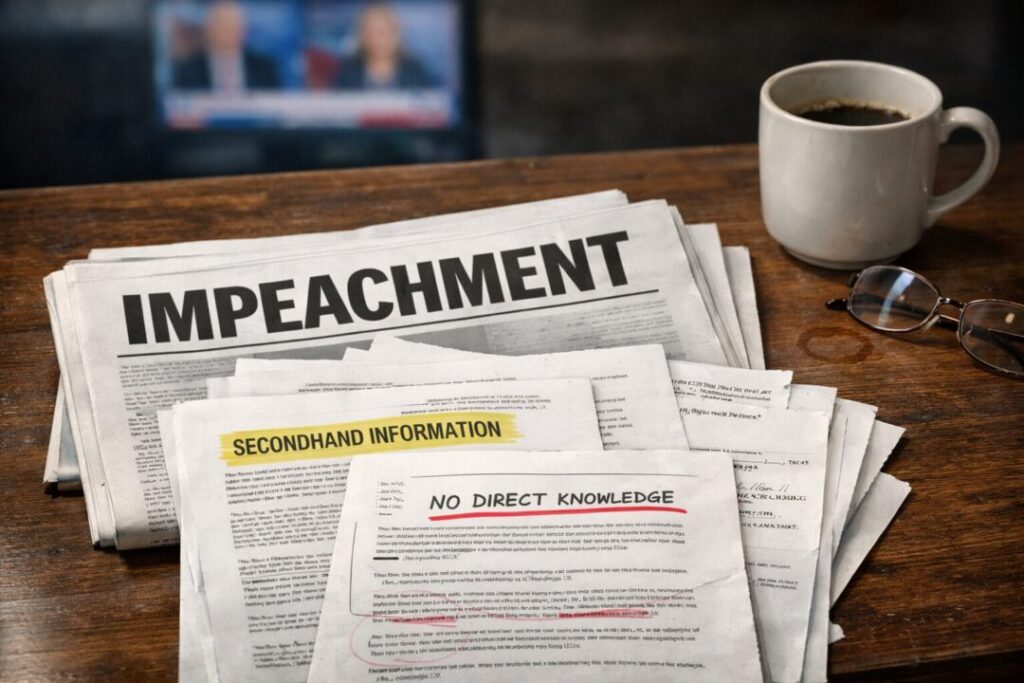
According to the newly declassified materials, the Intelligence Community Inspector General at the time, Michael Atkinson, built his “investigation” almost entirely on second-hand information.
The whistleblower himself (who has never been identified) admitted he had no direct knowledge of the Trump-Zelensky call. He was not on the call, did not hear it firsthand, and instead relied on what others told him and his own interpretations.
That alone should have been disqualifying. Instead, it became the foundation for an impeachment.
It gets worse. Atkinson reportedly interviewed just four individuals – the whistleblower, a key associate who helped shape the complaint, and two people who had no firsthand knowledge of the call.
One of those key sources admitted that their conclusions about any supposed wrongdoing came only “in hindsight,” required “reading between the lines,” and were not based on anything explicit in the call itself.
In other words, this was not evidence – it was speculation layered on top of hearsay.
Even more damning, the documents show that one of the central figures feeding information into the complaint was involved in crafting the now-discredited 2017 intelligence assessment that fueled the totally debunked Russia collusion hoax. That same individual had professional ties to former FBI agent Peter Strzok and openly acknowledged being frustrated with Trump’s policies.
So, the supposedly “neutral” process that launched an impeachment was, in reality, built on the input of politically biased actors with a track record of weaponizing their positions of public trust to hurt Trump.
The whistleblower himself later admitted to the Inspector General that he had communicated with Democrat congressional staff before filing his complaint – a fact he initially concealed. He also acknowledged being a registered Democrat and having worked closely with Joe Biden on Ukraine policy, raising obvious questions about bias and motive that were conveniently ignored at the time.
Meanwhile, Atkinson appears to have disregarded standard procedures.
Despite knowing a transcript of the call existed, he never sought to review it during his preliminary inquiry.
The Department of Justice concluded there was no basis for criminal action and that the complaint did not even meet the statutory definition of an “urgent concern.”
Atkinson ignored that guidance and pushed the complaint forward anyway, ensuring it reached Congress and, soon after, the media.
From there, the political machine took over. Then-House Intelligence Committee Chairman Adam Schiff and Speaker Nancy Pelosi seized on the narrative, amplifying it through sympathetic media coverage and using it as the basis to launch an impeachment circus.
But wait – wasn’t there another witness?
There was. It was Deep State bureaucrat Alexander Vindman, who was actually on the infamous call. Vindman corroborated the whistleblower’s claims.
But like the whistleblower, he’s hardly a neutral figure. He is now running for Senate in Florida as a Democrat on an explicitly anti-Trump platform, while his brother, Eugene Vindman, is a Democrat congressman in Virginia. That’s hardly the profile of an unbiased observer.
Taken together, these revelations paint a picture that is even more troubling than many conservative critics suspected at the time.
This was not a careful, fact-driven inquiry into serious allegations. It was a rushed, politically charged effort built on second-hand claims, partisan actors, and a willingness to ignore basic investigative standards.
And for what?
Impeachment is one of the most serious constitutional powers Congress possesses. It is supposed to be reserved for clear, demonstrable misconduct that threatens the integrity of the republic. Instead, Democrats turned it into a political weapon.
The irony is impossible to ignore.
Democrats claimed Trump was trying to influence the 2020 election. Yet their impeachment crusade functioned as a full-scale attempt to do exactly that by dominating headlines, shaping public perception, and weakening Trump politically heading into an election year.
Even worse, the episode deepened divisions in the country, eroded trust in key institutions, and set a dangerous precedent for using impeachment as a partisan cudgel.
It also elevated the profiles of many of the figures involved – from Schiff, who is now a U.S. senator, to the Vindman brothers, who parlayed their roles into political careers.
What was sold to the American people as a solemn defense of democracy now looks even more like a cynical power play built on a flimsy and compromised foundation.
The more we learn, the clearer it becomes that this impeachment was never about protecting the Constitution. It was about politics. And with each new revelation, Trump’s claim right from the start that it was a sham looks more and more justified.
Shane Harris is the Editor-in-Chief of AMAC Newsline. You can follow him on X @shaneharris513. The opinions expressed by contributors are their own and do not necessarily represent the views of Nevada News & Views. This article was originally published via AMAC.us on 4/16/26.