A Nevada News & Views review of FEC records traces uncashed refund checks to ten family-connected donors, most of whom gave again to Flippo’s next campaign, as a sworn complaint raises new questions about his finances.
Ten donors connected to David Flippo’s extended family were sent $28,800 in refund checks by his first congressional campaign in 2024. None of them cashed the checks, according to Federal Election Commission records reviewed by Nevada News & Views.
Months later, eight of those same donors gave again to his current campaign, most of them $7,000 each, the most one person can give for a primary and general election combined.
The records also show the campaign refunded a $7,000 contribution from Stephen C. Tuminello, a co-founder of the Arizona land venture behind one of Flippo’s largest reported assets, then accepted the same amount from him two weeks later.
The records add to a pattern: money flowing into and out of Flippo’s campaign through the same small circle of relatives and business partners, while Flippo declines to say where the $1.8 million he lent his campaign came from.
Federal rules allow campaigns to refund contributions, cancel uncashed refund checks and split donations between elections. However, several family contributions remain allocated above the primary-election limit in the reviewed records, and the campaign has not explained why.
Refund Checks That Were Never Cashed
Flippo lost the June 2024 Republican primary in Nevada’s 4th Congressional District. When a candidate loses a primary, the campaign generally must refund money donors gave for the general election.
On Aug. 3 and 4, 2024, his campaign reported $53,500 in refunds to 20 donors, including his wife, Dawn; his brothers Stephen and Richard; his sister, Laura Camp; and members of the Camp and Cole families.
On Dec. 31, 2024, the campaign reported that 14 of those checks, worth $39,200, had never been cashed. Ten of them, totaling $28,800, went to people connected to Flippo’s family, as shown in the chart below.
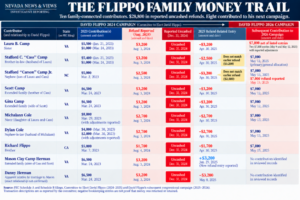
The campaign reissued only one check, a $3,200 refund to Mason Herman in January 2025.
Between April and June 2025, it took the rest off its books, filing amended reports that cancelled $38,700 in refunds. Those cancellations include a separate $2,700 negative refund entry discussed below.
Two of the cancellations don’t match.
Stafford “Cass” Camp’s original refund was $3,200, but the cancellation under his name was $2,500. His son’s original refund was $2,500, but his cancellation was $3,200. The records don’t explain whether that was a naming mix-up or something else.
The names don’t get any easier to follow.
Mason Camp Herman appears in the filings simply as “Mason Herman,” without the Camp surname she uses on social media. Stephen Flippo’s wife appears under her maiden name, Rebecca I. Guinn.
These ten donors weren’t strangers whose refund checks went uncashed. They were Flippo’s sister, brother, niece, nephews and extended family, people the campaign could easily have reached to make sure they received their money.
Apart from Mason Herman’s reissued check, the reviewed filings show no replacement refunds to the other nine family-connected donors.
The Same Donors Give Again
Eight of the ten (Laura Camp, Stafford C. Camp, Stafford Camp Jr., Scott Camp, Gina Camp, Michalann Cole, Dylan Cole and Richard Flippo) show up again in the records of Flippo’s current campaign, David Flippo for Nevada, mostly between May 9 and May 15, 2025.
Most gave $7,000, which the campaign split evenly between the 2026 primary and general elections, a routine step under federal limits.
Stafford Camp Jr. was the exception. The campaign reported a $7,000 contribution from him on May 13 and refunded all of it two days later.
Two sisters-in-law, Rebecca Guinn and Lana Flippo, also gave to both campaigns, including $7,000 each to the current one. Guinn received a $2,900 refund from the first campaign, but her check was not among those reported uncashed.
The current campaign has reported 12 refunds in all, totaling $59,550.
More Donors, More Money Returned
The refund questions extend beyond Flippo’s relatives.
Outside the family, another pattern appears: maximum contributions on a reporting quarter’s final day, followed by refunds in the next quarter. Some donors then gave again.
On June 30, 2025, the last day of the reporting quarter, a Henderson couple each gave $7,000 to Flippo’s current campaign. The campaign reported returning the husband’s money on July 10, then accepted another $7,000 from him two weeks later.
The wife appears in the campaign’s records under three different names: her first name, her middle name, and a nickname. Flippo’s first campaign also reported cancelling a $2,700 refund to her, even though the filings reviewed show no record of ever issuing her one.
In September, the campaign moved a separate $5 donation from the husband’s name to the wife’s.
A Pennsylvania couple also each gave $7,000 on June 30. The campaign reported refunding the wife’s entire contribution on July 17.
She gave another $7,000 on Sept. 30, the next quarter’s last day, and the campaign reported refunding that on Oct. 17.
Arizona Land Reserve Co-Founder Appears in Refund Records
The campaign also returned $7,000 to an Arizona Land Reserve co-founder—then accepted another $7,000 from him two weeks later.
Stephen C. Tuminello co-founded Arizona Land Reserve with Robert McDowell in January 2025, Mother Jones reported. Flippo listed a stake in the company worth $1 million to $5 million on a handwritten draft of his financial disclosure. Mother Jones also reported that Tuminello and McDowell helped raise money for Flippo.
The venture itself has drawn scrutiny. Arizona Land Reserve filed with the SEC to raise $20 million from investors, and its website promised them a steady 20 percent annual return for 20 years, according to Mother Jones. The SEC warns investors that promises of consistently high returns are a hallmark of fraud.
A forensic accountant who testified for the Justice Department in the Bernie Madoff case called those promised returns “a huge red flag,” Mother Jones reported.
The company’s website was taken down this month, according to Seale’s complaint. When Mother Jones asked whether Arizona Land Reserve had made its promised first payments to investors, Flippo, McDowell and Tuminello did not respond.
McDowell’s earlier ventures have also landed in court, Mother Jones reported. Arizona court records show he and business partners were accused of running a pyramid promotional scheme, and their company was found liable for breach of contract.
Rock Cabin Mining, a gold venture, filed for bankruptcy in 2018 after a customer sued alleging fraud. And in a 2021 motel bankruptcy, the man who sold McDowell the property accused him in court filings of taking investors’ money and not paying it back. McDowell did not respond to the magazine’s requests for comment.
The Flippo campaign reported a $7,000 contribution from Tuminello on May 15, 2025, and refunded all of it four days later.
On June 2, it reported another $7,000 from him, split between the primary and general elections. The transactions appear in the campaign’s FEC filing.
On September 30, 2025, the final day of the next reporting quarter, three more Tuminello family members—Charles, Gianna and Natalia—each gave $7,000.
The company and people tied to it have also given heavily to groups backing Flippo, including the Nevada Republican Party, Turning Point PAC and committees aligned with the House Freedom Caucus, according to Mother Jones.
The campaign has not explained why it refunded Tuminello’s first $7,000 and then accepted the same amount two weeks later.
The Contribution Math Raises More Questions
The refund trail isn’t the only part of the filings that fails to reconcile. Several family donors also have contribution adjustments that, as reported, leave amounts above the primary-election limit.
Flippo’s niece, Michalann Cole, contributed $8,000 in March 2023. The campaign attributed $2,000 to her husband, Dylan, but recorded another adjustment in the opposite direction from what would reduce her primary allocation: subtracting $3,300 from the general election and adding $3,300 to the primary.
Taken literally, those entries leave $9,300 assigned to the primary and a negative $3,300 general-election balance.
Danny Herman’s $6,500 contribution presents a different coding problem. The campaign reported a $3,200 redesignation, but coded both the subtraction and addition to the primary.
Those entries cancel each other out, leaving the entire $6,500 assigned to an election with a $3,300 contribution limit.
The same problem appears in the records for Richard Flippo, David’s brother. His $5,000 contribution came with a purported $1,700 redesignation, but both sides were assigned to the primary.
As reported, the adjustment leaves his primary allocation unchanged at $5,000.
These entries establish reporting discrepancies. Whether they reflect coding errors or contributions that were not properly corrected requires an explanation from the campaign. Separate contributions in the next election cycle do not resolve those earlier discrepancies.
A Sworn FEC Complaint
On Tuesday, Bob Seale, a former Nevada state treasurer and state Republican Party chairman, filed a sworn complaint with the FEC naming Flippo, his campaign, and treasurer Thomas Datwyler.
The complaint asks regulators to look at where Flippo got the more than $1.8 million he reported lending his campaign. It cites the handwritten draft disclosure Flippo gave The Nevada Independent, which lists major debts alongside stakes in Arizona Land Reserve and a company called “America First Home Mortgage.” Mother Jones could find no active U.S. company by that name.
KOLO 8 News reported on Thursday that campaign manager Steve Hilding declined to discuss the source of the campaign loan on the record, and that Flippo has repeatedly declined the station’s requests for an on-the-record interview.
The complaint also questions whether some family donors could afford their gifts and points to donors tied to Arizona Land Reserve’s founders. It compares the case to former Rep. George Santos, who pleaded guilty to federal crimes in 2024.
Flippo’s treasurer, Thomas Datwyler, also figured in the Santos controversy. His lawyer initially denied that Datwyler worked for Santos. The Daily Beast later reported that Datwyler had handled the campaign’s books while another man held the treasurer’s title. The lawyer subsequently withdrew his earlier denial, telling the FEC he had lost confidence in the accuracy of information Datwyler provided.
The complaint is a request for an investigation, not an FEC finding.
Other Questions About Donors and Disclosure
The Wall Street Journal reported Oct. 19 that the campaign listed a Las Vegas philanthropist who had died two years earlier as a donor. Consultant Rory McShane called it a clerical error, and the campaign corrected its filing.
Mother Jones reported that another person listed as a major donor said they never gave. Federal law prohibits giving money in someone else’s name.
Flippo has not filed the personal financial disclosure required of House candidates, despite a May 15 deadline. His campaign has said it would rather pay a $200 late fee than file a report it considers inaccurate.
“Mr. Flippo has decided that he can push the rules right up to the edge and then step over,” Seale told KTVN.
In September, Nevada News & Views reported that Flippo’s brother Stephen was the only reported donor to American Honor PAC, which ran ads against primary rival James Settelmeyer and shared a treasurer with Flippo’s campaign.
Mother Jones has since reported that Stephen loaned roughly $340,000 to an Arizona land venture run by McDowell, secured by land assessed at about $30,000—less than one-tenth of the loan amount.
Still Waiting for Answers
Nevada News & Views sent questions about the refunds to the Flippo campaign on Oct. 22 and received no response by the deadline. Mother Jones reported that questions it sent the campaign in September also went unanswered.
Flippo is asking Nevada voters to send him to Congress in less than two weeks.
His campaign’s own records, and reporting by other news outlets, now show a string of red flags:
- A listed donor who had been dead for two years, and another who says they never gave
- Family refund checks reported as uncashed, then canceled—with two cancellations recorded for amounts that don’t match the original refunds
- A niece still in college and a nephew about two years out of high school each giving $7,000 on the same day, with the nephew’s contribution reported refunded two days later
- Other donors giving $7,000, receiving refunds and giving again—including an Arizona Land Reserve co-founder
- No personal financial disclosure filed across two campaigns, only a handwritten draft provided to the press
- A major reported asset in a land company promising 20 percent annual returns, alongside another—“America First Home Mortgage”—that Mother Jones could not find registered as an active U.S. company
- The land company and people tied to it giving heavily to political groups backing Flippo
- A brother who funded attack ads against Flippo’s primary rival and loaned roughly $340,000 to the land company’s co-founder
Behind it all sits $1.8 million in campaign loans whose source Flippo has not explained.
David Flippo wants authority over the public’s money. But the public still deserves to know where his came from.
The opinions expressed by contributors are their own and do not necessarily represent the views of Nevada News & Views. This article was written with the assistance of AI.