David Flippo's brother is the only donor to the PAC attacking Settelmeyer. The same treasurer runs both operations. And the FEC has seen this playbook before.
A Family Affair
If you've seen attack ads going after James Settelmeyer in the NV-02 race, you might be wondering who's paying for them. The answer is hiding in plain sight — right there in the public records at the Federal Election Commission.
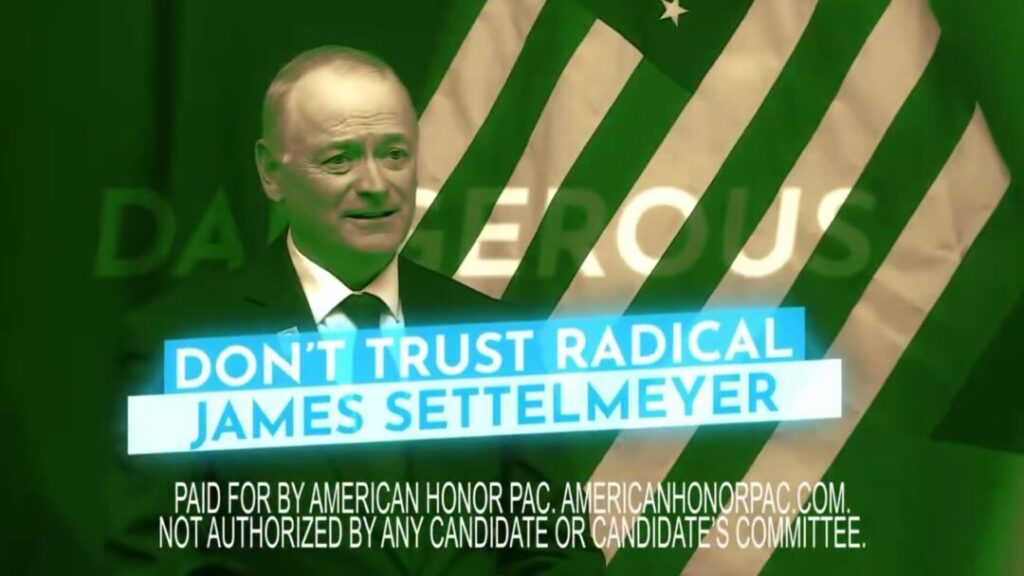
A Super PAC called American Honor PAC has been running ads attacking Settelmeyer, the former Nevada State Senate Minority Leader and heavy favorite in the June 9 GOP primary.
According to FEC filings, the only donor to American Honor PAC in the current election cycle is Stephen Flippo — the brother of David Flippo, the candidate those ads are designed to help.

That's right. Flippo's own brother is bankrolling the outside attack operation against his main competition.
One Man, Four Firms, One Race
Thomas Datwyler isn't just a treasurer for hire serving on both David Flippo's campaign and American Honor PAC. According to his own professional profile, he is the founder and CEO of four separate firms:
- 9Seven Consulting,
- AX Capital Compliance,
- Same Day Processing Caging,
- and 10Six Consulting.
FEC records show that David Flippo's campaign — David Flippo for Nevada — has made twelve consecutive monthly payments to AxCapital, LLC for “Compliance Consulting,” dating from April 2025 through March 2026. The payments ranged from $805 to $1,755 per month, totaling $13,755. That money went to Datwyler's firm.
American Honor PAC — the Super PAC funded entirely by David Flippo's brother — has also been making regular payments. But not to AxCapital. To another Datwyler firm: Same Day Processing.
Six payments between March 2025 and January 2026, totaling $1,755, for “Compliance Consulting” and “Accounting Consulting.” Both firms are registered in Wisconsin — right where Datwyler lives and works.
So the same man who serves as treasurer for both the campaign and the brother's Super PAC is also collecting fees through his other firms from both of them.
That's not just a shared treasurer. It's a financial ecosystem built around one congressional candidate and his family's money.
A PAC With No Donors — So Why the Caging Bills?
Here's the part that should make every Nevada Republican voter stop and think.
“Caging” is a specific term in political finance. It refers to processing incoming donation mail — sorting envelopes, handling checks, recording contributor data. It exists to manage a flow of donors.
American Honor PAC has had exactly two donations in its entire existence. Both are from Stephen Flippo, in separate election cycles. That's it.
No grassroots donors. No small-dollar contributors. No envelopes flooding in from across the district.
So why has this PAC been paying a caging firm six times over the past year?
There is no good answer to that question. A PAC with two donations from one person has no donor mail to process. The caging operation serves no obvious purpose — unless the purpose is something other than processing donations.
At minimum, it raises serious questions about whether American Honor PAC functions as a genuine independent political organization or as something closer to a fee-generating pass-through, funded by David Flippo's brother and managed by the same man running Flippo's campaign finances.
A Track Record Worth Knowing
Datwyler's history with the FEC is long and colorful. In 2023 and 2024 alone, campaigns he served as treasurer for racked up well over $150,000 in federal fines.
His clients have included the campaigns of Sen. Mike Braun of Indiana, which paid a $159,000 civil penalty to the FEC. Other campaigns he worked for were fined for failing to report hundreds of thousands of dollars in contributions on time.
In 2024, a Nevada Republican Super PAC filed a complaint with the U.S. Department of Justice accusing Datwyler of wire fraud, alleging he wrote an unauthorized $500 check from the PAC's account after stepping down as its treasurer. Datwyler's firm later offered to refund the money.
He also served as the “shadow treasurer” for disgraced former Congressman George Santos — the one who ended up in federal prison with an 87-month sentence before he was pardoned.
Datwyler's own attorney initially told the FEC he had nothing to do with the Santos campaign. Months later, that same attorney retracted the statement, saying he had lost confidence in his client's truthfulness.
Investigations into Datwyler's conduct have been opened or pursued in Mississippi, Tennessee, Minnesota, and Arizona, among other states. In Tennessee, investigators couldn't find conclusive evidence of an illegal act, in part because Datwyler refused to be interviewed.
His own website advertises him as an expert in FEC compliance — a man who helps campaigns “stay clean and stress-free.”
Make of that what you will.
A Pattern the FEC Has Seen Before
This is not the first time Datwyler has been at the center of this exact situation. Federal records show that in 2020, his 1820 PAC ran a TV ad for Sen. Susan Collins using footage lifted directly from Collins's own campaign YouTube page.
The FEC's General Counsel found reason to believe that constituted an illegal in-kind contribution and recommended conciliation proceedings against 1820 PAC and Datwyler in his official capacity as treasurer.
Now he has done it again in Nevada.
American Honor PAC — Datwyler's PAC, funded entirely by David Flippo's brother — ran a 30-second ad featuring Flippo. The footage in that ad is the same footage posted on David Flippo's campaign YouTube channel under his own name.

Under federal law, a Super PAC using a candidate's own campaign materials is not an independent expenditure. It is a contribution. A PAC that is supposed to operate independently of a campaign does not use the candidate's own footage by accident.

The FEC already told Datwyler once what that means.
The fact that the same treasurer, the same structure, and now the same footage have reappeared in Nevada — this time with the candidate's brother writing the checks — raises a straightforward question: where does the campaign end and the Super PAC begin?
Why This Matters to Conservatives
Conservatives believe in transparency. We believe money in politics should be traceable, accountable, and clean.
When a candidate's brother funds the only Super PAC running attack ads in the race, and the same man manages the finances for both the campaign and that Super PAC, and that same man's multiple firms are collecting fees from both operations, the independence that the law requires starts to look like a fiction.
Republican attorney Dan Backer, who filed one of the formal complaints against Datwyler, put it plainly:
“This kind of thing is hurting our side of the aisle, and it has to stop.”
He's right. The conservative movement cannot demand accountability from Washington while looking the other way when the same problems show up closer to home.
The Flippo Picture Gets Murkier
This isn't the only cloud hanging over the Flippo campaign.
NN&V has previously reported that retired Eureka County Sheriff Jesse Watts filed a formal FEC complaint alleging Flippo used campaign money to pay rent on a Reno home.
The complaint alleges that Flippo himself registered to vote at the property as his legal residence — which, under federal law, constitutes a prohibited personal use of campaign funds.
Read our prior reporting:
NV-02 Race: Watts Files FEC Complaint Against Flippo Alleging Campaign Paid His Rent, Voter Records Confirm Residency
Looking Ahead
The FEC records are public.
David Flippo is welcome to explain all of it — the shared treasurer, the family PAC, the caging bills with no donors to cage, the firms collecting fees from both sides of the same operation, the campaign footage showing up in a supposedly independent Super PAC ad, the rent payments on a Reno home his campaign funded, and a pattern of controversy that has followed him from CD4 to CD2.
The FEC has seen this playbook before, and Nevada's voters are listening.
The primary is June 9. Northern Nevada voters will have a dozen other choices on their ballots, including frontrunner James Settelmeyer.
The opinions expressed by contributors are their own and do not necessarily represent the views of Nevada News & Views. This article was written with the assistance of AI. Please verify information and consult additional sources as needed.