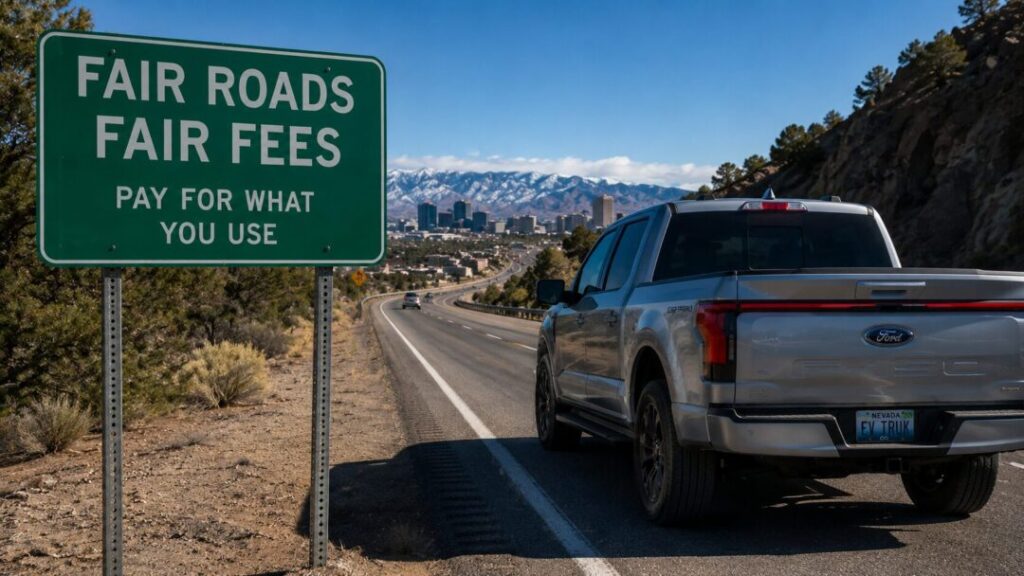
(D.C. Thornton) – As a conservative who owns an electric vehicle, I support the core principle behind Washoe County’s advisory ballot question: drivers should pay their fair share for the roads they use.
The user-pays model is a sound conservative idea rooted in personal responsibility—not wealth redistribution or green virtue-signaling.
The gas tax has long served as a rough proxy for road usage, and as more vehicles shift away from gasoline, that funding stream needs updating. Pretending the status quo is sustainable ignores basic math.
That said, the public discussion—often pitting “working-class” gas-truck drivers against “wealthy” Tesla owners while downplaying EV merits—risks turning a legitimate policy debate into divisive class warfare.
I’m not wealthy. I hold a middle-class job and bought a pre-owned EV because it made practical financial sense for my household. Lower long-term fuel and maintenance costs help stretch a regular paycheck.
Many other EV owners are in similar situations—not ultra-wealthy elites in brand-new luxury models.
The Funding Challenge Is Real—But Not an EV Crisis
EV registrations in Washoe County surged 407% from mid-2020 to mid-2024, and EVs plus hybrids now represent roughly 5% of the local fleet. This contributes to pressure on gas-tax revenue that funds hundreds of millions in local road projects.
The RTC-5 portion of the gas tax, now about 58 cents per gallon, is imperfect: it doesn’t perfectly track miles driven, vehicle weight, or out-of-state usage. Improving ICE efficiency has already eroded revenue for years. EVs accelerate the trend, but they are not the sole or primary villain.
A flat EV registration fee can serve as a reasonable interim bridge—over 40 states already have them. But the better long-term conservative solution is a technology-neutral mileage-based Road Usage Charge (RUC or VMT fee) applied to every vehicle—gas, hybrid, diesel, and electric.
Pay for what you actually use. Account for heavier vehicles causing more wear. This modernizes the user-fee principle without discriminating by powertrain or creating new classes of drivers.
EVs Align With Conservative Values
Conservatives should not reflexively oppose EVs. In addition to innovative technologies, many of us chose them for practical, pocketbook reasons:
• Dramatically lower operating costs—electricity versus gasoline, plus far fewer maintenance items like oil changes and brake jobs thanks to regenerative braking. These savings stay in families’ pockets rather than flowing to oil companies or repair shops.
• Greater energy independence. Reducing reliance on volatile global oil markets and OPEC strengthens national security—a classic conservative priority.
• Market-driven American innovation and jobs. Tesla’s Gigafactory Nevada has delivered billions in investment, thousands of direct and indirect jobs, and substantial economic activity in the Reno-Sparks area—far exceeding initial projections. This is free enterprise delivering results in our own backyard.
Pre-owned EVs make the technology accessible to middle-class buyers who want to cut monthly expenses. Higher upfront prices on new vehicles also mean many EV buyers pay more in sales taxes at purchase. The narrative that all EV owners are freeloading elites subsidized by working-class gas drivers is overstated.
I agree with critics that federal subsidies and mandates have distorted the market and should be reformed or phased out. Let consumers choose based on real economics.
But once someone buys an EV on the merits—like I did—hitting them with punitive extra fees framed as “fairness,” while ignoring broader inefficiencies, is poor policy.
What “Fair” Taxation Actually Means
A conservative EV owner wants equitable user fees, not special treatment or special punishment:
• Support an interim EV registration fee if it approximates the average gas-tax contribution of a comparable vehicle and is dedicated strictly to roads.
• Strongly prefer shifting toward a mileage-based system for all drivers. This is fairer, more sustainable, and avoids zero-sum framing.
• Demand transparency and safeguards: No fund diversion to other priorities. No bloated bureaucracy. Revenue-neutral where possible. Learn from past ballot failures—voters rightly reject vague or excessive new taxes.
The advisory question asks voters whether EVs should contribute. On that narrow principle, many conservative EV owners would say yes.
The real work is ensuring Carson City designs follow-on policy intelligently rather than using EVs as a convenient new revenue target or culture-war proxy.
This Issue Extends Beyond Washoe County
Though the advisory question is specific to Washoe, I live in Clark County. The same challenges exist there on a much larger scale.
A patchwork of county-by-county EV fees risks inconsistency, higher administrative costs, and uneven treatment across Nevada.
A better approach is a fair, statewide mileage-based user fee that applies equally to everyone, regardless of where they live or register their vehicle.
Bottom Line
Roads need reliable funding. All users should pay their share based on actual use.
EVs are not the enemy—they represent technological progress, consumer choice, lower household costs for regular middle-class families like mine, greater energy independence, and American manufacturing strength right here in Nevada.
Conservatives can champion both innovation and fiscal responsibility.
Reject the false choice between “punish the EV drivers” and “let anyone use roads for free.” Implement fair, usage-based fees across the board. Keep the money dedicated to actual pavement. And recognize that market-driven electrification, when it makes economic sense for individuals, doesn’t require government hostility to succeed or fail on its own terms.
Washoe County voters should engage thoughtfully with the advisory question.
Support the principle of fairness—but insist on smart, neutral policy that doesn’t pit drivers against each other or turn EVs into a scapegoat for decades of transportation funding challenges. That’s the conservative way forward.
D.C. Thornton is a Clark County resident, conservative, and technology enthusiast. He commutes daily and road trips occasionally in a Ford F-150 Lightning pickup truck. The opinions expressed by contributors are their own and do not necessarily represent the views of Nevada News & Views.