Every legislative session, somebody stands up and talks about “diversifying” Nevada's economy.
I've heard it my whole life in this state. And I get why people say it. Nobody wants all our eggs in one basket.
But here's what I think we get wrong every time we have that conversation.
We act like diversifying means finding some brand new industry Nevada has never tried before. A chip plant. A data center. Something totally different from what built this state.
I say we're looking in the wrong direction.
Nevada already does one thing better than anywhere else in the country: Tourism and entertainment. Nobody touches us.
We should “stick to the knitting” and expand what we're already the best at instead of chasing something new and unproven.
Right now, that expertise stops at the edges of Las Vegas and Reno. And here's a problem most people don't think about.
A lot of visitors who fly into those two cities end up spending real vacation money in California, Arizona, and Utah.
They drive to the Grand Canyon. They drive to Zion. They drive to Lake Tahoe's California side.
Nevada gets them for a few nights – and then hands the rest of their trip and their money to our neighbors.
I think that's a missed opportunity, and I want to talk about a concept that could change it.
An Idea Bigger Than Two Cities
“Frontier Nevada,” the wide-open middle of our state, has attractions most people have never heard of.
- A national park, recently ranked the best stargazing spot in the entire country.
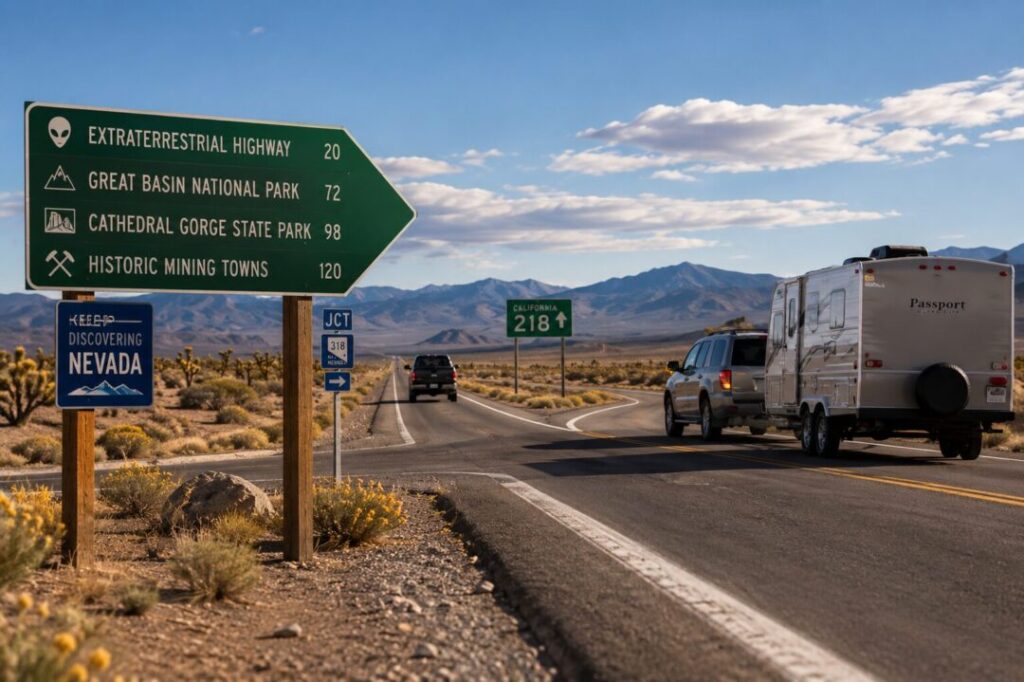
- A stretch of highway that's already famous nationwide as the Extraterrestrial Highway.
- Another one Nevada has proudly called the Loneliest Road in America for decades.
These places already draw visitors. What they don't have is a name, a map, and a reason for someone to plan a whole trip around them instead of driving straight to another state.
I recently obtained a copy of a concept document put together by Chuck Muth, president of Citizen Outreach Foundation, and former Nye County Commissioner Joni Eastley.
They're calling the idea “The Great Frontier Nevada Road Trip.” And after reading through it, I think it's exactly the kind of thinking Nevada needs more of.
It's the reason I'm writing this piece, and it's an idea I intend to pursue in the Legislature if elected in November.
The idea is simple: Take what's already out there and connect it into real, plannable road trips.
Give the routes names. Give people a reason to add two or three extra days onto a Nevada vacation instead of handing that time, and that money, to California, Arizona, or Utah.
Cheap to Start, Expensive to Ignore
Here's what I like most about this as a candidate for the Legislature.
Compare it to the usual diversification playbook. A chip fabrication plant or a data center can cost the state hundreds of millions of dollars in incentives before a single job shows up.
It can take a decade before we see a real return, if we ever do.
We just watched a version of this play out with AB5, the $1.8 billion film tax credit deal people around here call the “Hollywood Handout.”
That bill asked Nevada taxpayers to bet almost two billion dollars on the hope that a film studio would build jobs here someday.
I opposed it. My opponent championed it and voted for it.

I think that vote says a lot about the difference between us.
She was willing to hand Hollywood a $1.8 billion check on a promise.
I'd rather invest in something Nevada already knows how to do – and does better than any state in the country.
This concept starts with a map, a name, and a marketing push. That's it. Almost no cost to get moving.
If it works, and I believe it will, the infrastructure conversation, dump stations, hookups, better cell coverage, comes later, once we've proven people actually want to make the trip.
We don't have to bet the farm to find out.
Nevada already knows how to sell an experience. We've been doing it since the day Las Vegas decided a patch of desert could become the entertainment capital of the world.
Nobody built that with a spreadsheet. They built it by being bold enough to sell something nobody else had.
Frontier Nevada is the same instinct, aimed at a part of the state that's never gotten the same shot, and aimed at keeping tourist dollars inside our own borders instead of watching them drive across state lines.
Why This Matters for Frontier Nevada's Future
I'll be blunt about something else. A lot of our small towns are dying, and it's not because the history and the scenery aren't worth seeing.
It's because there's nothing keeping young people there.
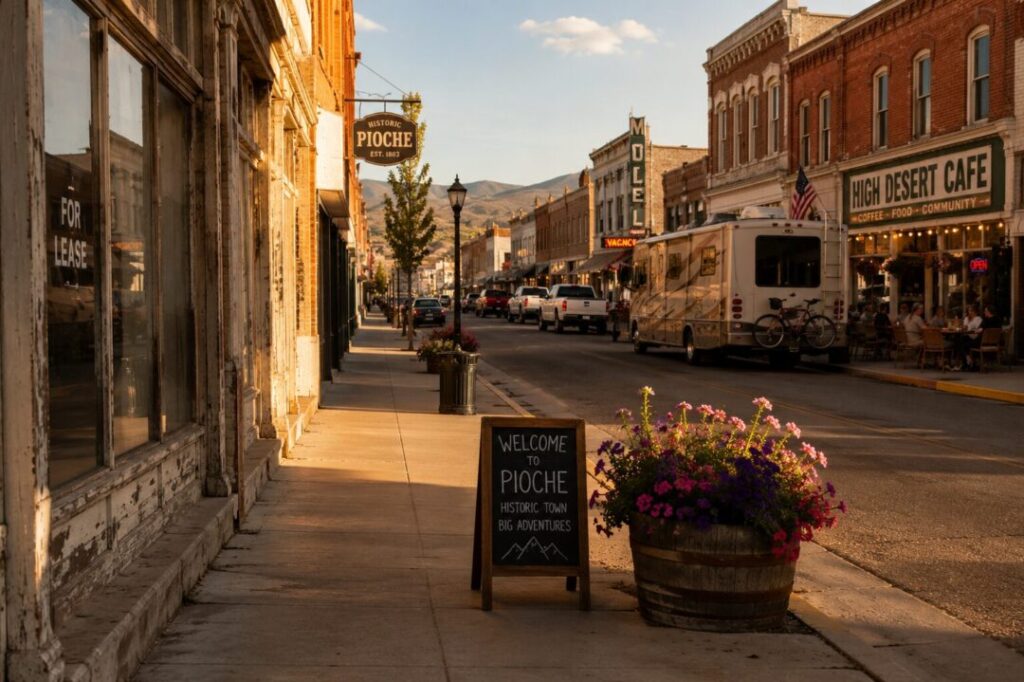
A kid grows up in Tonopah, or Pioche, or Ely. They graduate high school. And then what?
If there's no job waiting for them at home, they leave. They move to Las Vegas, or Reno, or out of state entirely.
And every time that happens, a little more of that town's future leaves with them.
That's how a living community slowly turns into an actual ghost town. Not overnight. One graduating class at a time.
Tourism is one of the only economic engines that can reach these towns without waiting on a mine to reopen or a factory to relocate there, neither of which most of these communities can count on.
A motel that stays busier longer into the season needs more staff.
A diner that sees more travelers needs more cooks and more servers.
A guide business, a gift shop, a mechanic shop that starts seeing more RV traffic.
All of it needs people. Real jobs, in the town where people already have roots, family, and history.
That's not a side benefit of this idea. That's the whole point.
Give these towns a reason for their own kids to build a life there instead of leaving, and you don't just save a local business. You save a town.
Skin in the Game
I own the Alien Research Center at the start of the Extraterrestrial Highway near Alamo. It's one of the stops on the Frontier Nevada concept.
Because I've spent years running a tourism business on this exact stretch of highway, I don't just think this idea will work. I know it will.
I've seen firsthand what happens when travelers are given a reason to pull off the highway and stop somewhere they didn't know existed.
A Job for the Lieutenant Governor
Nevada's lieutenant governor chairs the state's Commission on Tourism. That's not a side responsibility. It's one of the core jobs the office holds.
I'd love to see Lt. Governor Stavros Anthony take a close look at this concept and run with it.
He's already talked about big, bold ideas for growing Nevada's tourism economy and Frontier Nevada is exactly that kind of idea – and it's one that's ready to go right now, not years down the road.
I'd welcome his office's support in getting this off the ground, because this is precisely the kind of statewide tourism leadership his office was built for.
What This Doesn't Cost You
I know some people will read this and think it sounds like a gimmick. Aliens and ghost towns as economic policy.
But I'd remind those folks that Las Vegas was built on exactly that kind of unapologetic, big swing idea, and it's the most successful tourism economy in the country.
Nevada has never been shy about selling an experience. This is the same play, running in a part of the state that's been waiting its turn.
This concept doesn't ask the Legislature for a dime today. It asks us to think bigger about what “diversifying” Nevada's economy actually means.
And to stop letting our own tourists spend their vacation money in somebody else's state.
I don't think diversifying means chasing an industry that belongs to some other state. I think it means finally letting the rest of Nevada in on the one thing we already do better than anybody else.
Frontier Nevada has been sitting there the whole time, waiting for someone to give it a name and a map. I think it's time we did.
The opinions expressed by contributors are their own and do not necessarily represent the views of Nevada News & Views. Digital technology was used in the research, writing, and production of this article. Please verify information and consult additional sources as needed.