(Jeff Carter) – One of the problems all Nevada politicians are trying to figure out is how to diversify the tax base. Basically, Nevada runs on tourism and mining. Both can be irregular forms of tax revenue. Tourism is subject to a lot of variability. Mining is subject to the prices and demand of the commodities being mined.
Why is it important?
It’s not just about jobs. It’s also about the state’s credit rating. I wrote about that extensively here. TL;DR, state treasurers have very little impact on the state’s credit rating. It’s about the diversity of tax revenue, demographics, and other factors. The credit rating agencies have a formula. It’s not like you can go argue and make a case for yourself. It’s about numbers.
I diversified the tax base in Chicago. In 2007, there was little to no venture investment in the city. Last year, the city saw $2.5 billion in investment.
How did it happen?
The answer is, the government didn’t do it. Private citizens did it. Private dollars did it.
How can electing me as State Treasurer help Nevada diversify the tax base?
That’s a great question. When it comes to building a startup ecosystem, I know the blueprint. I can advise and help guide it. I can show people the structure and where the pitfalls are. I helped many angel groups and ecosystems get their start. But quite frankly, startup ecosystems are funder and entrepreneur-led, not government-led.
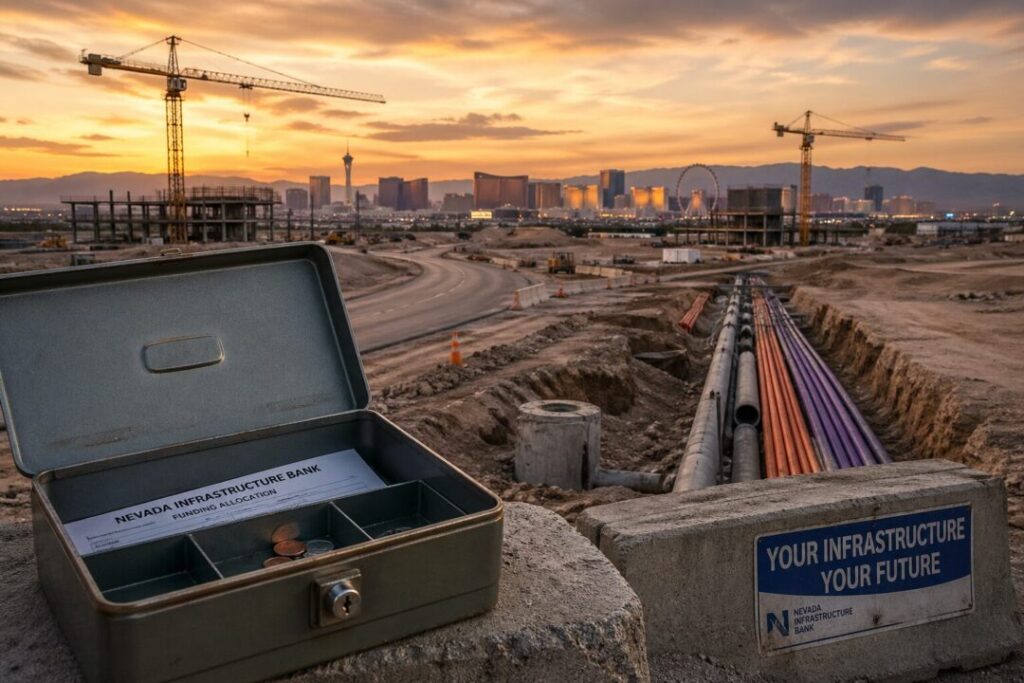
However, there is the Nevada State Infrastructure Bank(SIB). A lot of Nevadans do not know about the infrastructure bank. The Treasurer chairs the bank’s Board of Directors.
The 2021 legislature deliberately broadened the definition of “infrastructure” beyond roads and bridges to include:
- Transportation and utility infrastructure
- Broadband / digital infrastructure
- Affordable housing
- Charter schools
- Water and wastewater
- Renewable energy and recycling
- “Social infrastructure” — health care, homelessness, food insecurity
That last category — “social infrastructure” — is where the bank’s mandate got loose. This isn’t how state infrastructure banks work in most other states. Most SIBs (California, Florida, Texas) are strictly for physical infrastructure. Nevada is effectively a general-purpose social-purpose lender.
DEI/ESG investing never works. It doesn’t work for the SIB either.
One problem is that the bank has $0 in initial bond proceeds remaining. The entire $74.6 million capitalization has been committed. It’s now operating solely on investment income and loan repayment revenue.
Governor Joe Lombardo’s budget and the Assembly passed SB 502, recapitalizing the SIB in the 2025 Capital Improvement Program. The Nevada State Senate stripped that funding out. The annual report explicitly flags this: $29.1 million in pending projects cannot be funded because of it.
Governor Lombardo proposed $150 million in new GO bonds for the SIB, split into two $75M tranches. The second tranche would have been coordinated with a new Community Infrastructure Investment Fund for rural housing and economic development. The Assembly approved it. The Senate killed it.
If we look at other states that have similar infrastructure bank structures, the banks are funded in the billions, not millions. Governor Lombardo is on the right track.
The SIB was sold as an infrastructure bank. Its mandate now includes domestic violence shelters, charter school facilities, and hospital PT clinics. The”infrastructure bank” has become a euphemism for “general-purpose loan fund” that picks winners and losers based on political priorities, not capital allocation discipline.
I would tighten eligibility to physical infrastructure that generates a measurable public return. That measurable return is how you can start to build a base so that the economy can diversify.
As a venture capitalist, I have structured capital stacks professionally. The SIB’s loan pipeline suggests projects are being evaluated individually rather than systematically. A professional approach would mean:
- Published underwriting standards
- Clear risk-pricing framework
- Transparent eligibility criteria (the Treasury staff admitted at the October 2025 legislative subcommittee that SIB has not finalized eligibility rules for potential forgivable loans — that’s an extraordinary admission)
- Pooled financing structures to let small rural counties access better pricing
Nevada’s Infrastructure Bank has deployed its entire initial $75 million capitalization in four years, has $26 million in undisbursed commitments, another $12 million in applications pending, and $30 million in expected projects it cannot fund. Governor Lombardo tried to recapitalize it, but the State Senate gutted that idea. This is another reason it is important to turn over three seats in the State Senate, so Republicans have control.
The bank has no permanent Executive Director. Its eligibility rules are still being finalized. And it’s sitting on $14.5 million earmarked for an MLB stadium while rural hospitals and water districts wait in line. As Treasurer, I would run this as a professional capital allocator, published underwriting standards, clear rural pooling mechanisms, measurable return-on-investment criteria, not as a grab-bag of political priorities.
The opinions expressed by contributors are their own and do not necessarily represent the views of Nevada News & Views. This article was originally published via JeffreyCarter.substack.com on 4/24/2026.