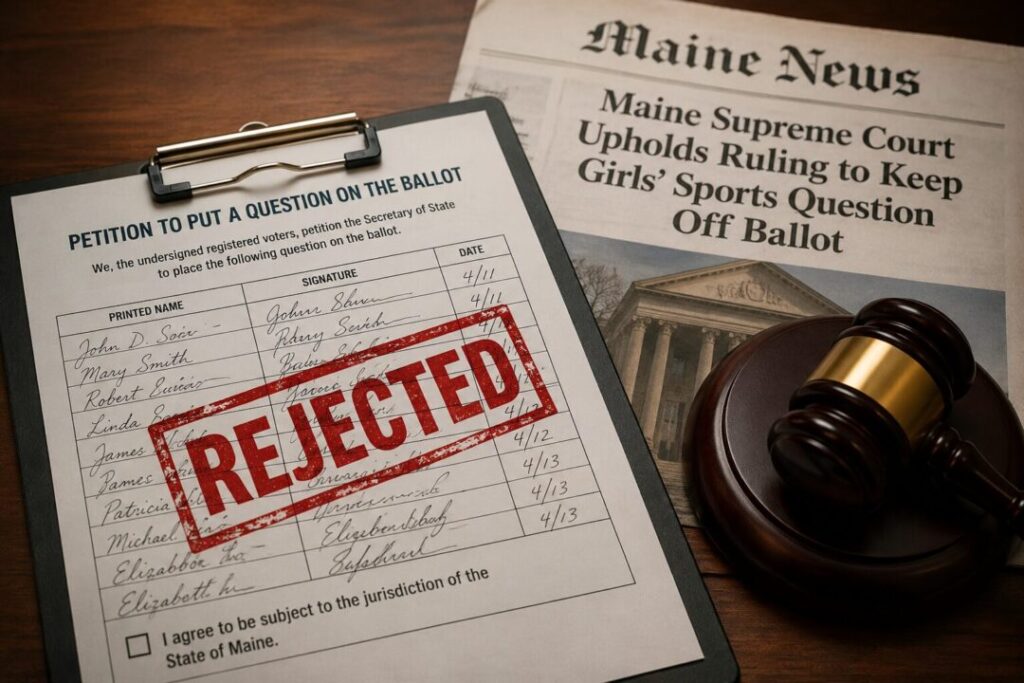
Ballot Question Dies by a Technicality, Not a Vote – Democracy Died with It
Nearly 80,000 signatures collected for a ballot question, only to have a judge toss it out over an unchecked box on a form.
That's what just happened in Maine.
On Friday, the Maine Supreme Judicial Court upheld a decision to keep a girls' sports protection question off the November ballot.
The measure would have required schools to base sports teams, locker rooms, and bathrooms on a student's biological sex, listed right there on the original birth certificate.
Simple. Clear. Fair.
Voters never got the chance to decide.
A group called Protect Girls Sports gathered close to 80,000 signatures, well above the roughly 67,700 needed.
Secretary of State Shenna Bellows, a Democrat now running for governor, first said the petition qualified. Then opponents sued.
After a review, election officials tossed out more than 12,500 signatures. The petition fell 532 signatures short.
Why? Mostly because four out-of-state circulators didn't check a box agreeing to Maine's legal jurisdiction.
That's it. Real Maine voters signed real petitions with real names, and their voices got wiped out over paperwork four hired workers filled out wrong.
The court didn't rule on whether boys should compete against girls. It ruled on a box.
In its unanimous decision, the justices wrote that Bellows was “not only authorized, but was constitutionally bound” to toss those signatures.
One circulator even tried to fix her form months late. The court said too bad, the deadline is the deadline.
Here's what should bother every fair-minded person, conservative or not.
Lawmakers in Maine's Democrat-controlled legislature already refused to touch this issue. So citizens did what citizens are supposed to do.
They organized. They knocked on doors. They got the signatures the constitution requires. And the government still found a way to say no.
Just weeks earlier, the U.S. Supreme Court upheld state laws in Idaho and West Virginia that keep biological males off girls' teams, citing basic fairness and safety for female athletes.
That ruling doesn't force Maine's hand, but it shows where the country is heading, and where the courts increasingly agree that biology matters in sports.
Nevada isn't Maine. But we've had the same fight here, and I've been proud to co-sponsor Protect Girls' Sports legislation in our own state.
The lesson from Maine applies just as much to us.
When elected officials won't act, and when the people try to force the issue through petitions, the process to get a question on the ballot can become a maze designed to trip up citizens, not empower them.
Girls in Nevada deserve fair competition. They deserve locker rooms and showers that respect their privacy.
Most Nevadans, like most Americans, agree with that in poll after poll.
The question isn't whether voters support protecting girls' sports. The question is whether the system will let them vote on it at all.
Protect Girls Sports says it isn't done. The group can still gather new signatures for a future election. Maine voters may get their say yet.
Here in Nevada, we can't afford to wait for the courts to decide whether our daughters get a fair shot. We need to keep pushing, in the legislature and at the ballot box, until the job gets done.
The opinions expressed by contributors are their own and do not necessarily represent the views of Nevada News & Views. Digital technology was used in the research, writing, and production of this article. Please verify information and consult additional sources as needed.