(Lyn Hellegaard) – Montana families know when something bigger is happening than the headline suggests.
Last week, the Montana Supreme Court issued a ruling in Kalarchik v. State of Montana that temporarily blocked enforcement of state policies tied to biological sex on government documents.
Many news stories framed it as a paperwork dispute over IDs. But let’s be honest. Most parents know this debate doesn’t stop at driver’s licenses.
When courts declare that transgender discrimination is automatically sex discrimination under the Montana Constitution, the legal ripple effects can spread far beyond forms and filing cabinets.
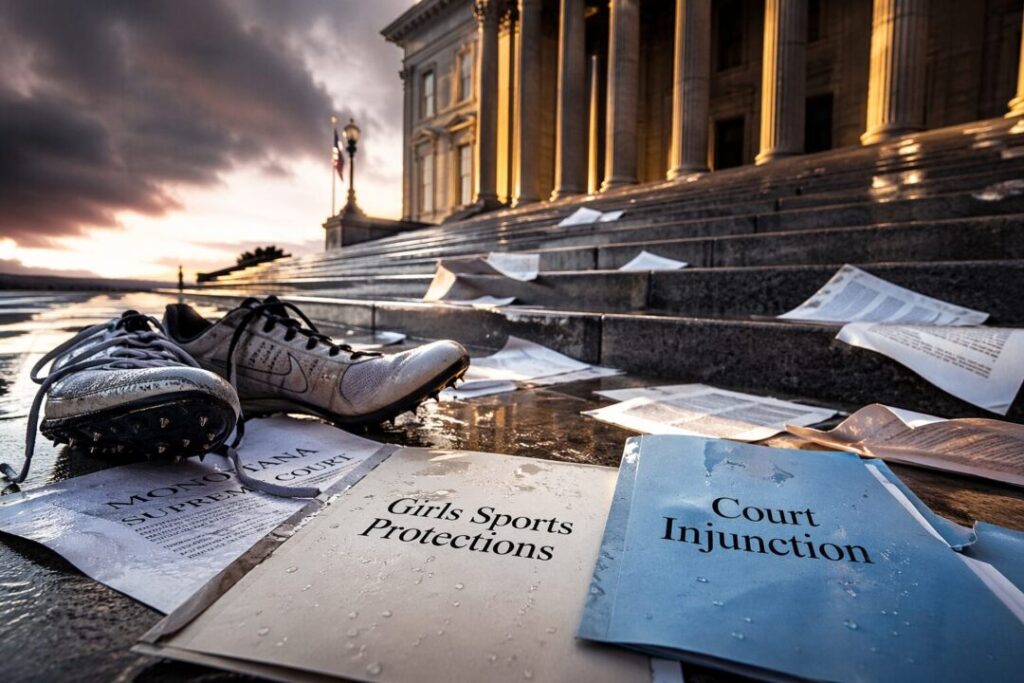
They can reach schools, locker rooms, scholarships, and girls’ sports. That’s why this ruling matters so much.
For years, women fought for fair athletic opportunities. Title IX helped open doors for girls and women who were often pushed aside. It created chances to compete, earn scholarships, and succeed through hard work.
Now many families worry those gains are being chipped away.
The concern is simple. If biological males are allowed to compete in female divisions, the playing field changes. Size, strength, speed, and physical development matter in sports.
That is not hate. That is reality.
Ask any coach.
Ask any parent who has watched a daughter train for years, only to lose a roster spot, podium finish, or scholarship chance because adults were too afraid to speak plainly.
Supporters of these policies argue inclusion matters and every student deserves dignity.
That’s true. Every person should be treated with respect. But respect does not require pretending men and women are physically identical in competition.
Government has a duty to protect fairness, not erase it.
This Montana court ruling may only be a preliminary injunction for now. The full case is still pending. But courts often lay groundwork long before the final whistle blows.
That’s why voters should also pay close attention to Constitutional Initiatives CI-131 and CI-132. These ballot measures would make Montana judicial races nonpartisan.
Supporters say that sounds fair and neutral. But many Montanans are asking who benefits when voters get less information about judges, not more.
Reports have tied support for these efforts to well-funded out-of-state interests.
That should concern every citizen who believes Montana courts should answer to Montana values, not national political money.
Judges already wield enormous power. We just saw that with this ruling.
If voters are stripped of party labels and other useful cues, many races will become low-information contests dominated by slick advertising and outside cash. That’s not reform. That’s camouflage.
And when judicial elections become easier to influence, families may wake up years later wondering why courts keep moving farther from common sense.
Montana is not alone. What happens here can become a model elsewhere.
Nevada, for example, has faced similar debates over women’s sports, school privacy, and activist-backed legal strategies.
So this is about more than one case and more than one election rule. It’s about whether moms and dads still get a voice when core truths are challenged.
Can girls count on fair competition? Can voters clearly judge the judges? Can Montana keep self-government in Montana hands?
I believe we can. But only if citizens pay attention now, not after the damage is done.
The warning light is blinking. Let’s not wait until The Last Best Place is only a fond memory.
Lyn Hellegaard is a former Montana state legislator, longtime conservative activist, and strong advocate for protecting women’s sports, parental rights, and constitutional government. The opinions expressed by contributors are their own and do not necessarily represent the views of Nevada News & Views. Digital technology was used in the research, writing, and production of this article. Please verify information and consult additional sources as needed