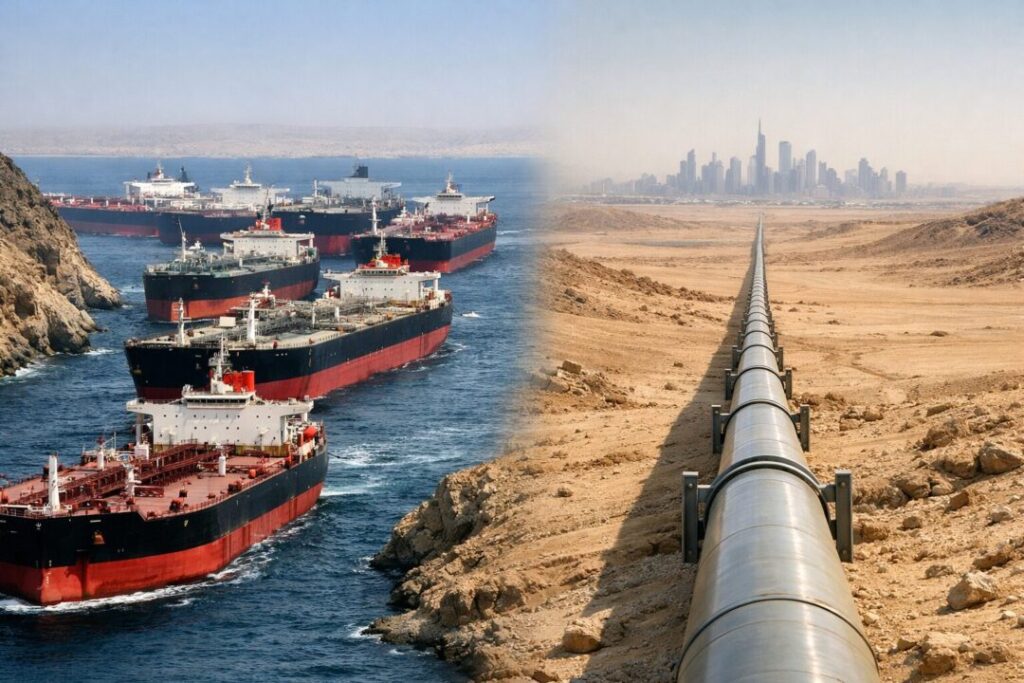
As Nevada residents have watched events unfold internationally and in Iran over the past seven weeks, large numbers of Americans have learned, likely for the first time, how dependent many Southeast Asian and European countries are on Middle East oil.
The Iranian Revolutionary Guard Corps (IRGC) closed the Strait of Hormuz in early March 2026 in response to attacks from the United States (U.S.) and Israel on Iranian targets that began on the morning of February 28, 2026. This closure of the Strait by the IRGC blocked a vital maritime passage for crude oil shipments.
Crude traders and the oil markets react to each breaking development and piece of news regarding this maritime passage since roughly 20 percent of global crude oil sales on water pass through the Strait of Hormuz.
That is why prices for gasoline and diesel fuel at the pump in Nevada have jumped in recent weeks, even though the U.S. is not dependent on Middle East oil.
Following the initiation of the Iran conflict, oil prices spiked significantly, with Brent crude oil produced from offshore fields in the United Kingdom surging from around 70 U.S. dollars ($70) per barrel to peaks exceeding $110 per barrel by late March and early April 2026 on the Intercontinental Exchange (ICE) in London.
The benchmark grade for U.S. crude oil trading using New York Mercantile Exchange (NYMEX) near-month futures contracts having a physical delivery point in Cushing, Oklahoma has also reached highs of over $100 per barrel.
Even after the conflict is resolved, it may take several weeks or months for retail liquid fuel prices to go back to their earlier levels.
The geography of the Strait of Hormuz makes this energy “pipeline” vulnerable and easy to disrupt. Only 21-miles wide (approximately 33 kilometers) at its narrowest point, the Strait is a strategic chokepoint through which around 20% of global oil trade passes when this route from the Arabian Gulf into the Gulf of Oman is not blocked.
Large quantities of the entire world’s liquified natural gas (LNG), nitrogen fertilizers, and chemicals also are sourced from the Middle East region and transit through the Strait of Hormuz.
Japan sits at the very top of a list of countries in Southeast Asia with a remarkable 93 percent dependence on energy flowing from the Middle East in the months leading up to the war with Iran.1 South Korea is number two on this list at only 67 percent. China gets 45 to 50 percent of its crude oil and 30 percent of its LNG imports through the Strait.
Japan’s long-term contracts, shipping routes, and oil refineries have all been heavily geared toward major suppliers of oil in the Arabian Gulf (also known as the Persian Gulf). Japan is currently facing significant fuel supply challenges due to shipments of Middle East oil via the Strait of Hormuz being disrupted.
As of April 2026, the country of Japan is experiencing rapidly falling gasoline, jet fuel, and diesel inventories. Daily operations of Japan’s manufacturing industries have been disrupted due to fuel shortages.
The Japanese government is now releasing national oil reserves held in aboveground storage tanks.
Those barrels of crude oil reserves are now being processed into fuels in Japan’s refineries in lieu of oil shipments from the Arabian Gulf so as to meet demand for liquid fuels and replenish stocks of transportation fuels until such time as the U.S. Navy clears underwater mines placed by Iran and establishes a safe route for the ships of U.S. allies such as Japan through the waterway.
In the meantime, oil tankers will likely be loading cargoes of light and sweet West Texas Intermediate (WTI) crude oil at Gulf of America ports along the U.S. Gulf Coast in Texas. WTI is comparable to Iranian grades of crude lifted from Kharg Island in the Arabian Gulf.
Not unlike the Japanese, Southern Nevadans are highly dependent on a single source for our liquid transportation fuels (gasoline, jet fuel and diesel) – California refineries.
California has regulated itself into an energy crisis which is threatening to take Southern Nevadans along for the (unwanted) ride.
Phillips 66 shuttered its Wilmington facility in October 2025. Valero has announced plans for the closure of its 170,000-barrel-per-day refinery in Benicia, California by the end of this month (April 2026).
Together with the Phillips 66 plant, these closures represent a reduction of around 20 percent of California’s total refining capacity.
This raises serious concerns about surging gasoline and diesel prices, not only in California, but also in Nevada and Arizona.
Both companies (Valero and Phillips 66) cited stringent environmental regulations (stricter than federal standards applicable in most states) for producers of refined products, rising compliance costs, and a generally hostile regulatory posture towards the fossil fuels industry.
The last straw for these two refining companies was likely “Gov. Nuisance’s” plan signed into law in October 2024 to empower the California Energy Commission to mandate that oil refiners maintain minimum gasoline storage levels.
Ostensibly, this measure was to prevent spikes in gasoline prices in California caused by low supplies and volumes in inventory during planned maintenance (called “turnarounds”) or unplanned refinery downtime.
Instead, it has given impetus to oil companies to exit the State of California and to permanently “turn out the lights” – shut down oil refining capacity.
Further, in January 2026, the California Air Resources Board (CARB) posted materials regarding a proposal for new gasoline regulations that would require a sharper near-term trajectory and reductions toward California’s 2030 statewide vehicle emissions targets beginning in 2027. CARB’s Board is scheduled to consider the more stringent emissions regulations in late May 2026.
Southern Nevadans have no control over these developments in California.
Nevada Republican Governor Joe Lombardo did send a letter to Gov. Newsome dated March 9, 2026, expressing concern if these new Cap-and-Invest regulations were to go into effect in California. There would likely be a substantial impact on fuel prices for the citizens of Nevada.
More broadly, there would be definite implications for seasonal fuel supply stability in the Western States, especially Nevada.
It is unlikely that discussions between administrators in the two States would change the course that has been set.
Moreover, the main artery for delivery of liquid fuels from California to the Las Vegas Valley and surrounding areas is the CALNEV pipeline, operated by Kinder Morgan. The CALNEV pipeline supplies approximately 90 percent of Southern Nevada’s transportation fuels, including gasoline, jet fuel and diesel.
This is our own “strategic chokepoint.”
Within a few days of this one pipeline system being taken out of service, we see a shortage of jet fuel for refueling those commercial airplanes bringing tourists into Harry Reid International Airport and taking guests home, plus lines at retail gasoline stations in Clark County as inventories fall at local fuel products terminals.
The CALNEV pipeline has experienced unplanned downtime in recent years. Most recently, in January 2025, the CALNEV pipeline was shutdown for about a week.
The root cause of the unplanned outage was wildfires in California. Electricity transmission lines feeding power to the electric motor-driven pumps located at Kinder Morgan’s petroleum products terminals in San Bernadino County along the CALNEV pipeline were deenergized as a precautionary measure to prevent the spread of those wildfires.
Previously, in February 2023, a leak was detected resulting from corrosion of steel lines comprising the CALNEV system that caused a shutdown for repairs of the main buried pipeline supplying roughly 90% of the Las Vegas Valley’s gasoline, jet fuel, and diesel.
This outage of several days severely affected and disrupted fuel deliveries to both Las Vegas and Phoenix, and prompted Gov. Lombardo to declare a state of emergency to facilitate deliveries of diesel fuel to North Las Vegas by rail and of additional gasoline by alternative means; specifically, the smaller diameter UNEV pipeline from Salt Lake City to Las Vegas owned by HF Sinclair Corporation.
There is little doubt that future unplanned downtime events will occur. The impact of those future CALNEV pipeline outages could be more severe as the population of the Las Vegas Valley grows.
Again, these events were and are out of our control as residents of Southern Nevada.
Gov. Lombardo has rightly responded to the stranglehold in which Democrat Governor Newsome’s administration and regulators in California have placed their neighbors to the east.
Gov. Lombardo has chartered a task force called the Nevada Fuel Resiliency Committee.
The Mission Statement for the Fuel Resiliency Committee is:
“To secure Nevada’s transportation fuel supply by identifying vulnerabilities, strengthening infrastructure, diversifying supply sources, and ensuring statewide readiness in the face of regional refinery closures, supply disruptions, and national security threats.”
Two open meetings of the Nevada Fuel Resiliency Committee have been held so far – on January 13, 2026, and on March 5, 2026. No recommendations have as yet been made public by the members of the Committee appointed by the governor.
We need to break our reliance on California as the primary source of our transportation fuel supplies. Like Japan, we need to diversify our supply sources.
And, similar to the Strait of Hormuz, the CALNEV pipeline is our “vulnerable pipeline” on which we are too dependent at present.
Nevadans need a viable and reliable alternative to California for our liquid fuel supplies.
Possible alternatives exist in Utah, in Texas and in the Midwest U.S. Those will be highlighted in a second article for Nevada News and Views.
By J. Mark Landrum, P.E., President – James Square Energy Advisors (Las Vegas & Houston). The opinions expressed by contributors are their own and do not necessarily represent the views of Nevada News & Views.