Market, Message, Media: The GOP’s Missing Sales Strategy.
Republicans have the better product. They just aren’t selling it very well.
That’s not a knock on conservative ideas. It’s a knock on how those ideas get sold.
The better product
Conservative policies work. Most readers here already know that. So let’s just review the basics.
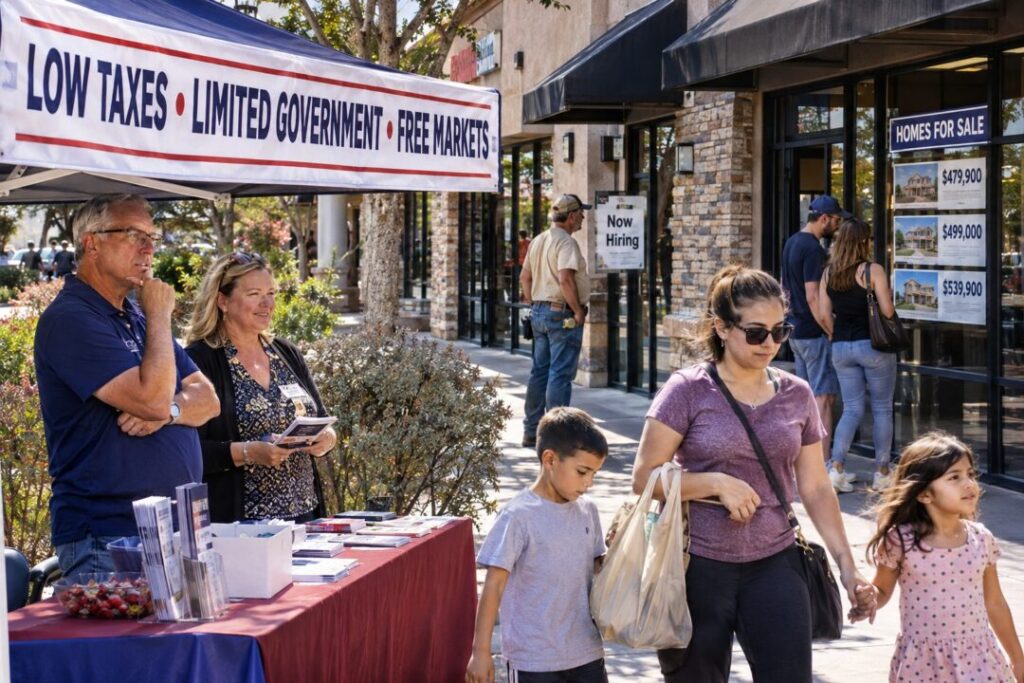
Low taxes. Limited government. Free markets. Individual liberty. Personal responsibility.
Those are the features. But voters don’t buy features. They buy benefits.
So here’s what those features actually mean in people’s lives.
Low taxes mean a bigger paycheck. More of your money stays in your pocket instead of going to the government.
Limited government means fewer bureaucrats telling you how to run your life, your business, or your family.
Free markets mean more choices and lower prices. Businesses compete for your dollar instead of the government picking winners and losers.
Less regulation means it costs less to build a house, open a shop, or hire a worker.
School choice means your kid isn’t trapped in a failing school because of your ZIP code.
Individual liberty means you make your own decisions. Not some politician. Not some agency. Not some bureaucrat.
That’s a pretty good product.
The competition is moving left
Meanwhile, the other side has been moving further and further left.
Democratic socialism used to be a fringe idea. Not anymore.
Self-described democratic socialists now hold seats in Congress, legislatures and city councils.
One has been elected mayor of New York City. Another was just elected mayor of Los Angeles.
Their pitch is simple. Free college. Free health care. Free housing. Free child care. Government-run grocery stores.
Free, free, free.
And here’s the problem for Republicans. “Free stuff” is an easy sell. It’s like a salesman offering a free car.
People don’t stop to read the fine print.
Nothing is free
Of course, nothing is actually free. Somebody always pays.
They pay through higher taxes. They pay through inflation that eats away at every paycheck. They pay through longer lines, worse service, and fewer choices.
“Free” health care means waiting months to see a doctor.
“Free” college means higher taxes on the plumber who never went.
“Free” housing means rent controls that make apartments disappear.
But here’s the catch. Those costs aren’t obvious.
The benefits of conservative policies aren’t always obvious either.
They have to be explained. They have to be sold.
That’s where Republicans keep falling short.
The three M’s
Every successful sales effort comes down to three things. Market. Message. Media.
Who are you selling to? What are you telling them? And how are you reaching them?
Get any one of those wrong, and you lose the sale.
Unfortunately, most Republican campaigns get all three wrong.
Market: who are you selling to?
Let’s start with who campaigns should NOT be spending money on.
Registered Republicans who vote in every election are going to show up.
And exit polls routinely show that 90% or more of them vote for the Republican candidate in any given race.
They’re already sold. Spending money to convince them is like a car dealer advertising to people who already bought the car.
Yet that’s exactly where many GOP campaigns spend much of their budget. Preaching to the choir.
So who should campaigns be targeting? Two groups.
The first is low-propensity Republicans. These are registered Republicans who vote in presidential years and stay home in other elections.
They agree with you. They just don’t show up.
The second is nonpartisan voters.
In poll after poll, more Americans now call themselves independents than Republicans or Democrats. They’re up for grabs.
But be careful here. Many states now register voters automatically through the DMV, and a lot of them get registered as nonpartisans. Plenty of them rarely vote.
So the real target is nonpartisans who are both persuadable AND likely to vote.
Otherwise, a campaign is paying to persuade people who’ll never cast a ballot.
Message: what are you telling them?
Here’s where most campaigns make another big mistake. They send the same message to everybody.
But these two markets need completely different messages.
Low-propensity Republicans don’t need to be persuaded. They already agree.
What they need is a reason to vote in an election they might otherwise skip.
Maybe they think only the presidential race matters. Maybe they don’t know the candidates. Maybe nobody ever asked them.
The message to them is simple: this race matters, here’s why, and your vote is needed.
Nonpartisan voters are a different story. They need to be persuaded. They need a reason to pick the Republican over the Democrat.
And here’s what turns them off fast: the traditional loud, screaming attack mailer. Grainy black-and-white photos. Ominous music. Big red letters.
Nonpartisans chose not to join either party. Many of them are sick of the yelling.
Hit them with a typical attack ad, and they tune out. Some even hold it against the candidate who sent it.
So what works instead?
Calm contrast. Lay out the differences between the candidates in a straightforward way.
Real people. Let neighbors, local business owners, and community leaders vouch for the candidate.
Specific solutions. Talk about real problems in their community and what the candidate will do about them.
Respect. Treat the voter as smart enough to make up their own mind.
And one more thing. Don’t lead with the party label.
These voters chose not to be Republicans. Lead with the issue and the candidate. The “R” can come second.
Media: how are you reaching them?
Now that you know who you’re targeting and what you’re saying, how do you reach them?
This is where campaigns waste the most money.
Think about a TV ad. Who sees it?
Kids. People from out of state. People who aren’t citizens. People who aren’t registered. Diehard Democrats who’d never vote Republican. Loyal Republicans who were voting for you anyway.
Only a small fraction of the people watching are in your target market. But you pay to reach every one of them.
Radio and newspaper ads have the same problem. They’re mass media. They reach the masses.
That’s fine for Coca-Cola, which wants to sell soda to everybody. It’s a terrible deal for a campaign that needs to reach a few thousand specific voters.
What about digital ads? They’re often sold as “targeted.”
But the targeting is spotty at best. Matching voters to their online accounts is hit-and-miss.
You can’t be sure who actually saw your ad. And plenty of voters aren’t on social media at all.
But every registered voter has one thing in common. A mailing address.
That’s why targeted direct mail is the most precise, most reliable tool a campaign can buy.
You pick the exact voters. You send them the exact message meant for them. And you know it landed in their mailbox.
Low-propensity Republicans get one message. Persuadable nonpartisans get another.
No wasted money on people who’ll never vote, or who’ve already made up their minds.
Personal phone calls from real people are another good tool.
They reach the same targeted voters, and a real conversation can go a long way. Door-knocking works too, but it eats up an enormous amount of time.
For a campaign with a limited budget, though, targeted mail should be the backbone.
The best product doesn’t always win
History is full of great products that lost to inferior ones with better marketing.
Coca-Cola is one of the most famous brands on Earth. It still spends a fortune on advertising every year.
Why? Because the company knows that the moment it stops selling, a competitor will happily take its place.
Republicans need to learn that lesson.
Having the better ideas isn’t enough. Those ideas have to be sold. To the right market. With the right message. Through the right media.
Republicans don’t have a political problem. They have a marketing problem.
And marketing problems can be fixed.
The opinions expressed by contributors are their own and do not necessarily represent the views of Nevada News & Views. Digital technology may have been used in the research, writing, or production of this article. Please verify information and consult additional sources as needed.