She calls it protecting a right. The record shows a decade-long campaign to take doctors, hospitals, and safety standards out of Nevada abortion law.
On June 24, 2022, the U.S. Supreme Court struck down Roe v. Wade in its Dobbs decision, handing abortion policy back to the states.
So what happened to abortion access in Nevada that day?
Nothing.
Nothing happened, because nothing needed to. Nevada’s abortion law had been settled since 1990, when voters themselves locked it in by direct referendum, a law no Legislature, no governor, and no court ruling out of Washington could touch without another statewide vote.
Dobbs changed the landscape in dozens of states overnight. In Nevada, it changed nothing.
Nicole Cannizzaro’s own reaction that day tells a different story. She wrote:
“Radicals on the Supreme Court are hellbent on stripping away our fundamental rights. It’s based on shameful ideology, not law. Nevada will remain a safe place for women to seek abortion care. As long as Democrats continue to govern, those rights will be protected in our state.”
Radicals on the Supreme Court are hellbent on stripping away our fundamental rights. It’s based on shameful ideology, not law. Nevada will remain a safe place for women to seek abortion care. As long as Democrats continue to govern, those rights will be protected in our state.
— Nicole Cannizzaro (@Nicole4Nevada) June 24, 2022
Read that closely.
She didn’t say Nevada’s protections were already locked in, immune to whoever held power in Carson City — because they were, and had been for 32 years. She said they’d hold “as long as Democrats continue to govern,” casting decades of settled law as a contingent, fragile thing that depended on her party staying in office.
That wasn’t true in 2022. And it’s not true today.
It’s the same framing she’d use a year later to justify writing her own amendment: treat three decades of very secure access as an emergency, so that a genuinely radical rewrite of how it’s regulated can be sold as merely protecting what’s already there.
What actually happened is that Cannizzaro spent years, both before and after Dobbs, building something considerably more aggressive than “protecting” a law that was never threatened: a legal framework with fewer checks at every step, culminating in an amendment that will appear on Nevada’s ballot this fall.
This is her record, bill by bill, and the pattern is impossible to dismiss.
2019: The environment she led into
In 2019, in her first year as Senate Majority Leader, Nevada’s Legislature passed Senate Bill 179, the “Trust Nevada Women Act.”
The bill’s sponsor was a different senator, Yvanna Cancela, but it passed through the chamber Cannizzaro ran, during the first year of full Democratic trifecta control in Carson City, and it set the terms everything that followed would build on.
SB179 did three things that matter enormously here. It removed the requirement that only a licensed physician could supply or administer medication to induce an abortion. This meant that going forward, a non-physician, including a partner, could provide the drug.
It repealed the requirement that a doctor verify a patient’s age before performing an abortion. And it eliminated the requirement that a doctor confirm a patient’s consent was given “freely and without coercion.”
This is not an abstract concern.
A 2022 survey of 1,060 UK women commissioned by the BBC found that 3% had been given a pill or substance to induce an abortion without their knowledge or consent.
In the U.S., men in multiple states have faced criminal charges for secretly dosing partners with abortion drugs — prosecuted under general poisoning and assault statutes, prosecuted under general poisoning and assault statutes, because until very recently, no state had a crime specifically covering it.
Louisiana became one of the first to close that gap, creating the crime of “coerced criminal abortion by means of fraud” in 2024.
Nevada has no equivalent law.
Instead, in 2019, they removed the one procedural safeguard that existed to catch it before the fact: the requirement that a doctor independently confirm a patient’s decision was her own, given freely and without coercion.
Nevada didn’t just fail to criminalize this specific act; it also repealed the safety checks in place to prevent it.
The bill’s original language went even further still: as introduced, its title included repealing parental notification requirements for minors outright. That provision was pulled in committee by its sponsor, not because of objections to it, but as she said, because it “convoluted the intent of the bill.”
Eliminating parental notification wasn’t shelved because anyone changed their mind. It was shelved for a more convenient vehicle— one that arrived four years later, carried by a different sponsor with a bigger office: Nicole Cannizzaro.
That 1985 law requiring parental notification has been in legal limbo, blocked and unenforced, for most of the last 40 years; hardly an emergency of any kind.
2021: Building without asking who’s watching
Two years later, Cannizzaro introduced her own bill: Senate Bill 190, allowing pharmacists to dispense hormonal contraceptives (the pill, patch, ring, and injectable shot) without a doctor’s prescription.
This is not an abortion bill; it concerns contrac eption, a different category of care.
But it belongs in this portrait because it shows the same instinct at work under her own name: replace a physician visit, where risk factors like blood-clot or stroke history get caught through direct examination, with a self-reported questio
nnaire filled out at a pharmacy counter.
The bill applies to patients of all ages, with no parental-involvement requirement in the record. It is real access expansion, and it is also a real reduction in clinical oversight specifically for the youngest patients.
2023: Her own bills, her own language
By 2023, Cannizzaro moved from building around the edges of abortion law to writing it directly.
In February, she introduced Senate Bill 131, shielding anyone who receives or provides an abortion in Nevada from prosecution under another state’s law. It passed with bipartisan support and is the most defensible bill in her record on its face.
But announcing it, Assembly Speaker Steve Yeager, flanking Cannizzaro’s push, declared Nevada would:
“never allow extremists to rollback a woman’s right to choose.”
That framing, casting any regulation anywhere as extremism, is not incidental. It recurs across everything that follows.
A month later came the bill that defines her legacy: Senate Joint Resolution 7, now Question 6, up for its final, binding vote this November.
Cannizzaro didn’t co-sponsor this one; she wrote it, with 40 Democratic co-sponsors behind her from the start.
Announcing it, she said:
“The Supreme Court failed Nevadans when it upended fifty years of law to overturn Roe v. Wade. In light of that decision, Nevadans deserve an opportunity to decide for themselves whether to enshrine reproductive freedoms into our state constitution.”
That sentence does not survive contact with what the bill does.
Nevada’s abortion law has required a public vote to change, in either direction, since 1990. Nevadans already decide for themselves, and have for 35 years.
What SJR7 actually changes is the standard: it r
eplaces a fixed statute with a constitutional right subject to court-decided “strict scrutiny,” meaning any future health, safety, or licensing rule has to survive a legal test decided case by case by judges. Not the voters, and not the Legislature.
The bill marketed as “letting Nevadans decide for themselves” removes Nevadans’ ability to decide anything further, short of an extraordinarily difficult two-election process to claw it back.
It also strips out two specific safeguards that current law has held in place since 1973.
Under NRS 442.250, only a licensed physician may perform an abortion in Nevada, and any abortion performed after 24 weeks must be performed in a hospital licensed under state law.
Question 6 carries neither guardrail forward.
Its text protects abortion “whenever the abortion is performed by a qualified health-care professional,” not “a physician,” the current statutory standard. It sets no hospital-setting requirement for late-stage procedures at all. And it replaces the fixed 24-week marker with “fetal viability” alone, defined by nothing but the treating provider’s own judgment, case by case, with no statutory number attached.
Taken together, that means a non-physician could perform a late-term abortion in an outpatient clinic up to birth, with no hospital-level equipment or emergency capacity required by law. This is a dangerous combination of that the current Nevada statute doesn’t permit.
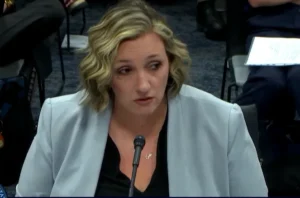
At the SJR7 hearing, Republican lawmakers asked Cannizzaro directly whether the amendment would let a preteen obtain an abortion without her parents’ knowledge, or allow abortion up to the point of birth. She wouldn’t answer either question:
“To get into very specific hypotheticals ignores what SJR 7 is doing, which is establishing a right.”
The text explains why she couldn’t just say no: it protects “all individuals” with no age carve-out, and defines “fetal viability” not as a fixed point in pregnancy but as whatever the treating provider determines, case by case.
Asked to rule out the two most extreme readings of her own bill — a minor with no parental involvement, and a procedure performed by a non-physician in an outpatient setting up to the point of birth — its own author declined.
Notice the shape of it, because it’s the same shape every time. The pill, the shot, the abortion itself: pharmacists and other providers step in where a doctor used to stand, and the doctor’s role, consent requirement, and age verification step out right along with them.
SB190 replaced the physician’s exam with a self-reported questionnaire. SJR7 replaces the physician requirement itself for the procedure that carries the most risk.
It’s not three separate stories. It’s the same substitution, made three times, each one further along than the last.
2025: The pattern completes itself
As a candidate for Attorney General, Cannizzaro sponsored one more bill: Senate Bill 217, mandating Medicaid coverage for IVF treatment.
It passed the Senate 15–5 with Republican votes. Governor Lombardo vetoed it, citing the unfunded cost to the state budget, while saying plainly he supports expanding IVF access.
Rather than engage that objection, Cannizzaro said Lombardo was “bowing to pressure from far-right anti-abortion activists,” a claim his own veto message doesn’t support, and one that not even her own party’s outgoing Attorney General endorsed in his criticism of the veto.
It’s the same move as 2023’s “extremists” line: when the actual objection is a budget number, reach for “far-right” instead of an answer.
What the portrait actually shows
Reasonable people in a pro-choice state can support contraceptive access, or a safe-haven law, or even sympathize with wanting IVF covered.
What the full record shows is not a position; it’s a method. Bill after bill, across three sessions and two different offices, the throughline is the same: reduce the checkpoints (physician-only distribution, age verification, coercion-free consent, in-person exams, a fixed viability standard, legislative and voter oversight), and when asked to explain or defend the reduction, respond with “extremist” or “far-right” instead of a direct answer.
Go back to where this allegedly started.
Dobbs fell, and Nevada’s law didn’t move an inch. It was never going to, no matter who sat on the Supreme Court. Nicole Cannizzaro called that day devastating anyway, and told Nevadans their rights would hold only “as long as Democrats continue to govern.”
She wasn’t describing the law. She was describing her own plan for it: an emergency that didn’t exist, used to justify a rewrite that did.
That rewrite is now four bills deep, and it started before Dobbs ever gave her a crisis to point to. And every version has moved in the same direction: fewer checks, no restorations, and a constitutional amendment that would put matters of safety and regulation out of reach.
Nevada is being asked this November to ratify not a protection, but a method: trade the basic safety standards the public can read, question, and change, for whatever one senator wrote and then wouldn’t explain when asked to her face.
That senator is now asking Nevada to make her its chief law-enforcement officer.
Cannizzaro built her career upon calling other people radicals: the Supreme Court, Lombardo, anyone who asked her a direct question about her own bill. Read the record, and the label lands on her.
She is the one who stripped the physician’s exam and replaced it with a questionnaire. She is the one who let a non-physician perform a late-term abortion in an outpatient clinic with no hospital standard attached, and then refused to say so out loud.
That’s not a defense of reproductive rights. That’s the most radical rewrite of abortion regulation in Nevada’s history, and Nevada is being asked to make it permanent this November, and then hand her the office that enforces the law she just finished hollowing out.
Voters don’t have to guess who the radical is. They just have to read what she wrote.
This article is part of an ongoing series. Read Part Three: Who’s Funding the “Consumer Champion”? or catch up on the Question 6 background piece that set up this installment.
The opinions expressed by contributors are their own and do not necessarily represent the views of Nevada News & Views. This article was written with the assistance of AI.