Every campaign wants voters to feel like the clock is running out. But Question 6 isn't a sudden emergency.
It's the last step in a deregulatory push that state lawmakers have been building toward for years. Understanding that timeline is the best argument for slowing down and reading the amendment for yourself before November.
The law voters already locked in
Nevada's abortion statute, NRS 442.250, wasn't written by activists or imposed by a court.
It was drafted in 1973 by two Washoe County Assemblymen from opposite parties, Democrat Robert Barengo and Republican Robert Broadbent, as a bipartisan attempt to meet the standard set by Roe v. Wade.
It allowed abortion up to 24 weeks, and after that only to protect the life or health of the mother.
In 1985, the Legislature added a parental notification requirement for minors.
In 1990, Nevadans were asked directly whether to keep the law as written. They said yes, 63.5% in favor, and because that vote came through a referendum, Article 19 of the state constitution now says the statute can't be touched by the Legislature at all, in either direction, without going back to the voters.
That's been the law for 35 years. Nothing about the current landscape changes what's already settled and voter-protected. The people who tell you Nevada's abortion access is fragile or under threat are skipping this part.
The parental notification law nobody enforced
The 1985 notification requirement is the clearest example of how slow-moving this fight actually is.
It was blocked by a federal injunction almost immediately and simply sat on the books, unenforced, for nearly 40 years. It took until December 2023, after Dobbs, for two Nevada district attorneys to even file a motion asking a court to lift that injunction.
A federal judge finally allowed it to take effect in April 2025. Planned Parenthood sued again in state court within days. In May 2026, the Nevada Supreme Court put the injunction back in place, and the underlying challenge is still pending.
So the honest timeline of parental notification in Nevada is this: passed in 1985, blocked before it applied to anyone in practice, briefly revived last year, and blocked again.
It's a law, intended to protect children, that's been fought to a standstill in court for four decades, mostly by the same advocacy groups now backing Question 6.
A decade of legislative groundwork, not a sudden reaction
Question 6 didn't appear out of nowhere. It's the endpoint of a decade of legislative steps, each one loosening what the state required before, each one making the next step easier to justify.
In 2019, the Legislature passed Senate Bill 179, the Trust Nevada Women Act, sponsored by Democratic state Sen. Yvanna Cancela.
Before that bill, it was a crime for anyone other than a licensed physician or the pregnant woman herself to supply or administer medication to induce an abortion.
SB 179 removed that criminal penalty language from state abortion statutes altogether, meaning non-physicians, including a boyfriend or husband, can now legally provide the drug without facing an abortion-specific criminal charge.
The bill also repealed the requirement that a physician verify a patient's age before performing an abortion, and it eliminated the state's informed-consent requirement, which had obligated doctors to confirm a patient's decision was made freely and without coercion.
This isn't a hypothetical risk.
A 2022 survey of 1,060 UK women commissioned by the BBC found that 3% had been given a pill or substance to induce an abortion without their knowledge or consent. 15% of women in the survey said that they experienced pressure to terminate a pregnancy when they didn't want to.
What most people don't remember about SB 179 is that it originally went further still. As introduced, the bill's own title included “repealing parental notification requirements for abortions performed upon pregnant minors.”
NARAL Pro-Choice Nevada was pushing to get the notification law off the books entirely that session. It only survived because Cancela pulled the provision out during committee, saying that it “convoluted the intent of the bill” and was distracting from the rest of what she was trying to pass, not because she'd changed her mind about it.
Eliminating parental notification wasn't a new idea Question 6 introduced in 2023. It was already the plan in 2019. It just got shelved for a more convenient vehicle.
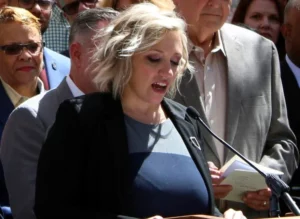
FILE – Senate Majority Leader Nicole Cannizzaro speaks at an event on April 22, 2019, in Carson City, Nev. Cannizzaro introduced a constitutional amendment on Thursday, March 16, 2023, that could codify abortion rights into the Nevada state constitution over a three-plus year process.
AP Photo/Ryan Tarinelli
By March 2023, that groundwork was solid enough for Senate Majority Leader Nicole Cannizzaro to introduce SJR7, the constitutional amendment that has since become Question 6, with 40 Democratic co-sponsors behind it from the start.
At the SJR7 hearing, Republican lawmakers asked Cannizzaro directly whether the amendment's language would allow preteens to get abortions without parental consent, or allow abortion up to birth.
She answered that:
“To get into very specific hypotheticals ignores what SJR 7 is doing, which is establishing a right.”
Those aren't fringe questions. They're the exact provisions Question 6's own text leaves open, unresolved even now, with the amendment one vote away from becoming permanent.
(Cannizzaro, who is now the Democratic nominee for Nevada Attorney General, has a larger role in this fight that goes beyond this hearing, and it's worth a closer look in a future piece.)
The real deadline, and what it isn't
Question 6 doesn't create the voter lock Nevada already has. That's been in place since 1990.
What it changes is the standard any future rule has to clear. Right now, NRS 442.250 is a fixed statute: it says what it says, and changing it takes a public vote either way.
Question 6 replaces that with a constitutional right subject to strict scrutiny, meaning any health, safety, or licensing regulation touching abortion, now or decades from now, has to survive a “compelling state interest” test decided case by case in court.
Courts, not voters, become the ones interpreting what that standard allows each time it's challenged. That's a bigger structural change than anything in the 1973, 1985, or 1990 history above, and it's arrived only after a decade of incremental legislative groundwork, not because of some new crisis in access.
The current law making abortion access legal in Nevada already survived a direct statewide vote in 1990 and cannot be repealed without another one.
Nothing is expiring. Nothing is about to disappear.
The only thing on a deadline is the amendment itself, which requires a second vote this November to become permanent.
The constitution isn't the place for language that still needs to be worked out. It's a lockbox, built for things that don't need ongoing interpretation or regulation, not a placeholder for queries Question 6's own sponsors won't answer.
And it's not the place to strip out safety oversight by default, without saying so directly.
This isn't guesswork; it's built into the text: “all individuals” means a child can get an abortion without a parent ever knowing, and “fetal viability” defined by the treating practitioner, not a fixed point in pregnancy, means outpatient abortion effectively up to birth.
When lawmakers asked the sponsor to deny either one, she couldn't, because the text already does both.
Undoing it after passage wouldn't just take one more election. It would take an entirely new initiative, passed by voters in two separate general elections in a row. This means years of campaigning through multiple cycles just to get back to where the law already stands today.
Once all of it is in the Constitution, undoing any piece of it is a far harder road than voting the whole thing down now.
Abortion isn't an industry that should have a constitutional right to deregulation, while putting the health and safety of women (and pregnant children) last.
The amendment's sponsors might not have a direct answer for Nevadans, but voters in November can give them one: No.
Read the full text of Nevada Question 6
The opinions expressed by contributors are their own and do not necessarily represent the views of Nevada News & Views. This article was written with the assistance of AI. Please verify information and consult additional sources as needed.