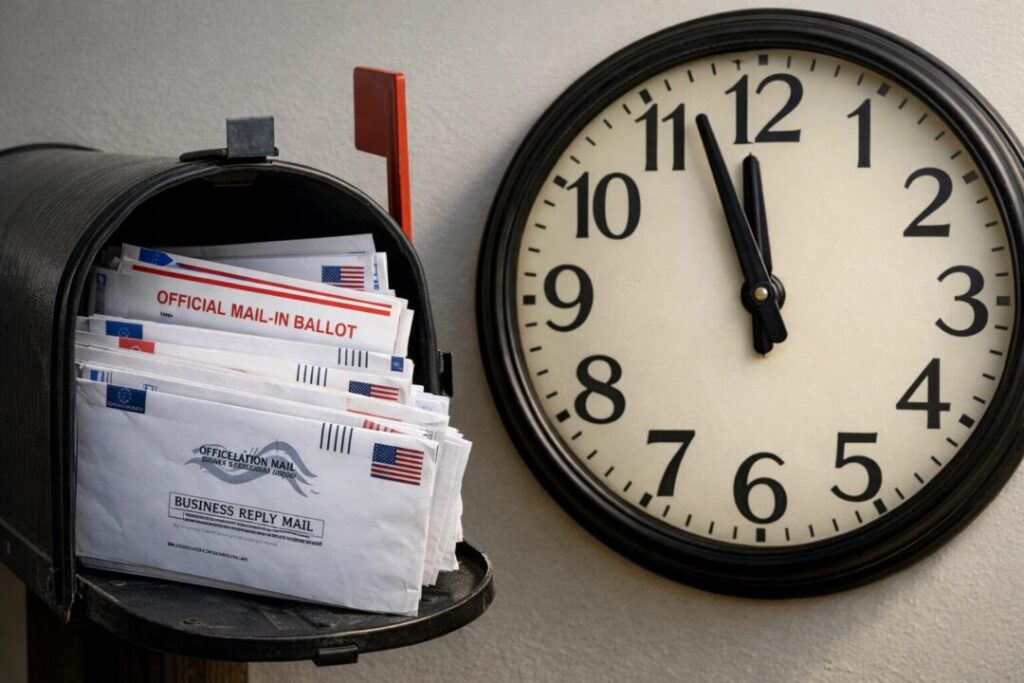
On March 23, the Supreme Court heard a challenge to a Mississippi state law that allows mail-in ballots postmarked by Election Day to be received and counted afterwards.
More than a dozen states – including Nevada—have similar laws that accept mailed ballots received after Election Day as long as postmarked on or before that date.
After two hours of oral argument, a majority of justices seemed to agree with the challengers—including the Republican National Committee and the Republican Party of Mississippi—that ballots must be cast and received by election officials no later than Election Day to be counted.
Mississippi passed the law at issue in 2020, in response to the COVID-19 pandemic. It allows mail-in ballots to be counted if they are postmarked by and then received within five business days of Election Day.
The GOP group’s attorney, Paul Clement, argued the Mississippi law clashed with a federal law enacted by Congress in 1845 that establishes the Tuesday after the first Monday in November as “Election Day.”
Federal law provides: “The Tuesday next after the 1st Monday in November, in every even numbered year, is established as the day for the election, in each of the States and Territories of the United States….”
Clement and U.S. Solicitor General John Sauer contended that “Election Day” is the day by which all votes must be cast and counted.
“That ballot box has to be closed on Election Day,” Sauer said.
Clement also argued that late-arriving ballots that change the outcome of elections contribute to the perception of fraudulent or rigged elections, and that those concerns must be addressed.
A three-judge panel of the Fifth Circuit Court of Appeals agreed with the challengers that federal law requires all ballots to be received by Election Day (Watson v. Republican National Committee).
The case went to the Supreme Court.
The Court’s liberal justices suggested Congress was aware states allow ballots received after Election Day to be counted and have failed to ban the practice.
However, a conservative majority of justices appeared ready to overturn the Mississippi law.
Justice Brett Kavanaugh had a practical question. If the court ruled for the challengers in June, Kavanaugh asked, would it be too late to implement that decision for the 2026 elections?
He was assured it would not be. A decision is expected in June.
In Nevada, mail-in ballots postmarked by Election Day that arrive up to four days late are required to still be counted, and ballots arriving with no postmark or an unclear postmark are counted up to three days after the election.
Republican Governor Joe Lombardo said during his 2025 State of the State address that all mail-in ballots should be received by the time polls close on Election Day, not four days later. No bill doing so passed out of Nevada’s Democrat-controlled Legislature in 2025.
Waiting up to a week for final unofficial election results was “a national embarrassment,” Lombardo said.
Mail-in ballots don’t have to mean delayed results. Florida, for example, was one of the first states to embrace widespread use of mail-in ballots yet is usually among the first states to announce accurate official results on election night. Unlike Nevada, ballots in Florida must be received by election officials on or before Election Day.
Nevada’s Secretary of State Democrat Cisco Aguilar said after the Supreme Court argument that the actual votes coming in after Election Day was “relatively small.”
Out of 587,000 mail-in ballots in the 2024 election counted in Nevada’s two largest counties, Clark and Washoe, 2 percent of the vote—11,875 votes— were received after Election Day.
A hard deadline for receiving ballots eliminates the potential for a slew of late ballots to alter close races.
The political parties and Secretary of State will need to make any new deadlines perfectly clear to voters.
The opinions expressed by contributors are their own and do not necessarily represent the views of Nevada News & Views.